.svg)

Streamline Month-End Close: Simplify Workflows and Reduce Errors

Ask questions, get summaries, or uncover key takeaways from this article.

Blog Summary / Key Takeaways
- Streamlining means fewer surprises. You reduce month end close complexity and rework. You do not cut checks.
- Standardization beats speed hacks. Define the same phases, the same order, and the same “done” rules.
- Dependencies drive most delays. Make inputs predictable with clear owners and due dates.
- Review must start earlier. Account-level review throughout the month prevents end-of-close cleanup.
- Workflow makes it repeatable. Owners, statuses, approvals, and documentation keep the close consistent.
What “Streamlining” Actually Means In Month-End Close
To Streamline Month End Close, you remove avoidable complexity. You improve coordination. You prevent rework. You do not just “close faster.”
This matters for accounting teams managing month-end close that already close every month. However, they still deal with late surprises. They also deal with variable steps. Review also changes based on who is available.
In this guide, you will get three things:
- A practical month-end close process and workflow optimization framework.
- A standardized close structure you can reuse across entities or clients.
- A checklist and control approach that supports accuracy and repeatability.
If you want to close the books faster, this approach still helps. It speeds up close by reducing stop-and-start work. Therefore, you gain time without lowering quality.
What Is The Month-End Close Process?
Month-end close is the repeatable set of accounting activities that finalizes the period’s books. It produces reliable financial statements and supporting documentation.
Most teams include these close activities:
- Cutoff handling for revenue, expenses, and timing differences.
- Reconciliations for key balance sheet accounts.
- Accruals and deferrals with support and clear logic.
- Review and approval of entries and reconciliations.
- A reporting package, often with variance notes.
Month-end close does not include everything finance touches. Teams often mix it up with:
- Ongoing bookkeeping and coding cleanups.
- Large historical corrections and “catch-up” projects.
- Ad-hoc analysis requests that can wait.
This scope line matters. If you do not draw it, you will never truly simplify month end close work. The close becomes a bucket for every unfinished item.
Why Month-End Close Gets Slow And Painful
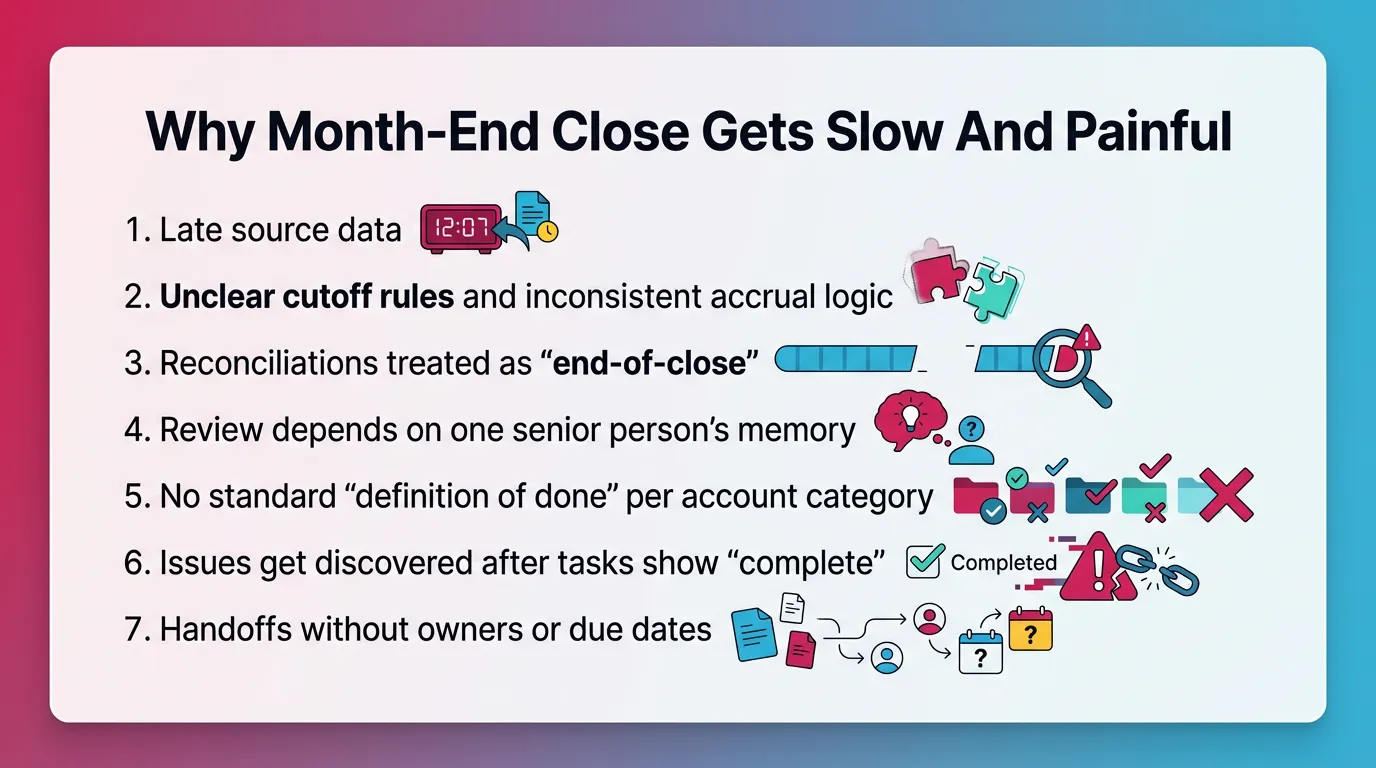
The 7 Drivers Of Close Complexity
Month-end close slows down because work waits. It waits on inputs, decisions, and review. It also waits on unclear rules.
Here are the seven drivers that usually create the biggest drag:
- Late source data
Banks, payroll, AP tools, and expense apps do not align. Therefore, teams chase missing items instead of closing. - Unclear cutoff rules and inconsistent accrual logic
Two people handle the same scenario differently. This creates debate later. It also creates rework when the reviewer disagrees. - Reconciliations treated as “end-of-close” creates reconciliation bottlenecks.
If you reconcile only at the end, you find issues too late. That pushes fixes into the final days. - Review depends on one senior person’s memory
The reviewer knows what “looks right.” However, that knowledge stays in their head. When they are out, quality drops. - No standard “definition of done” per account category
A “completed” bank rec might mean different things. One person attaches support. Another does not. - Issues get discovered after tasks show “complete”
Teams close tasks, then review finds problems. That creates the classic rework loop. - Handoffs without owners or due dates
Teams wait on “someone” to send reports or approvals. No one owns the dependency. Therefore, delays repeat.
Where time really goes:
- Waiting on payroll files.
- Waiting on AP cutoffs.
- Waiting on bank transactions to settle.
- Waiting on review sign-off.
- Rebuilding workpapers after late changes.
This is why “work harder” never fixes close. You must improve month end close workflow design.
A Quick Diagnostic: Are You Experiencing Close Rework?
You likely have close rework if these show up often:
- Post-close “cleanup” feels normal every month.
- You see flux surprises in cash, AR, AP, payroll liabilities, or revenue.
- Different team members use different structured close checklist versions.
- You produce multiple versions of the same financials.
- You post entries after you said the close was done.
Rework signals a control problem. It also signals a workflow problem. Fixing it drives real month end close process optimization.
Month-End Close Workflow Optimization Framework
You streamline close by making it consistent. You also make inputs predictable. You improve review quality. Then you operationalize the process with workflow.
1) Standardize The Close
Standardization creates repeatability. It also makes training easier. It reduces reviewer variance.
Start with close phases:
- Pre-close (prep and validations).
- Close (accounting work and reconciliations).
- Post-close (reporting, follow-ups, and process updates).
Next, define “done” by account category. Keep it short and specific.
For example:
- Cash: bank rec ties to bank statement end date. Unreconciled items have notes.
- AP: subledger ties to GL. Old items have explanations or action owners.
- Payroll liabilities: tie to payroll reports. Timing differences get documented.
Also standardize workpaper naming. The goal is fast handoff.
For example: 2026-01 Cash - Operating - Reconciliation.pdf
When you standardize month end close steps, you stop reinventing the wheel each month.
2) Reduce Dependencies
Dependencies cause the most close delays. Fixing them often creates the biggest gains.
Move upstream and set due dates for:
- Vendor bills and approvals.
- Expense submissions.
- Payroll final files and employer tax reports.
- Revenue reports from billing systems.
Introduce cutoff rules. Also create “no-fly” rules for late changes.
For example: “No vendor bills dated in the prior month after Day 2. Route late items to next month unless material.”
Create a dependency map. Each dependency needs:
- One owner.
- One due date.
- One escalation path.
This step does more to reduce month end close complexity than any new tool.
3) Improve Review Quality
Review should not happen only at the end. You need account-level review throughout the close.
Shift from checklist-only review to account-level review that asks:
- Does the balance make sense for this business?
- Did the account move in line with expectations?
- Do we see missing entries signals?
- Do we see timing issues that need accruals, and are we managing accruals efficiently?
Then review earlier in smaller batches.
For example, review cash and clearing on Day 1. Review payroll liabilities on Day 2. Review revenue and deferred revenue on Day 3.
This reduces the “all-at-once” pressure. It also prevents rushed sign-off.
4) Operationalize With Workflow
Workflow, plus automating repetitive close tasks, turns a good SOP into a repeatable process. It makes ownership visible. It also creates a record of what happened.
For more on how automation and tooling fit into this, see our guide on the role of technology in streamlining year-end close procedures.
Operational workflow needs:
- Owners and backup owners.
- Due dates and dependency links.
- Status definitions like “Not started,” “In progress,” “Blocked,” “Ready for review,” and “Approved.”
- Clear handoffs between preparer and reviewer.
- A trail of what changed and why.
This is the foundation for a stable, efficient month end close process.
Step-By-Step: How To Streamline Month-End Close Processes
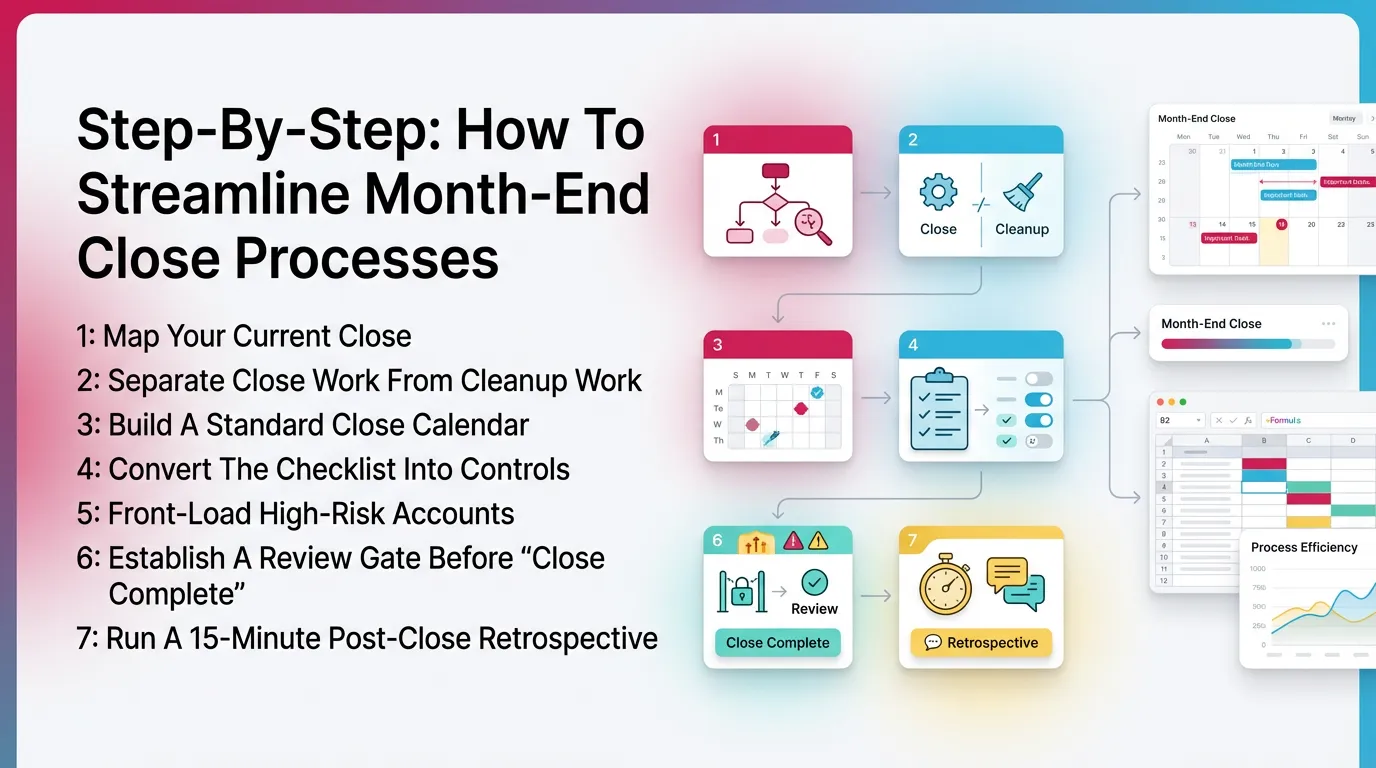
Step 1: Map Your Current Close
Start by mapping what actually happens. Do not start with what you wish happened.
Capture these details:
- Every task that occurs in the last 10 days of the period.
- Owner and backup owner.
- Tool used (ERP, spreadsheets, bank portal, payroll portal).
- Inputs required.
- Average duration.
- Where the task waits.
Focus on wait time, not work time. Wait time drives late closes.
Practical example from a controller workflow:
A team told me cash reconciliation took “two hours.”
The work took two hours. The waiting took two days.
They waited for a final bank sweep report from treasury.
Once they moved the sweep timing earlier, cash finished on Day 1.
Step 2: Separate Close Work From Cleanup Work
To simplify month end close, separate “must-close” items from cleanup.
Define “close blockers” as items that:
- Change financial statement accuracy in a material way.
- Affect key reconciliations.
- Affect compliance deadlines.
- Affect covenant or board reporting.
Everything else goes into a remediation queue.
That queue should not hijack the current close.
This separation stops scope creep. It also stops late nights spent fixing old issues.
Step 3: Build A Standard Close Calendar
A close calendar keeps everyone aligned. It also makes dependencies visible.
Build it backward from the reporting deadline. Then set stakeholder expectations.
Example timeline you can adapt:
- Day -3 to 0: pre-close validations and missing item chase.
- Day 1–3: reconciliations and adjusting entries.
- Day 3–5: review, approvals, and reporting package.
Add service-level expectations for stakeholders.
For example:
- Department heads submit expenses by Day 0 noon.
- Payroll sends final reports by Day 1 10 a.m.
- AP closes invoice entry by Day 1 end of day.
This calendar supports month end close workflow optimization because it reduces uncertainty.
Step 4: Convert The Checklist Into Controls
A checklist alone does not create quality. Controls do.
For each close task, add four fields:
- Inputs required: what must exist before work starts.
- Output expected: the workpaper, report, or entry.
- Review test: what must be true when done.
- Approval owner: who signs off.
Example for payroll liabilities:
- Inputs: payroll register, tax report, benefits invoice.
- Output: tie-out sheet and recon.
- Review test: liability equals reports within threshold.
- Approval: controller.
This is how you standardize month end close without creating busywork.
Step 5: Front-Load High-Risk Accounts
Front-load accounts that create rework when they go wrong.
High-variance categories often include:
- Cash and clearing.
- AR and AP.
- Payroll liabilities.
- Deferred revenue and revenue.
- Intercompany and allocations.
- Inventory, if applicable.
Set flux thresholds and expected patterns.
For example:
- Investigate any balance sheet account movement over 10%.
- Investigate P&L line items over $X or over Y% month over month.
Therefore, you catch issues early. You do not find them in final review.
Step 6: Establish A Review Gate Before “Close Complete”
A close is not complete when tasks are checked off. It is complete when key accounts meet review expectations.
Do not sign off until:
- Key accounts pass variance checks.
- Reconciliations have support and explanations.
- Open issues have clear disposition.
Disposition should be explicit:
- Fix now.
- Roll to next period with rationale.
- Accept as immaterial with rationale.
This gate reduces late-stage churn. It also supports reliable reporting.
Step 7: Run A 15-Minute Post-Close Retrospective
A short retrospective creates steady improvement. Keep it structured.
Ask three questions:
- What caused rework this month?
- What arrived late, and why?
- What rule or check would have caught it earlier?
Write down one change. Implement it next month.
Small process changes compound into real month end close process optimization.
Standardize Month-End Close: A Reusable Close Workflow Template
Suggested Close Phases
Pre-Close
Pre-close prevents end-of-close surprises. It creates a clean runway into Day 1.
Use this phase to:
- Confirm cutoff dates and reporting requirements.
- Confirm bank feeds and subledgers stay up to date.
- Collect missing documents and approvals.
- Review open recon items from the prior month.
- Confirm recurring entries schedule.
Close Execution
This phase records the period. It ties the books to source systems.
Core steps:
- Reconcile cash and clearing accounts.
- Reconcile AR and AP, as applicable.
- Tie payroll and benefit liabilities to source reports.
- Post accruals and deferrals with support.
- Post recurring entries with a reasonableness check.
- Handle fixed assets and depreciation, if applicable.
This phase usually drives the most “close days.”
However, it only goes fast when inputs and cutoffs stay stable.
Review And Sign-Off
Review should confirm accuracy and completeness. It should also confirm consistency.
Complete these steps:
- Account-level variance review for P&L and balance sheet.
- Tie-outs and sanity checks.
- Confirm support exists for key estimates.
- Capture approvals and finalize documentation.
A strong review phase helps you improve month end close workflow quality.
It also reduces next-month cleanup.
Post-Close
Post-close turns the close into action. It also improves next month.
Use this phase to:
- Deliver the reporting package.
- Log issues and root causes.
- Update close rules and documentation.
- Maintain a backlog for cleanup work.
This phase supports repeatability. It also helps teams reduce month end close complexity over time.
Common Close Bottlenecks And How To Fix Them
| Bottleneck | Root Cause | Fix That Reduces Complexity | Best Metric |
|---|---|---|---|
| Late adjustments | Review happens at the end | Add mid-close review gates | # of post-review journal entries |
| Reconcile delays | Missing inputs | Dependency calendar + earlier cutoff | % reconciliations done by Day X |
| Inconsistent results | Reviewer-specific logic | Standard “definition of done” per account | Rework rate |
| Status confusion | No single source of truth | Centralized close workflow + ownership | Cycle time by phase |
Checklist: Efficient Month-End Close Process
Minimum Viable Close Checklist
Use this when you need an efficient month end close process right now. Keep it tight.
- Pre-close inputs confirmed (bank feeds, payroll, bills, revenue data).
- Cash and clearing reconciled with support.
- AR and AP reviewed and reconciled, as applicable.
- Accruals and deferrals posted and documented.
- Key balance sheet accounts reviewed for anomalies and flux.
- P&L reviewed for classification and variance drivers.
- Open issues logged with disposition (fix now / roll with rationale).
- Approvals captured and close marked complete.
“Standard Close” Checklist Add-Ons
Add these once the basics run smoothly. These support repeatability.
- Materiality and threshold policy for investigation.
- Recurring entry library reviewed quarterly.
- Control evidence stored consistently (workpapers, notes, approvals).
- Standard recon templates by account category.
- A monthly retrospective log with actions and owners.
If you want a Faster Month End Close, start with the minimum viable list.
Then add maturity items one at a time.
Best Practices To Streamline Month-End Close
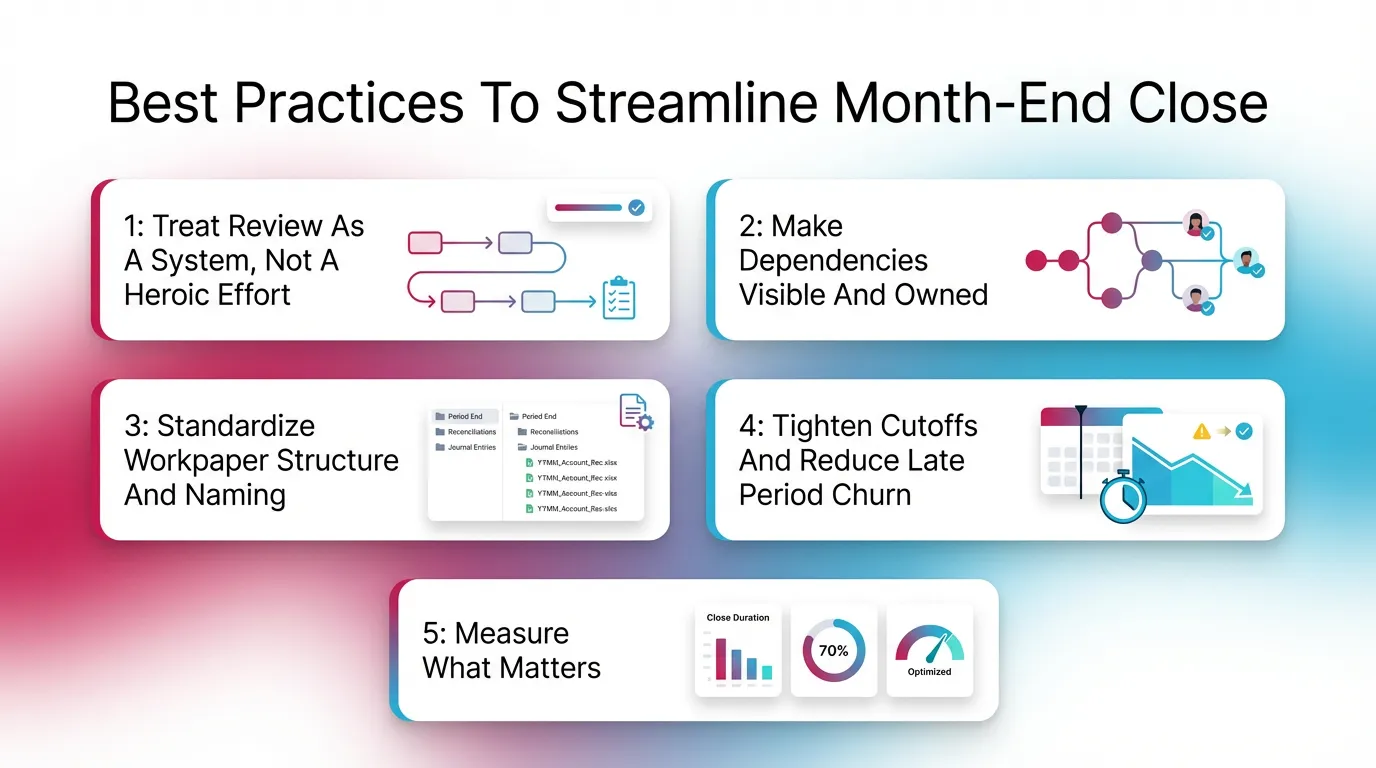
Best Practice 1: Treat Review As A System, Not A Heroic Effort
System review beats heroic review—one of the best practices for closing the books. It reduces dependence on one person.
Do this:
- Document account expectations.
- Use the same variance questions every month.
- Review in batches, not all at once.
Therefore, you avoid last-day surprises. You also avoid rushed approvals.
Best Practice 2: Make Dependencies Visible And Owned
A dependency without an owner becomes a repeated delay.
Do this:
- Assign one owner per dependency.
- Set one due date.
- Set one escalation path.
This directly supports month end close workflow optimization.
Best Practice 3: Standardize Workpaper Structure And Naming
Consistent workpapers speed up review. They also reduce training time.
Use:
- Consistent folders by month and entity.
- Standard file naming.
- Standard tie-out templates.
This helps you standardize month end close across teams and entities.
Best Practice 4: Tighten Cutoffs And Reduce Late Period Churn
Late changes cause cascading rework. One late entry can break a recon.
It can also change variance conclusions.
Do this:
- Set clear cutoff rules.
- Define what qualifies as an exception.
- Track exceptions and fix the upstream cause.
Best Practice 5: Measure What Matters
Total close days can hide bad quality. Measure what drives stability.
Track:
- Rework rate.
- Late issues found after “close complete.”
- Time spent waiting on inputs.
- Review exceptions by account category.
- Time-to-approval after tasks hit “ready for review.”
These metrics show real month end close process optimization.
They also keep quality from drifting.
Common Mistakes That Increase Month-End Close Complexity
These mistakes show up in both companies and firms. They create noise.
They also create recurring delays.
- Relying on a bigger checklist instead of better review logic.
- Standardizing tasks but not standardizing “done.”
- Treating cleanup as normal close work.
- Reviewing only at the end, which forces rushed decisions.
- Optimizing only for speed while accuracy drifts.
- Not documenting why exceptions were accepted. This kills repeatability.
If you want to reduce month end close complexity, fix these first.
They create the biggest downstream problems.
How Xenett Helps Teams Operationalize A Standardized, Review-First Close
Xenett helps teams run a review-first close. Account review anchors the work. Tasks exist to resolve what review finds. This design supports consistent execution.
Xenett does not provide audit services. It is not an audit tool. It supports accounting workflow, review, and close management.
Where Xenett Fits In A Streamlined Month-End Close
Xenett fits where close processes often break down. It connects tasks, review, and approvals in one workflow layer. Therefore, teams run the same process every month.
Close Task And Checklist Management
Xenett helps you centralize close steps into structured checklists. These align to your close phases.
It also helps you:
- Standardize recurring tasks across clients or entities.
- Attach expected outputs and “definition of done” to tasks.
- Reduce tribal knowledge in spreadsheets and DMs.
This supports a more consistent standardize month end close approach.
Review And Approval Workflows
Xenett helps route review items to the right owner. This includes anomalies, flux questions, and reconciliation gaps.
It also helps you:
- Capture approvals as part of the workflow.
- Make sign-off explicit and repeatable.
- Escalate unresolved items near deadline.
Therefore, you improve review quality without adding meetings.
Visibility Into Close Status And Bottlenecks
Xenett provides a clear view of close status. You can see what is complete, blocked, or waiting on inputs.
This helps teams:
- Identify bottlenecks by phase and by account category.
- Spot late-stage rework patterns.
- Manage capacity across preparers and reviewers.
That visibility supports improve month end close workflow execution.
FAQ: Streamlining Month-End Close
What Is The Best Way To Streamline The Month-End Close Process?
Use continuous, account-level review throughout the month. Combine it with standardized close steps and clear ownership. This reduces late surprises and rework.
Then operationalize it with workflow and review gates.
What Should Be Included In A Month-End Close Process?
Include cutoff handling, reconciliations, adjusting entries, and account-level review of the P&L and balance sheet. Also include approvals and final reporting package preparation.
Keep cleanup projects outside the close unless they block accuracy.
How Do You Simplify Month-End Close Without Losing Accuracy?
Remove duplicate work and standardize “definitions of done.” Shift review earlier and in smaller batches. Accuracy improves when issues get detected before sign-off.
Also separate close blockers from cleanup work.
How Do You Standardize Month-End Close Across Multiple Clients Or Entities?
Use one close calendar, consistent workpaper structure, and standardized task templates. Add account-level review rules that scale across account types.
Then keep exceptions documented so logic stays consistent.
What Are The Biggest Causes Of Month-End Close Delays?
Late inputs, unclear cutoffs, review happening at the end, and inconsistent reconciliation standards cause most delays. These issues create rework loops.
Fix dependencies first to reduce close variability.
How Can You Improve Month-End Close Workflow Coordination?
Make dependencies explicit and assign owners and due dates. Use one system to track status, blockers, review findings, and approvals.
This improves handoffs and reduces “who has it” confusion.
What Metrics Indicate A More Efficient Month-End Close Process?
Track rework rate, time waiting on inputs, and percent of reconciliations done by Day X. Also track post-review adjustments and time-to-approval.
These metrics show whether your workflow actually improved.
Conclusion
If you want to Streamline Month End Close, focus on repeatability first—and connect it to broader financial close operations. Standardize phases and “done” rules. Reduce dependencies. Move review earlier. Then lock it in with workflow.
Pick one change to implement this month:
- Add a review gate for two high-risk accounts.
- Set one upstream cutoff with a clear owner.
- Convert five checklist tasks into controls with inputs and review tests.
If you want help pressure-testing your close workflow, map one recent close. Then compare it to the four-part framework above. You will see where to simplify, where to standardize, and where to remove rework.