Deferral Accounting: Deferred Revenue and Deferred Expenses Explained

Ask questions, get summaries, or uncover key takeaways from this article.

Key Takeaways
- Definition: A deferral delays recognizing revenue or an expense until the period it belongs to. Cash moves first.
- Two types: Deferred revenue is a liability. A deferred expense, also called a prepaid expense, is an asset.
- Deferral vs accrual: Deferrals record cash first. Accruals record the work or the use first.
- Review check: Every deferral needs a schedule, and the balance should shrink on a known date.
A client pays a $3,600 annual insurance premium in January. The bookkeeper books the whole amount as January expense. January looks terrible, and the next eleven months look unusually good.
Flip the situation. Your firm collects a $3,600 retainer in January and books all of it as January revenue. The error is the same, but now it sits on the revenue side.
Both are deferral problems. This guide explains what deferral accounting is, the two types, and how to review them. For the revenue side in depth, start with our deferred revenue guide.
What Is Deferral Accounting?
Deferral accounting delays recognizing revenue or an expense until the period it relates to. Cash moves first. The income statement catches up as the service is delivered or the benefit is used.
A deferral sits on the Balance Sheet until it's earned or used. Then a release entry moves the right amount to the P&L, usually every month.
Why Do Deferrals Exist?
Because the accrual method matches revenue and expenses to the period they belong to. Without deferrals, your P&L would follow the bank account instead of the work.
The effect is large on lumpy items. Annual insurance, prepaid software, advance retainers, and tuition all move cash in one month and deliver value across twelve.
What Are the Two Types of Deferrals?
Deferred revenue and deferred expenses. Deferred revenue is cash you received before earning it, so it's a liability. A deferred expense is cash you paid before using the benefit, so it's an asset.
For the expense side, see our guide on prepaid expenses accounting. Here, we focus on how the two fit together.
What is the difference between deferral and accrual?
A deferral records cash first and recognition later. An accrual records the work or the use first and cash later. The grid shows all four cases.
One question sorts any item into the grid: which came first, the cash or the work? For the revenue pair, read accrued revenue vs deferred revenue.
Who Handles Deferrals at an Accounting Firm?
The bookkeeper sets up the deferral and posts the release. The reviewer checks the balance against the schedule at close. The owner signs off and answers client questions.
Deferrals get missed when nobody owns the release entry. Assign it to a person, not a template, and add the check to your month-end close checklist.
When Do You Release a Deferral?
At the end of every period the benefit or service covers. Most firms release monthly. The amount comes from the schedule, built when the cash moved.
Release entries are adjusting entries. They run at period end, after the transactions are in, and before the books are closed. For contract-based revenue, see how to recognize deferred revenue.
How Do You Record Deferrals? One $3,600 Payment, Two Sets of Books
Debit the asset and credit cash for a deferred expense. Debit cash and credit the liability for deferred revenue. Release each over the period, at the same monthly amount.
Take a $3,600 annual retainer paid January 1. Your firm is the seller. The client is the buyer. Here are both sets of entries.
The two balances mirror each other. Both fall by $300 a month and both reach zero in December.
For the full revenue entry sequence, see the deferred revenue journal entry guide.
What is the journal entry for a deferred expense?
When you pay, debit Prepaid Expense and credit Cash. Each period, debit the expense account and credit Prepaid Expense for the part used. The asset shrinks to zero by the end of the term.
Where Do Deferrals Go Wrong?
Most errors come from one of two places: the first entry skips the balance sheet, or the release entry never gets posted. Both leave the P&L wrong.
Tax treatment can differ from the book entry for accrual-method clients. IRS Publication 538 covers accounting methods and advance payments, so confirm the tax rule separately.
Are deferrals adjusting entries?
Yes. Deferral release entries are adjusting entries posted at period end. They move the earned or used portion from the Balance Sheet to the P&L so the period shows the right amounts.
How do you set up a deferral schedule?
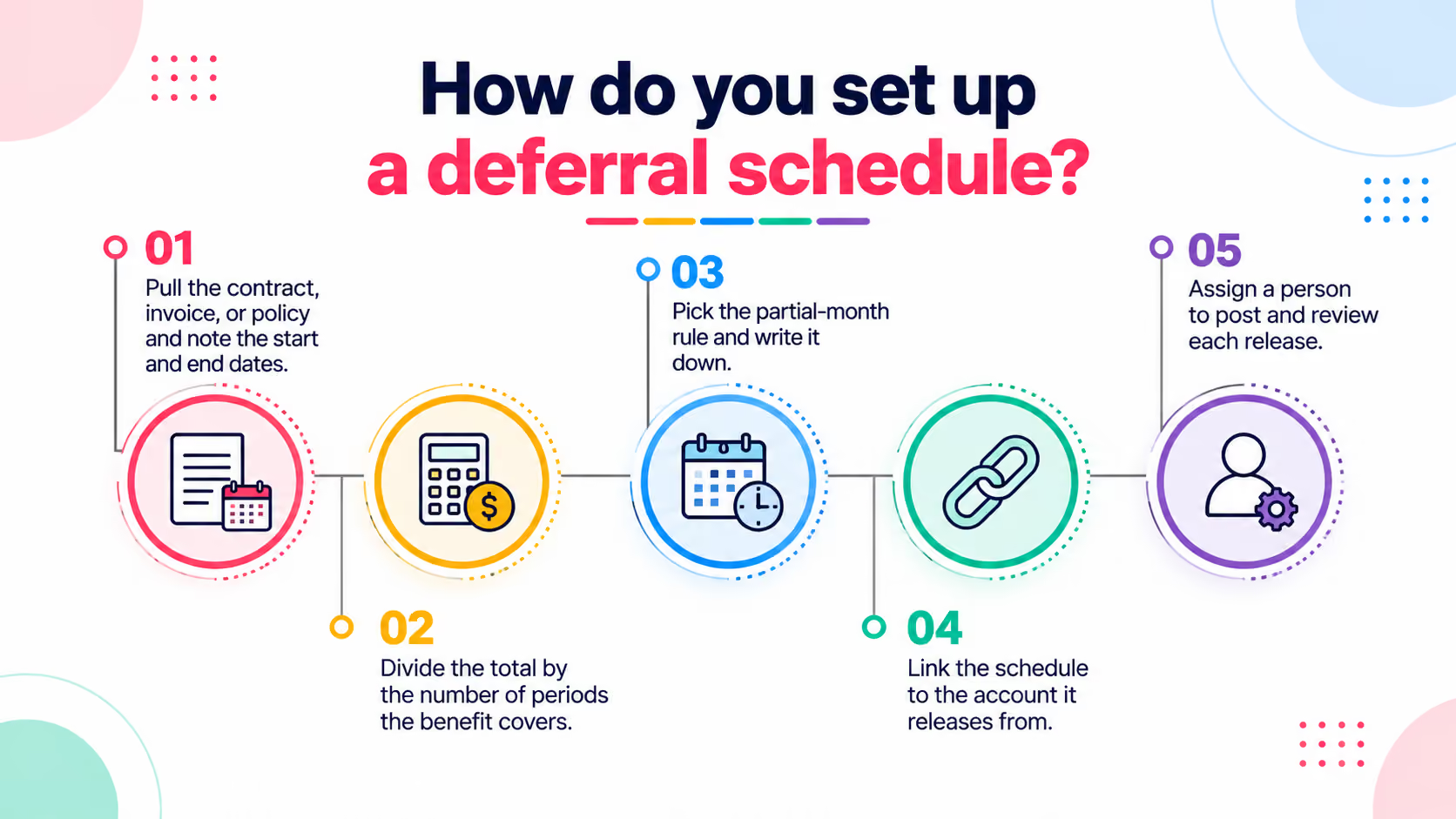
Build it on the day the cash moves, not at month-end. A schedule built late is usually built from memory, and the start date is the first thing to go wrong.
- Pull the contract, invoice, or policy and note the start and end dates.
- Divide the total by the number of periods the benefit covers.
- Pick the partial-month rule and write it down.
- Link the schedule to the account it releases from.
- Assign a person to post and review each release.
The partial-month rule matters more than it looks. A policy that starts on the 20th can be released as a full month or prorated by day. Either is workable, but the firm should use one rule on every file.
Also decide what happens when the term changes. A cancellation, an extension, or a refund should update the schedule from the change date, not rewrite the months already closed.
With the schedule in place, the release entry becomes routine, and the review becomes a tie-out and nothing more.
Keep the schedule in one place that the reviewer can open without asking. A spreadsheet on a bookkeeper's desktop fails the first time that person is out during close.
Review the oldest balances first. A deferral that should have reached zero three months ago points to a skipped release or a term that changed without notice.
Review Time Cut by 70%: Royer Accounting
Royer Accounting helps clients understand their numbers. Before Xenett, the team lacked an efficient automated review and had to jump between tools to check data.
With Xenett, it reports a 70% reduction in review time per client file, 99% data accuracy, and 50 fewer review hours in a single month.
Royer's results have nothing to do with deferrals specifically, so we won't claim otherwise. The point that carries over is practical: a monthly check like the deferral roll-forward only survives if the review is fast enough to run on every file. See the Royer Accounting case study for the full story.
How Xenett Can Help
Deferrals are simple entries on one file. Across a full client list, each file with its own prepaids and advance payments, the schedules multiply and the checks are the first thing to slip.
Xenett's AI Accruals handles the timing entries on both sides of that grid, including prepaid, payroll, and deferred revenue. It finds the source transactions and proposes a schedule, and your reviewer approves it.
- AI Accruals, Prepaid: finds prepaid transactions and proposes the recognition schedule
- AI Accruals, Deferred Revenue: finds advance invoices and builds the month-by-month schedule
- Entries checklist: records review, comments, and sign-off with an audit trail
See where this fits in the month-end close process.
Conclusion: Ask Which Came First
A deferral is cash that moved before the work or the benefit. Put it on the Balance Sheet, build the schedule on day one, and release it on a known date.
Try Xenett free for 14 days, no credit card required, and see how it handles prepaid and deferred revenue schedules on a real client file. If you'd rather talk it through first, book a 15-minute demo.
FAQ: Deferral Accounting
What is deferral accounting?
Deferral accounting delays recognizing revenue or an expense until the period it relates to. Cash moves first, and the income statement catches up as the service is delivered or the benefit is used.
What are the two types of deferrals?
Deferred revenue and deferred expenses. Deferred revenue is cash received before the work is done, recorded as a liability. A deferred expense, or prepaid expense, is cash paid before the benefit is used, recorded as an asset.
What is the difference between deferral and accrual?
A deferral records cash first and recognition later. An accrual records recognition first and cash later. Deferred revenue and prepaid expenses are deferrals. Accrued revenue and accrued expenses are accruals.
What is an example of a deferral in accounting?
A client pays $3,600 for a 12-month insurance policy on January 1. The firm records a prepaid expense and moves $300 to insurance expense each month. The asset falls to zero by December.
Is a deferral an asset or a liability?
It depends on the side. A deferred expense is an asset because the business has paid for a future benefit. Deferred revenue is a liability because the business owes the customer future work.
What is the journal entry for a deferred expense?
When you pay, debit Prepaid Expense and credit Cash. Each period, debit the expense account and credit Prepaid Expense for the part used. The asset shrinks to zero by the end of the term.
Are deferrals adjusting entries?
Yes. Deferral release entries are adjusting entries posted at period end. They move the earned or used portion from the Balance Sheet to the P&L so the period shows the right amounts.
FAQ: Deferral Accounting
Deferral accounting delays recognizing revenue or an expense until the period it relates to. Cash moves first, and the income statement catches up as the service is delivered or the benefit is used.
Deferred revenue and deferred expenses. Deferred revenue is cash received before the work is done, recorded as a liability. A deferred expense, or prepaid expense, is cash paid before the benefit is used, recorded as an asset.
A deferral records cash first and recognition later. An accrual records recognition first and cash later. Deferred revenue and prepaid expenses are deferrals. Accrued revenue and accrued expenses are accruals.
A client pays $3,600 for a 12-month insurance policy on January 1. The firm records a prepaid expense and moves $300 to insurance expense each month. The asset falls to zero by December.
It depends on the side. A deferred expense is an asset because the business has paid for a future benefit. Deferred revenue is a liability because the business owes the customer future work.