
.svg)

Financial Close Best Practices: A Practical Guide for Finance Teams

Ask questions, get summaries, or uncover key takeaways from this article.

Blog Summary
Financial close best practices help finance teams reduce manual work, improve accuracy, and close the books faster. This guide explains how modern finance teams can build a smoother, more reliable close process.
What Are Financial Close Best Practices?
Financial close best practices are specific, repeatable actions that help finance teams close the books faster, with fewer errors, and less stress. Instead of rushing at month-end, these practices distribute work across the period, improve accuracy, and create clear accountability.
1. Standardize the Close Process
Create a documented close checklist with defined tasks, timelines, and owners. A standardized process reduces confusion, prevents missed steps, and ensures consistency across every close cycle.
2. Use a Close Calendar
Maintain a shared close calendar that outlines daily, weekly, and month-end activities. This helps teams prepare in advance and avoid last-minute bottlenecks.
3. Automate Manual and Repetitive Tasks
Automation is one of the biggest accelerators of a fast close. Automate reconciliations, journal entries, and transaction matching to reduce errors and free up time for analysis.
4. Perform Continuous Reconciliations
Don’t wait until month-end to reconcile accounts. Reconcile high-volume and high-risk accounts throughout the month to spread workload and catch issues early.
5. Assign Clear Ownership and Accountability
Every close task should have a single owner. Clear ownership improves accountability and ensures issues are resolved quickly without delays or duplicated work.
6. Prioritize High-Risk Accounts
Focus early on accounts with high transaction volume, estimates, or historical errors. Addressing these first reduces surprises late in the close process.
7. Review and Improve After Every Close
Conduct a short post-close review to identify delays, errors, and improvement opportunities. Continuous improvement helps reduce close time month after month.
Traditional Close vs Close using best practices
One accountant explains it like this: “The traditional close feels like running a marathon every month. The modern close feels like a daily walk that somehow gets you to the same place.”
The difference between a traditional and modern close is not effort. It is structure, automation, and visibility. Financial close best practices help teams move away from last-minute pressure toward steady, predictable work.
A traditional close depends heavily on manual tasks and spreadsheets. A modern close relies on integrated systems, automation, and real-time data. Therefore, modern teams close faster and with fewer surprises.
Traditional Close vs Modern Close Comparison
In short, the traditional close asks accountants to fix problems at the end. The modern close prevents most of them from happening in the first place. Or as one accountant jokes, “The best close is the one that doesn’t feel like an emergency.”
Why Financial Close Best Practices Matter
One accountant says it best: “If the numbers are wrong, everything built on them wobbles.” That is why financial close best practices matter more than most teams realize.
Financial close best practices ensure financial statements are accurate, timely, and reliable. Therefore, leaders can trust the numbers they use for decisions, planning, and reporting.
When best practices are missing, finance teams spend more time fixing errors than analyzing results. However, structured processes turn the close into a dependable routine instead of a monthly crisis.
Key Reasons Financial Close Best Practices Are Essential
- Accurate and reliable data: Verified and reconciled transactions prevent errors that affect financial health and credibility.
- Better decision-making: Leaders receive current, trustworthy data for budgeting, forecasting, and resource planning.
- Stakeholder confidence: Clean, consistent reports build trust with investors, lenders, and executives.
- Higher efficiency: Automation and standardization shorten the close cycle and reduce manual effort.
- Audit readiness: Clear records and audit trails make audits smoother and less stressful.
- Stronger financial control: Locked periods protect historical data from unexpected changes.
In short, financial close best practices protect accuracy, save time, and reduce stress. Or as one accountant jokes, “When the close is clean, everyone sleeps better.”
Strategic Value of a Modern Financial Close
When the close gets faster, finance finally gets time to think. That is the real value of a modern close.
A modern financial close turns accounting from a back-office task into a strategic function. With real-time data and fewer manual steps, finance teams can support smarter decisions instead of chasing numbers.
Key Strategic Benefits of a Modern Financial Close
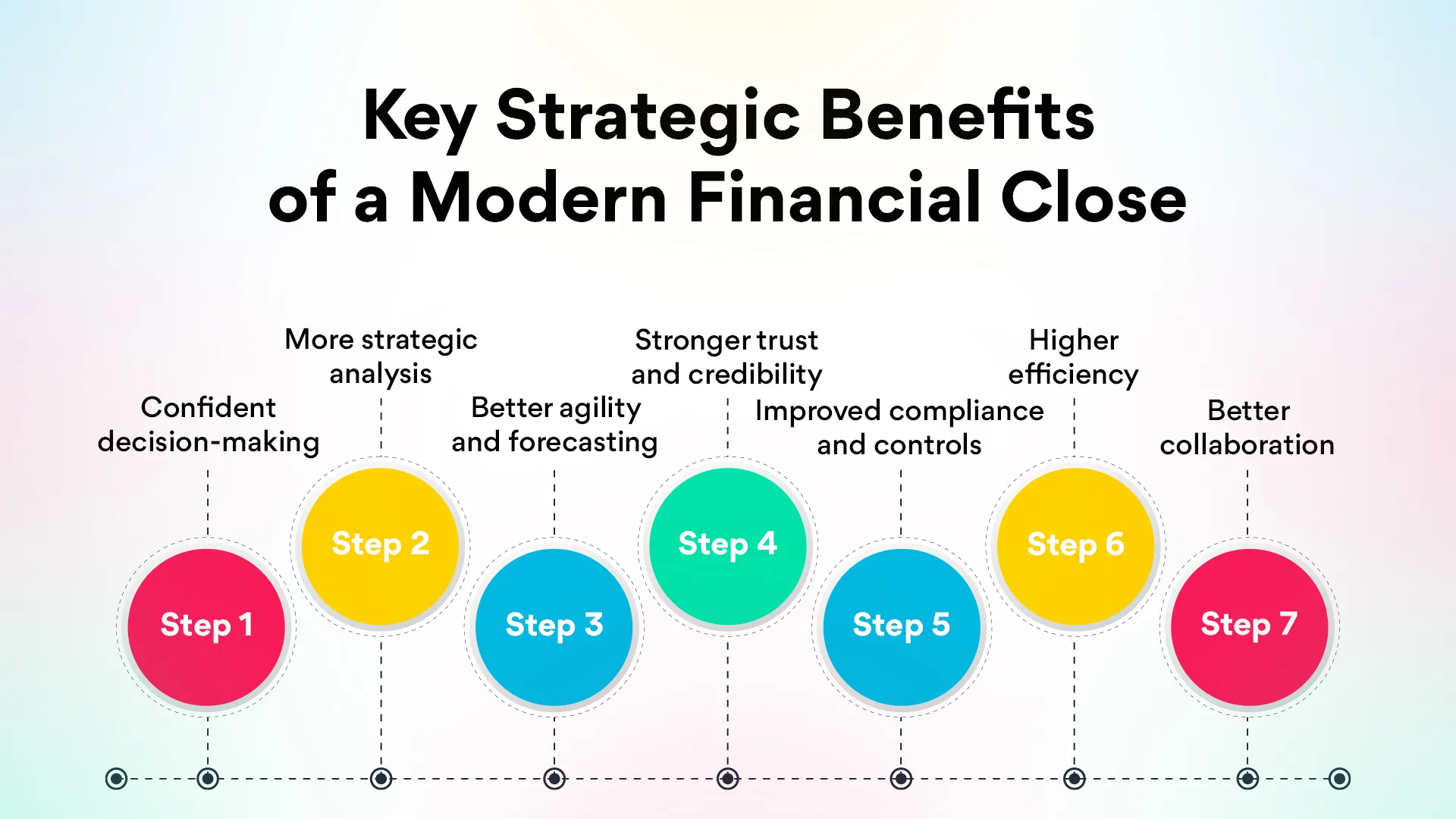
- Confident decision-making: Real-time, accurate data replaces outdated reports and helps leaders plan with confidence.
- More strategic analysis: Automation frees finance teams from data entry so they can focus on trends, risks, and opportunities.
- Better agility and forecasting: Faster close cycles allow quicker adjustments and more accurate forecasts.
- Stronger trust and credibility: Clean and timely reports build confidence with investors, boards, and auditors.
- Improved compliance and controls: Standard workflows and audit trails reduce compliance risk.
- Higher efficiency: Streamlined processes lower errors and help teams use their time better.
- Better collaboration: Centralized data creates a single source of truth across departments.
How Finance Teams Achieve a Modern Close
- Automation: Reconciliations and data movement happen with minimal manual effort.
- Technology: Modern close software replaces spreadsheets and disconnected tools.
- Standardization: Clear workflows, ownership, and tracking keep the close on schedule.
In short, a modern financial close removes friction and adds value. Or as one accountant might say, “Less closing, more advising.”
Core Components of the Financial Close Process
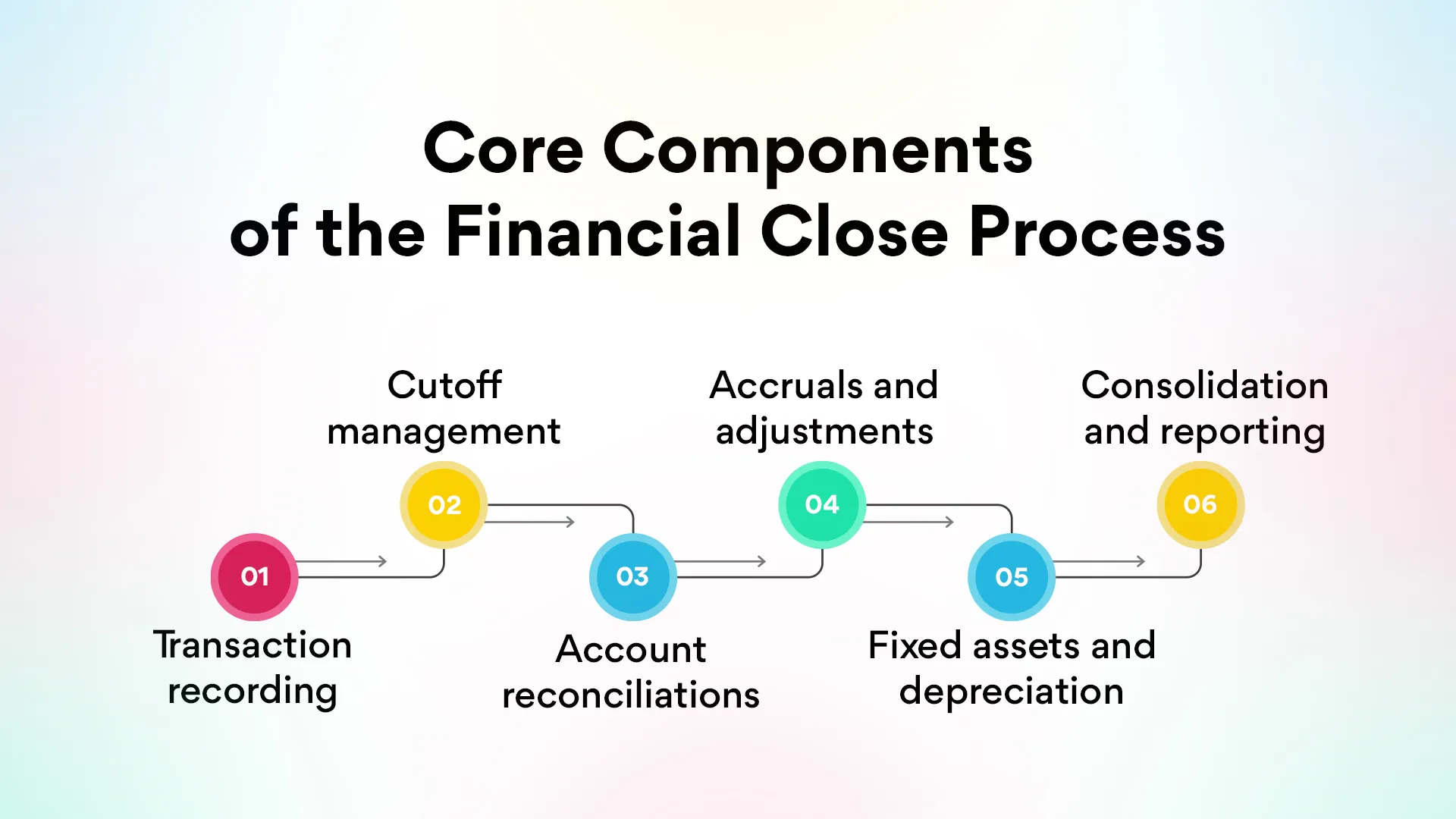
One accountant explains it like this: “The close is not one task. It’s many small tasks pretending to be one big problem.”
The financial close process has several core parts that work together. If one part breaks, the entire close slows down.
- Transaction recording: Daily entries from payroll, expenses, revenue, and vendor bills are captured correctly.
- Cutoff management: Transactions are recorded in the correct period, not “close enough.”
- Account reconciliations: Balances in the general ledger are matched with supporting documents.
- Accruals and adjustments: Expenses and revenue are recorded in the right month, even if invoices arrive late.
- Fixed assets and depreciation: Assets are tracked, and depreciation is recorded accurately.
- Consolidation and reporting: Data from all entities is combined to produce final financial statements.
When these components run smoothly, the close feels predictable instead of painful.
Key Financial Close Challenges and Solutions
Most close problems are not new. They just repeat every month with better excuses.
- Manual work overload: Spreadsheets and hand-entered data slow everything down.
Solution: Automate repetitive tasks and focus reviews only on exceptions. - Last-minute adjustments: Late invoices and missed entries delay reporting.
Solution: Use continuous accounting to catch issues earlier in the month. - Poor visibility: Teams do not know what is done and what is stuck.
Solution: Central dashboards show close status in real time. - Communication gaps: Finance waits on other teams for data.
Solution: Clear ownership, deadlines, and shared tools keep everyone aligned.
Fixing these issues one by one leads to a faster and calmer close.
Financial Close Best Practices for Modern Teams
Modern finance teams follow financial close best practices to stay in control and reduce stress.
- Standardize the month-end close process with clear workflows and checklists.
- Automate reconciliations, journal entries, and data movement.
- Spread close work across the month using continuous accounting.
- Define clear roles for preparers and reviewers.
- Maintain strong internal controls and audit trails.
- Review each close cycle and improve what slowed things down.
As one accountant jokes, “The goal is not to work harder at close. It’s to work less.”
Financial Close Tools Comparison
One simple rule accountants agree on:
“If the tool cannot show where the close stands, it is not really helping.”
How Xenett Can Help
Xenett doesn’t replace accountants. It just takes away the work we hate.
Xenett helps finance teams follow financial close best practices by using AI and automation to make the close faster, cleaner, and easier to manage. Instead of chasing spreadsheets, teams get clarity and control.
How Xenett Supports Financial Close Best Practices
- Automation and efficiency: Xenett automates data entry, journal entries, and reconciliations, reducing manual effort and speeding up the close.
- Better accuracy with fewer errors: AI-powered checks catch missing entries, duplicates, and unusual transactions before they become problems.
- Real-time visibility: Dashboards show exactly where the close stands, so teams stop guessing and start knowing.
- Smoother collaboration: Comments and client portals keep all communication in one place, cutting down follow-ups and confusion.
- Standardized workflows: Built-in checklists and preparer-reviewer roles create consistency and stronger controls.
- Audit readiness: Linked workpapers and clear audit trails make audits simpler and less stressful.
- More time for strategic work: With busywork handled, finance teams can focus on analysis, planning, and advising the business.
How Xenett Puts Best Practices into Action
- Real-time close: Work happens throughout the month, not all at once at period-end.
- Smart checklists: Tasks stay organized with clear deadlines and ownership.
- Seamless integrations: Xenett connects with QBO and Xero to keep data flowing.
- AI insights: Machine learning supports better cash flow analysis and reporting.
The result is a close that feels controlled instead of chaotic. “With Xenett, the close stops being scary and starts being… boring. In a good way.”
Frequently Asked Questions (FAQs)
What are financial close best practices?
They are proven methods that help finance teams close faster, accurately, and with less manual work.
Why are financial close best practices important?
They improve reporting accuracy, compliance, and decision-making.
What slows down the financial close process?
Manual work, late data, and poor visibility cause most delays.
How can finance teams close faster?
By automating tasks and spreading close work throughout the month.
What is a modern financial close?
It uses automation, integration, and real-time data instead of spreadsheets.
Do small finance teams need close automation?
Yes, automation helps small teams save time and reduce errors.
How does Xenett support financial close best practices?
Xenett automates close tasks, improves visibility, and keeps teams aligned.
Is financial close software worth the investment?
Yes, it reduces close time, improves accuracy, and lowers audit risk.
Conclusion
Financial close best practices turn a stressful, last-minute scramble into a smooth and predictable process. With the right structure, automation, and visibility, finance teams can close faster, stay accurate, and focus on work that actually adds value.
Instead of chasing numbers, teams gain confidence in their data and get their time back in their day. Or as most accountants would agree, “A calm close is a good close.”
Ready to simplify your close and stop the monthly fire drills?
See how Xenett helps finance teams apply financial close best practices and close the books with speed, accuracy, and confidence.


