.webp)
.svg)

Financial Close and Reporting Process: Step-by-Step Guide

Ask questions, get summaries, or uncover key takeaways from this article.

Financial Close and Reporting Process: Step-by-Step Guide
Have you ever wondered why the financial close and reporting process takes longer than anyone expects, even when the numbers seem straightforward? I have asked that same question more times than I can count.
After years of working through month-end and year-end closes, I have learned that delays rarely come from complex accounting. They usually come from unclear steps, missed reviews, and small issues that quietly pile up.
The financial close and reporting process is meant to create confidence in the numbers. However, without a clear structure, it often turns into a race to meet deadlines instead of a process that supports good decisions.
In this guide, I will walk through the financial close and reporting process step by step. The goal is to explain what really happens, why each step matters, and how teams can close accurately without unnecessary stress.
Blog Summary
The financial close and reporting process provides structure for collecting, reviewing, and sharing financial information. It ensures numbers are accurate, timely, and reliable for decision-making.
This guide breaks down the financial close and reporting process into clear, practical steps. It explains what happens at each stage, why it matters, and where teams commonly face delays.
By understanding the full process, finance teams can reduce errors, shorten close cycles, and deliver reports with confidence. The goal is not speed alone, however, but clarity and consistency.
What Is the Financial Close and Reporting Process?
The financial close and reporting process is the structured way companies finalize their financial records at the end of a period. It turns daily transactions into accurate, decision-ready financial statements.
Simply put, this process ensures the numbers tell the truth. It confirms that revenue, expenses, assets, and liabilities are recorded correctly before reports go out to anyone important.
What Does the Financial Close and Reporting Process Actually Include?
At its core, the financial close and reporting process includes collecting, verifying, reconciling, and adjusting financial data. These steps happen at month-end, quarter-end, and year-end.
Teams review transactions, reconcile accounts, and post adjusting entries. For example, accruals and corrections ensure activity is recorded in the right period, not just when cash moves.
Once the books are closed, financial reporting begins. This includes preparing the income statement, balance sheet, and cash flow statement for internal and external use.
How Is Financial Close Different From Financial Reporting?
Financial close focuses on accuracy and completion. Financial reporting focuses on communication and analysis. However, one cannot exist without the other.
The close confirms the numbers are correct. Reporting explains what those numbers mean for management, investors, lenders, and regulators.
Together, the financial close and reporting process provides confidence. It supports compliance, reduces risk, and delivers insights that guide smarter business decisions.
Why Is the Financial Close and Reporting Process Important?
The financial close and reporting process is critical because it ensures financial statements are accurate, complete, and reliable. These statements serve as the foundation for business decisions, regulatory compliance, and maintaining stakeholder trust.
By closing the books properly, organizations gain a clear and consistent view of their financial position. This allows leadership to assess performance, plan strategically, and respond confidently to financial questions.
Key Reasons the Financial Close and Reporting Process Is Important
Accuracy and Data Integrity
The financial close and reporting process verifies that all transactions are recorded correctly. It creates a single source of financial truth and reduces the risk of errors or misstatements.
Informed Business Decision-Making
Accurate financial reports provide insight into profitability, cash flow, and expenses. Executives rely on this information for budgeting, forecasting, and resource allocation.
Regulatory Compliance
A structured close process supports compliance with accounting standards such as GAAP and IFRS. It demonstrates strong internal controls and helps organizations avoid penalties or reporting issues.
Stakeholder Confidence
Investors, lenders, and boards depend on transparent financial reporting. Consistent and accurate close processes build credibility and long-term trust with stakeholders.
Performance Measurement
The financial close and reporting process enables tracking of key performance indicators. It allows organizations to measure results against goals and identify areas for improvement.
Audit Readiness
Clean reconciliations and documented reviews simplify audits. This reduces audit risk and shortens review cycles, therefore minimizing disruption to finance teams.
Financial Close and Reporting Process Explained: Step-by-Step Guide
The financial close and reporting process is a structured accounting cycle completed at the end of a reporting period. It is performed monthly, quarterly, or annually to finalize financial records and produce accurate reports for stakeholders.
This process ensures all financial activity for the period is captured, reviewed, and validated. The result is a reliable set of financial statements that reflect the organization’s true financial position and performance.
Step-by-Step Financial Close and Reporting Process
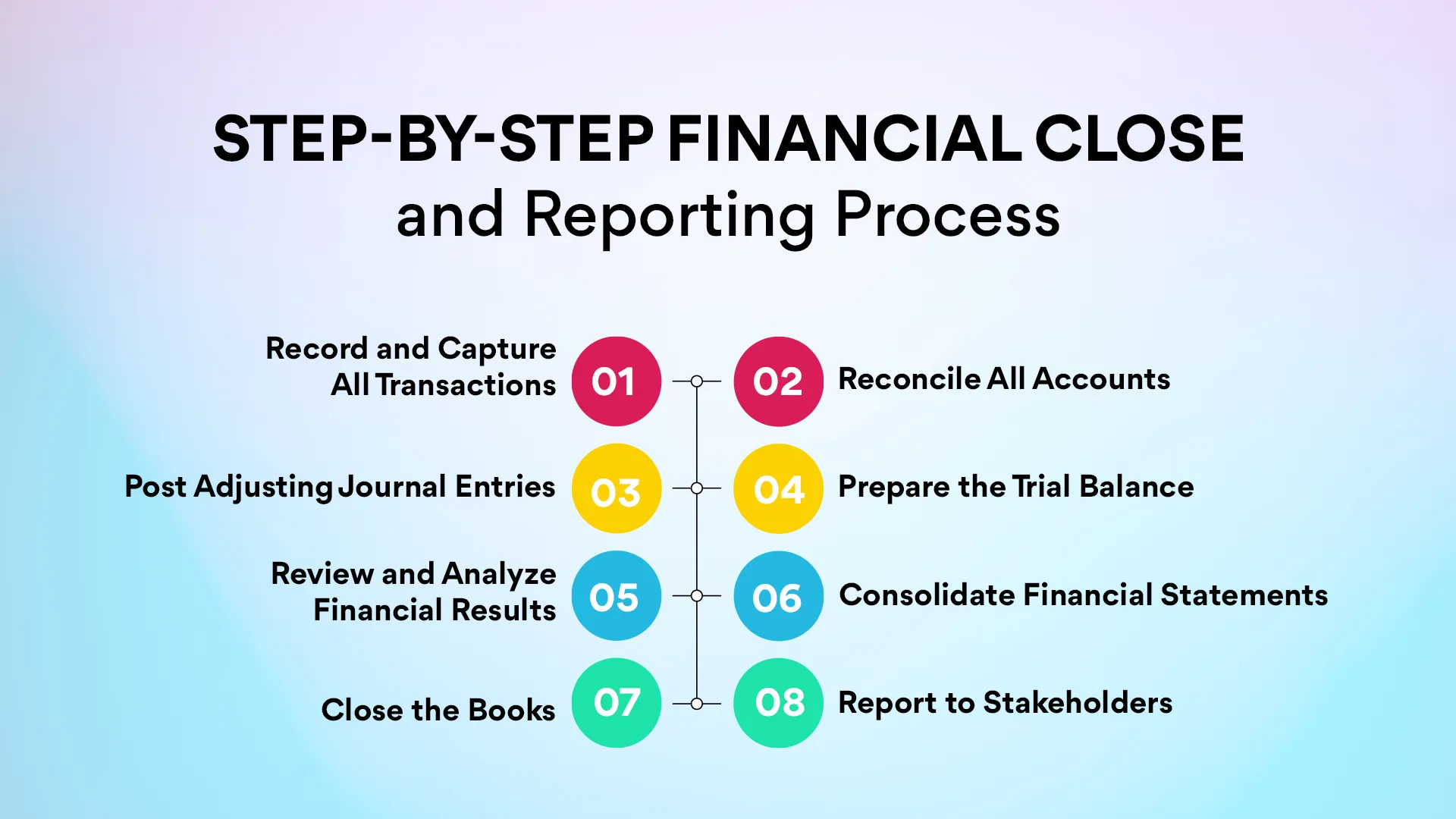
Record and Capture All Transactions
The process begins by gathering all financial activity for the period. This includes sales invoices, purchase orders, expense receipts, payroll entries, and other operational transactions.
Reconcile All Accounts
Internal records are matched against external documents such as bank statements and vendor reports. Any discrepancies are identified and resolved before moving forward.
Post Adjusting Journal Entries
Adjustments are recorded for items not captured through routine transactions. These include accruals, prepayments, depreciation, and amortization.
Prepare the Trial Balance
An unadjusted trial balance is prepared to confirm debits and credits align. After adjustments, an adjusted trial balance is generated to validate final balances.
Review and Analyze Financial Results
Account balances are reviewed for accuracy and reasonableness. Significant variances are analyzed and explained against budgets or prior periods.
Consolidate Financial Statements
For organizations with multiple entities, financial results are consolidated. Intercompany transactions are eliminated to present a unified financial view.
Close the Books
Closing entries are posted to reset temporary accounts. Revenue and expense balances are transferred to retained earnings, formally closing the period.
Report to Stakeholders
Final financial reports are prepared and distributed. These reports support internal management, investors, lenders, and regulatory requirements.
Key Financial Statements Produced
Income Statement
The income statement summarizes revenue, expenses, and net profit or loss for the period.
Balance Sheet
The balance sheet presents assets, liabilities, and equity at a specific point in time.
Cash Flow Statement
The cash flow statement details cash inflows and outflows from operating, investing, and financing activities.
2026 Best Practices to Optimize the Financial Close and Reporting Process
Continuous Accounting
Close activities are spread throughout the period instead of concentrated at the month-end. This reduces pressure and improves accuracy.
Automation
Cloud-based accounting and ERP systems automate data entry, reconciliations, and transaction matching. This minimizes manual effort and errors.
Standardized Checklists
Detailed close calendars and documented procedures ensure consistency. They also improve accountability across finance teams.
Post-Close Reviews
Teams review each close cycle to identify bottlenecks. Improvements are then applied to the next reporting period.
Common Challenges in the Financial Close and Reporting Process
If the financial close and reporting process were always smooth, finance teams would leave on time every month. In reality, the same issues tend to show up again and again, usually right when deadlines are closest.
Most challenges are not caused by accounting rules. They come from how data is collected, shared, and reviewed across the business.
Why Do Manual Processes Slow Everything Down?
Many teams still rely heavily on spreadsheets for reconciliations and adjustments. Spreadsheets work, one wrong formula can quietly undo hours of work.
Manual data entry also increases the risk of errors. Fixing those mistakes late in the close often means rechecking everything, which no one enjoys.
What Causes Data Errors and Mismatched Numbers?
Data rarely lives in one place. Sales, payroll, expenses, and inventory often sit in different systems; mismatches are common.
When data is incomplete or outdated, reconciling balances becomes a guessing game. That slows reporting and reduces confidence in the final numbers.
How Do Disconnected Systems Create Bottlenecks?
Different departments often use different tools that do not talk to each other. This turns consolidation into a manual mapping exercise.
Instead of analyzing results, finance teams spend time pulling reports and reformatting data. That is busy work, not value-added work.
Why Does Communication Break Down During Close?
The close process depends on timely inputs from multiple teams. Late expense reports or missing invoices can stall progress instantly.
Chasing updates through emails and messages creates delays. It also adds stress when timelines are already tight.
How Do Deadlines Increase Risk and Errors?
Month-end and year-end deadlines leave little room for delays. When tasks pile up, teams rush to finish.
Rushed work leads to fatigue, mistakes become more likely. This is usually when errors slip through unnoticed.
Why Does Lack of Automation Hurt the Close Process?
Without automation, repetitive tasks like reconciliations take longer than they should. Finance teams end up managing data instead of analyzing it.
Automation shifts focus from number chasing to insight building. Without it, close cycles remain longer and more painful than necessary.
What Happens When Transactions Are Missing?
Late invoices or unrecorded accruals often appear at the worst possible time. Balances change suddenly, forcing last-minute corrections.
These surprises disrupt the entire close. They also reduce trust in the process, especially when they happen every month.
Why Does Limited Visibility Affect Reporting Quality?
When teams rely on outdated reports, they lose real-time insight. This makes it harder to spot issues early.
Limited visibility delays decisions. By the time reports are ready, the opportunity to act may already be gone.
Manual vs. Automated Financial Close Process: Key Differences
This is where things usually click. Most close frustrations are not about accounting knowledge; they are about how the work gets done.
Below is a simple comparison to show how a manual close differs from an automated financial close process. No fluff, just reality.
Manual close processes can work; however, they rely heavily on people remembering steps, formulas, and deadlines. That is risky, especially when teams are stretched thin.
Automated financial close processes remove repetition. They bring structure, consistency, and visibility; finance teams spend less time fixing numbers and more time understanding them.
Financial Close Checklist: What Needs to Be Done Before Closing the Books
Before closing the books, a clear checklist makes all the difference. It keeps the financial close and reporting process structured, predictable, and far less stressful.
Think of this as the guardrail that stops last-minute surprises. It ensures nothing important is missed before reports are finalized.
Pre-Close Checklist: Key Activities
Control the Close Calendar
Set a detailed close schedule with clear deadlines. Always close the previous period fully before opening the next one.
Gather and Record All Transactions
Confirm all sales, expenses, receipts, and vendor payments are recorded in the general ledger. Missing entries always show up later, usually at the worst time.
Reconcile All Accounts
Reconcile bank accounts, credit cards, accounts receivable, and accounts payable. If balances do not match, stop and fix them before moving forward.
Process Accounts Payable (AP)
Post vendor payments and accrue outstanding liabilities. Reconcile AP balances to ensure nothing is overstated or missing.
Process Accounts Receivable (AR)
Apply customer payments and process credit memos. Review outstanding receivables to confirm revenue is valid and complete.
Manage Fixed Assets and Inventory
Record depreciation and amortization accurately. Review inventory counts and valuations to avoid distorted cost and margin figures.
Handle Payroll and Employee Expenses
Post payroll entries and review unpaid expense reports. Payroll errors have a way of multiplying if ignored during close.
Make Adjusting Entries
Record accruals, deferrals, and other necessary adjustments. These entries ensure activity is reflected in the correct period.
Review and Analyze the Numbers
Generate an unadjusted trial balance, then an adjusted one. Compare results against budgets and prior periods to identify unusual variances.
Prepare Financial Statements
Create the income statement, balance sheet, and cash flow statement. Review them together to confirm they tell a consistent story.
Lock the Period
Once reviewed and approved, lock the general ledger. This prevents late changes and protects the integrity of the closed period.
A strong checklist does not slow the close. It actually speeds it up by removing uncertainty and rework.
How Xenett Can Help Simplify the Financial Close and Reporting Process
Xenett simplifies the financial close and reporting process by reducing manual effort, improving accuracy, and increasing visibility across close activities. It helps finance teams close faster while maintaining control and audit readiness.
By combining automation, structured workflows, and real-time insights, Xenett addresses the most common pain points in close and reporting.
Key Ways Xenett Simplifies the Process
AI-Powered Error Detection
Xenett automatically identifies duplicate transactions, uncategorized entries, and general ledger misclassifications. This reduces manual review time and prevents errors from carrying into final reports.
Task and Workflow Automation
Built-in checklists, task assignments, and approval workflows ensure all close activities are completed on time. This improves accountability and consistency across close cycles.
Real-Time Financial Data and Reporting
Xenett provides immediate access to accurate financial data throughout the close. This eliminates delays caused by manual report updates and supports faster decision-making.
Enhanced Collaboration
Centralized collaboration tools and a client portal streamline communication. Questions, clarifications, and document sharing remain connected to the financial data.
Streamlined Review Process
Review notes, time tracking, and clear task visibility make reviews more efficient. This shortens review cycles and improves transparency.
Deeper Financial Insights
Users can drill down from summary reports to transaction-level details. Customizable reports provide better visibility into financial performance.
Focus on Strategic Work
By automating a significant portion of manual close tasks, Xenett allows finance teams to shift focus from data management to analysis and strategic planning.
Conclusion
The financial close and reporting process does not have to be slow or unpredictable. With clear steps, strong controls, and the right tools, teams can close faster, report accurately, and focus on decisions instead of corrections.
Modernizing the close is not about doing more work. It is about doing the right work, at the right time, with confidence.
Frequently Asked Questions (FAQs)
It is the process of finalizing financial records and producing accurate financial statements at period end.
It is typically completed monthly, quarterly, and annually.
It ensures accurate reporting, compliance, and informed business decisions.
Most organizations aim to complete it within five to ten business days.
Automation and close management tools help reduce errors and shorten close cycles.
Yes, automation improves accuracy and efficiency regardless of company size.