.svg)

SEO for Accounting Firms: What Actually Works in 2026

Ask questions, get summaries, or uncover key takeaways from this article.

Blog Summary
- Why accounting firm websites struggle with organic search
- What SEO actually means for a CPA or bookkeeping practice
- The highest-impact actions to take first - local SEO, content, and on-page basics
- What keyword research looks like specifically for accounting firms
- How Xenett Pulse turns your close quality into a client acquisition tool
Introduction
You have 15 years of experience. Your clients trust you completely. Your referrals are solid.
But when a business owner in your city searches "bookkeeping firm near me" or "CPA for small business," you don't show up.
Someone else does. A newer firm. A less experienced team. They rank. You don't.
That's the SEO problem for most accounting firms, not that they don't deserve the traffic, but that they've never built the infrastructure to earn it. Referrals kept the pipeline full, so the website was always a secondary concern.
In 2026, that's changed. Prospects search before they call. They check your website before they reply to your email. And if you're not findable, you're not in the conversation.
This guide covers what SEO actually looks like for accounting and bookkeeping firms, not generic digital marketing advice, but the specific tactics that move the needle for practices like yours.
Why Do Most Accounting Firm Websites Get No Organic Traffic?
Most accounting firm websites get no meaningful organic traffic because they were built to look professional, not to rank. They have a homepage, a services page, an about page, and a contact form and no content that answers the questions their prospects are actually searching for.
Google doesn't rank websites. It ranks pages. Specifically, it ranks pages that directly answer what someone typed into the search bar.
The three most common reasons accounting firm websites don't rank:
1. No content beyond static service pages - A services page that says "we offer bookkeeping, tax preparation, and payroll" doesn't rank for anything. Google needs content that answers specific questions "how much does a bookkeeper cost" or "what is a month-end close checklist."
2. No Google Business Profile Optimization - For local searches, "accountant near me," "CPA in [city]", Google Business Profile (GBP) is often more important than the website itself. Most firms have a GBP listing but haven't touched it since they created it.
3. No inbound links from other websites Google uses backlinks as a trust signal. A new blog post with no links from other sites ranks slowly, regardless of how well it's written. Most accounting firm websites have almost no external links pointing to them.
According to Thomson Reuters research on accounting firm marketing, fewer than 30% of small accounting firms have an active content strategy. That's the gap. If you publish consistently, you're already ahead of most competitors.
What Is SEO for Accounting Firms?
SEO for accounting firms is the process of making your website and online presence appear in search results when potential clients search for services you offer or questions you can answer.
It has three components:
All three matter. But they don't all matter equally at the start. For most accounting firms, local SEO is the fastest win and it's where I'd tell any firm to begin.
Who Should Be Doing SEO - You or an Agency?
It depends on your firm size and how much time you can realistically invest.
Do it yourself if:
- Your firm has under 10 clients and you're in growth mode
- You have a team member who is comfortable with content and can write consistently
- Your budget is limited and you want to build organic traffic over 12–18 months
Hire an agency or specialist if:
- You're managing 30+ clients and have no time for content
- You've tried DIY SEO and nothing has moved in 6+ months
- You have a specific geographic or niche market you need to dominate quickly
The middle path - what most small firms do well: Set up the technical basics yourself (Google Business Profile, page titles, meta descriptions). Hire a writer or use a structured content process for the blog. Review and approve before it goes live.
The firms that get the best SEO results are the ones that stay consistent, publishing one well-researched post per month beats three rushed posts per week every time.
Where Should Accounting Firms Focus Their SEO Effort?
Start with local SEO. Then on-page basics. Then content.
In that order, because local SEO produces results in weeks, on-page optimization in weeks to months, and content compounds over 3–6 months. Doing content before you've fixed local SEO is like writing blog posts before you've put your firm's address on Google Maps.
Priority sequence:
Priority 1 - Local SEO (weeks 1–4)
- Claim and fully complete your Google Business Profile
- List your firm on accounting directories (AICPA member directory, local chambers)
- Get consistent NAP (name, address, phone) across every listing
Priority 2 - On-page basics (weeks 2–6)
- Fix page titles and meta descriptions on every service page
- Make sure your homepage clearly states who you serve and where
- Check that your site loads in under 3 seconds on mobile
Priority 3 - Content (months 2 onwards)
- Write one blog post per month targeting a specific keyword your prospects search for
- Optimize your service pages for search terms, not just descriptions
- Build internal links between related pages
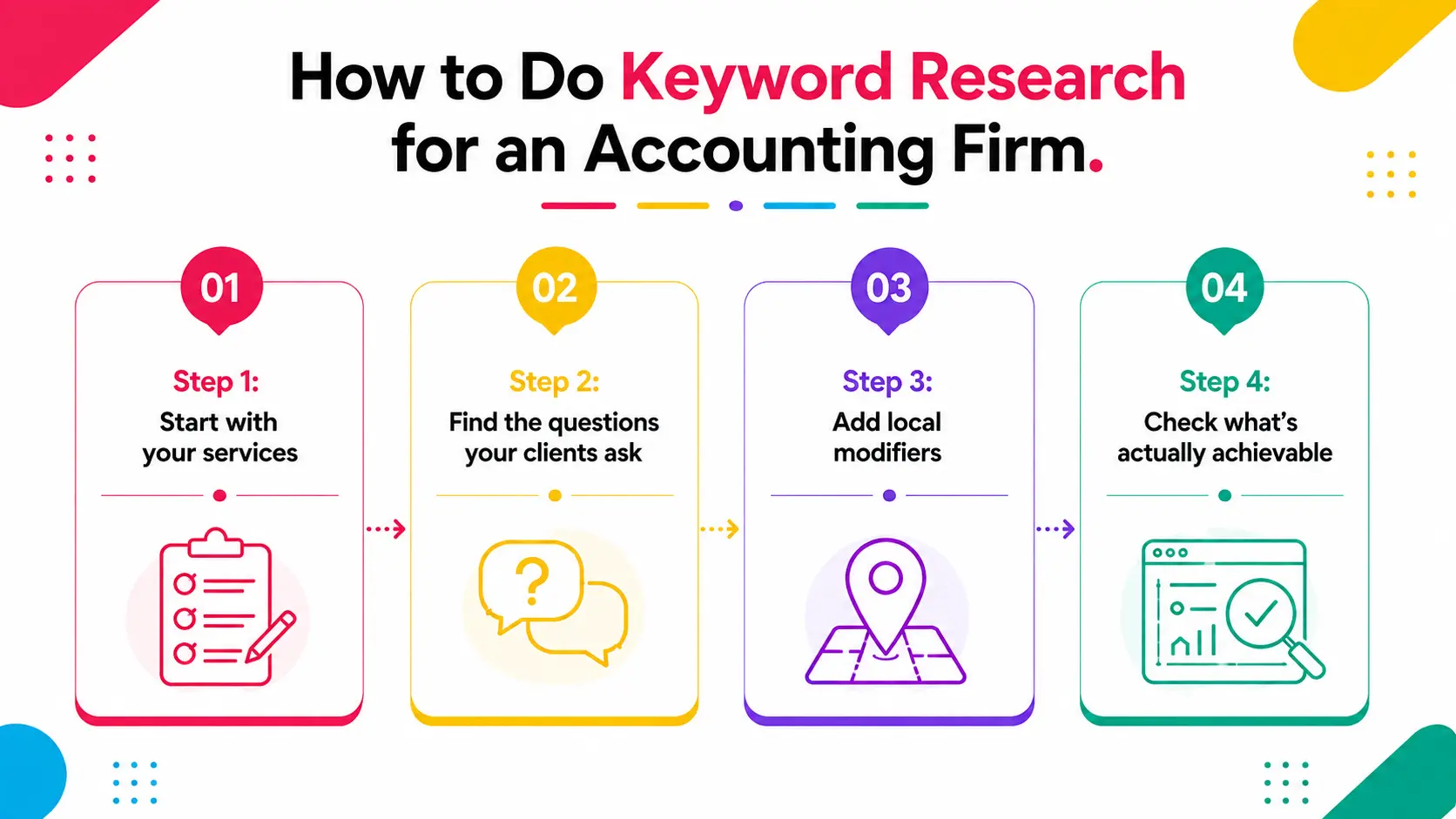
Keyword research for accounting firms means finding the specific search terms your ideal clients type into Google, then creating content that directly answers them.
Step 1: Start with your services List every service you offer. For each one, think about how a non-accountant would search for it. "Small business bookkeeping," "tax return for LLC," "payroll services for restaurants." These are your commercial keywords, people actively looking to hire.
Step 2: Find the questions your clients ask Every question a client has ever asked you in a meeting is a keyword opportunity. "How much does a bookkeeper cost?" "What is the difference between a CPA and a bookkeeper?" "Do I need an accountant for my LLC?" These are informational keywords, people researching before they buy.
Step 3: Add local modifiers For any service keyword, add your city or region: "bookkeeper in Vancouver," "CPA for small business Toronto," "accounting firm Houston." Local intent keywords convert at much higher rates than broad terms.
Step 4: Check what's actually achievable Use a tool like Ahrefs Keywords Explorer or Google's free Keyword Planner to check search volume and keyword difficulty. For a new website, target keywords with difficulty under 10. For an established site (DR 30+), you can go up to difficulty 20–30.
Example keyword map for a bookkeeping firm:
Local SEO for Accounting Firms: The Foundation
Local SEO is the single highest-ROI SEO activity for most accounting firms. It puts you in front of people actively searching for accounting help in your area - today, not in six months.
Google Business Profile (GBP) - the non-negotiable:
Your GBP listing is what appears in Google Maps and the "local pack" (the three businesses that show up with a map when someone searches locally). If yours isn't fully optimized, you're invisible for local searches.
A fully optimized GBP listing includes:
- Business name exactly matching your signage and website
- Correct primary category ("Accounting Firm," "Bookkeeper," or "Tax Preparation Service")
- Complete services list with descriptions
- Business hours, kept current including holiday hours
- At least 10 photos (office, team, logo)
- Responses to every review, positive and negative
- Weekly Google Posts about your services or content
Local citations, consistency matters:
A local citation is any mention of your firm's name, address, and phone number on another website. Google uses citation consistency as a trust signal. Make sure your NAP is identical across:
According to Moz's local SEO research, consistent citations across authoritative directories can move a local business from position 8 to position 3 in Google Maps without any other changes. For accounting firms, this is one of the easiest wins available.
On-Page SEO: What Your Website Pages Actually Need
On-page SEO is making sure each page on your website is set up correctly so Google understands what it's about and who it's for.
The five things every service page needs:
1. A clear page title (H1) with your target keyword Not "Services", "Bookkeeping Services for Small Business in [City]." Your H1 is the single most important on-page signal.
2. A meta title under 60 characters with the keyword near the front This is what appears as the blue link in Google results. Write it for the searcher, not for yourself.
3. A meta description under 160 characters that makes someone want to click It doesn't directly affect rankings, but it drives click-through rate, which does.
4. Content that directly answers the searcher's intent A bookkeeping services page should tell the visitor: what you do, who you do it for, what they get, and how to get started. Not a 50-word description and a contact form.
5. Internal links to related pages Link your bookkeeping page to your month-end close page. Link your tax page to your advisory page. Internal links help Google understand your site structure and help visitors find related content.
Content SEO: What Topics Accounting Firms Should Write About
Content SEO is publishing articles and guides that answer the specific questions your ideal clients search for. It's the strategy that builds long-term organic traffic and it compounds. A post published today can be driving traffic two years from now.
The three content categories accounting firms should cover:
Category 1: Educational content (TOFU) What, why, and how articles for accounting concepts. "What is a chart of accounts," "how does month-end close work," "what is accrual accounting." These bring in people who are learning and some of them are business owners about to hire an accountant.
Category 2: Comparison and evaluation content (MOFU) "QuickBooks vs Xero for small business," "CPA vs bookkeeper, what's the difference," "best accounting software for construction companies." These attract people actively evaluating options.
Category 3: Local and niche content (BOFU) "Bookkeeping services for restaurants in Chicago," "tax accountant for freelancers in Toronto," "accounting firm for e-commerce businesses." These are your highest-converting pages, low search volume, very high intent.
Content publishing cadence:
Consistency beats volume. One post per month for two years outperforms 12 posts in one month and then nothing.
How Long Does SEO Take for an Accounting Firm?
SEO takes longer than most people expect and less time than most people fear, if you start with the right priorities.
Here's a realistic timeline:
The firms that quit at month four, because "SEO isn't working" are the ones who would have seen results at month six. The timeline is not a myth. It's just slower than paid ads.
Real Scenario: How One Firm Went from Zero to 400 Monthly Visitors in 6 Months
A 7-person bookkeeping firm in Calgary had a website but no organic traffic. All their clients came from referrals and one paid Google Ads campaign that cost $800 per month with inconsistent results.
What they did:
Month 1: Fully optimized their Google Business Profile. Added 12 photos, updated their service descriptions, and started responding to all reviews. Within three weeks, they appeared in the local map pack for "bookkeeper Calgary" for the first time.
Months 2–3: Published four blog posts targeting low-competition keywords: "what is bookkeeping," "how much does a bookkeeper cost in Canada," "bookkeeping for small business Canada," and "month-end close checklist." All four were written following a 5W1H structure with direct answers under each heading.
Months 4–6: Two of the four posts reached page one of Google. The GBP listing was generating 40–60 profile views per week. The firm paused their Google Ads campaign entirely.
Result at 6 months: 400 organic visitors per month, up from near zero. Three new client inquiries directly attributed to organic search. One of those became a $2,400/month bookkeeping client fully covering the cost of their content investment for the next two years.
How Xenett Pulse Converts the Traffic You Build
Getting traffic to your website is one problem. Converting that traffic into clients is another.
Xenett Pulse is a free books health diagnostic tool you can offer to prospects. A business owner visits your site, runs a quick diagnostic on their books, and gets a Books Health Score - a clear, visual report showing where their financials stand.
For accounting firms using Xenett Pulse as a conversion tool:
- Prospects self-qualify, if their books have issues, they need your help
- The diagnostic report gives you a concrete conversation starter for the sales call
- No pitch required, the report shows the prospect exactly what needs fixing
Based on data from 1,000+ accounting firms using Xenett, firms that use Xenett Pulse in their prospect flow see a 70% improvement in prospect-to-client conversion. The diagnostic does the selling because it shows the problem rather than describing it.
The traffic-to-client flow looks like this:
Step 1: Prospect searches "bookkeeper in [city]" → finds your website via local SEO Step 2: They run a free books diagnostic using Xenett Pulse on your website Step 3: They receive a Books Health Score showing issues in their financials Step 4: They book a call, already convinced they need help
Your SEO builds the top of the funnel. Xenett Pulse converts it.
Pair your content strategy with your month-end close process to also demonstrate your firm's operational quality, which is increasingly what sophisticated prospects evaluate before hiring.
Book a 15-minute demo to see how Xenett Pulse fits into your firm's prospect flow.
FAQs
What is SEO for accounting firms?
SEO for accounting firms is the process of improving your website and online presence so you appear in search results when potential clients search for accounting services or related questions. It covers local SEO (Google Maps rankings), on-page SEO (page structure and content), and content SEO (blog posts and guides).
How long does SEO take for an accounting firm?
Realistic timeline: local SEO improvements show up in 4–8 weeks, on-page changes in 6–12 weeks, and content-driven traffic builds over 3–6 months. Most accounting firms see their first meaningful organic leads between months 6 and 12 if they start with local SEO and publish consistently.
What are the most important SEO actions for a small accounting firm?
In priority order: (1) Fully optimize your Google Business Profile, (2) Make sure your NAP is consistent across all directories, (3) Fix page titles and meta descriptions on your main service pages, (4) Start publishing one keyword-targeted blog post per month. These four steps alone will move most accounting firm websites from zero to meaningful traffic.
What keywords should accounting firms target?
Start with low-competition local keywords, "bookkeeper in [city]," "CPA for small business [city]." Then add informational keywords your clients search for, "how much does a bookkeeper cost," "what is month-end close," "do I need an accountant for my LLC." Use tools like Google Keyword Planner or Ahrefs to find terms with under 10 keyword difficulty if your site is new.
Should accounting firms do SEO themselves or hire an agency?
Smaller firms (under 10 clients or in early growth mode) can handle the basics themselves, GBP optimization, page titles, one blog post per month. Larger firms managing 30+ clients often benefit from hiring a specialist for content production while keeping strategy in-house. The key is consistency, not who does it.
What is local SEO for accounting firms?
Local SEO is optimizing your online presence to appear in Google's local search results, specifically the map pack that appears when someone searches "accountant near me" or "bookkeeper in [city]." The primary tool is Google Business Profile. Secondary factors include local citations (consistent NAP across directories) and reviews.
How does content marketing help accounting firms get clients?
Content marketing builds organic search traffic by answering questions your potential clients are already searching for. A business owner who finds your blog post on "how to clean up messy bookkeeping" is already interested in bookkeeping help. Well-written, specific content positions your firm as an expert and brings in leads that didn't come from referrals. According to Accounting Today research, firms with active content strategies report significantly higher website-driven inquiry rates than those without.
Conclusion
SEO for accounting firms is not complicated. It's just slower than most people want it to be and more sequential than most people realize.
Local SEO first. On-page basics second. Content third. In that order, because each layer builds on the one before it.
The firms that have strong organic traffic in 2026 are the ones that started 12 to 18 months ago and stayed consistent. The firms starting now will have that same advantage in 2027 or they won't, because they waited another year.
Referrals will always be part of how accounting firms grow. But referrals have a ceiling. Organic search doesn't. A client who finds you through Google came to you. You didn't have to ask anyone to recommend you. That changes the dynamic from the first conversation.
Start with your Google Business Profile this week. Get one blog post live this month. The compounding starts from the first piece you publish.
SEO for accounting firms is the process of improving your website and online presence, so you appear in search results when potential clients search for accounting services or related questions. It covers local SEO (Google Maps rankings), on-page SEO (page structure and content), and content SEO (blog posts and guides).
Realistic timeline: local SEO improvements show up in 4–8 weeks, on-page changes in 6–12 weeks, and content-driven traffic builds over 3–6 months. Most accounting firms see their first meaningful organic leads between months 6 and 12 if they start with local SEO and publish consistently.
In priority order: (1) Fully optimize your Google Business Profile, (2) Make sure your NAP is consistent across all directories, (3) Fix page titles and meta descriptions on your main service pages, (4) Start publishing one keyword-targeted blog post per month. These four steps alone will move most accounting firm websites from zero to meaningful traffic.
Start with low-competition local keywords "bookkeeper in [city]," "CPA for small business [city]." Then add informational keywords your clients search for "how much does a bookkeeper cost," "what is month-end close," "do I need an accountant for my LLC." Use tools like Google Keyword Planner or Ahrefs to find terms with under 10 keyword difficulty if your site is new.
Smaller firms (under 10 clients or in early growth mode) can handle the basics themselves GBP optimization, page titles, one blog post per month. Larger firms managing 30+ clients often benefit from hiring a specialist for content production while keeping strategy in-house. The key is consistency, not who does it.
Local SEO is optimizing your online presence to appear in Google's local search results, specifically the map pack that appears when someone searches "accountant near me" or "bookkeeper in [city]." The primary tool is Google Business Profile. Secondary factors include local citations (consistent NAP across directories) and reviews.


