.svg)

Month End Close Roles and Responsibilities: Who Does What?

Ask questions, get summaries, or uncover key takeaways from this article.
Blog Summary / Key Takeaways
- Month end close roles work best when you assign ownership by process and by account.
- “Who is responsible for month end close” usually means the controller owns it.
- You need early review. Late review creates rework and delays.
- A RACI plus an account ownership matrix fixes most role confusion.
- A strong finance team close structure scales with specialization and review gates.
- Xenett helps teams operationalize ownership, review, and visibility in one place.
Executive Summary
Month end close roles are the people who prepare, review, approve, and report. Clear ownership by account and process prevents late surprises.
One-sentence definition: Month-end close roles are the people and functions that prepare, review, approve, and report monthly financial results with clear ownership by account and process.
What most teams get wrong: unclear close ownership in accounting. Review happens late. Issues show up in flux review. The team reworks entries. Reporting slips.
What “good” looks like: a documented close structure. It names owners, reviewers, and approvers. It sets deadlines and evidence standards.
Quick takeaway list: the 6–8 roles most companies need. One person can hold more than one role.
- Staff or GL Accountant
- AP Specialist / AP Lead
- AR Specialist / Billing
- Payroll Specialist / HR Ops partner
- Revenue Accountant (if you have contracts or deferrals)
- FP&A partner
- Accounting Manager
- Controller (and CFO oversight)
What Are Month-End Close Roles?
Month-End Close Roles
Month-end close roles define who does what in the close. They also define what “done” means for each account.
A “role” does not always mean a job title. A role means a responsibility.
- For example, “cash reconciler” can be a Staff Accountant.
- “Revenue reviewer” can be a Controller in a small team.
Roles should map to accounts and core assertions.
- Does the balance exist.
- Did you capture all activity.
- Did you cut off in the right period.
- Did you value it correctly.
You do not need to turn this into audit language. However, you should keep the same logic.
What’s Included in the Month-End Close
Month-end close includes the work required to publish reliable month-end numbers. It ends when leadership can use the results.
Included in most closes:
- Cutoff and posting of remaining activity
- Subledger closes (AP, AR, payroll, revenue, inventory as needed)
- Journal entries, accruals, and allocations
- Balance sheet reconciliations and rollforwards
- Review and approval workflows
- Flux analysis and explanations
- A reporting package for leaders
Not included in a healthy close:
- Big “cleanup we have been meaning to do”
- Chart of accounts redesigns
- System migrations
- Large policy rewrites
You can do those items. However, run them as projects. Keep them out of the critical close path.
Why Close Roles Break Down in Practice
Close roles break down when ownership stays vague. The work still gets done. However, the team pays for it later.
Common failure patterns:
- The “everyone helps” trap
People jump in wherever they can. No one owns the final balance. - Over-reliance on one senior reviewer’s memory
The controller becomes the system. The process becomes fragile. - Review happens too late
People mark tasks “done.” Review finds issues on day four. Rework starts.
I have seen this in teams that “close in five days.” They still run late.
They close in five days only when nothing goes wrong. Something always does.
Therefore, role clarity must include review timing. Not just task lists.
Who Is Responsible for Month-End Close?
A Clear Answer
The month-end close is typically owned by the Controller (or Accounting Manager). The accounting team executes the work (GL, AP, AR, payroll). The CFO or VP Finance finalizes oversight and communicates results.
Define responsibility at two levels:
- Process owner
Owns the end-to-end close timeline and gates. - Account owner
Owns specific balance sheet and key P&L accounts.
This model answers “who is responsible for month end close” without confusion.
It also stops the “everything belongs to the controller” problem.
RACI for Month-End Close
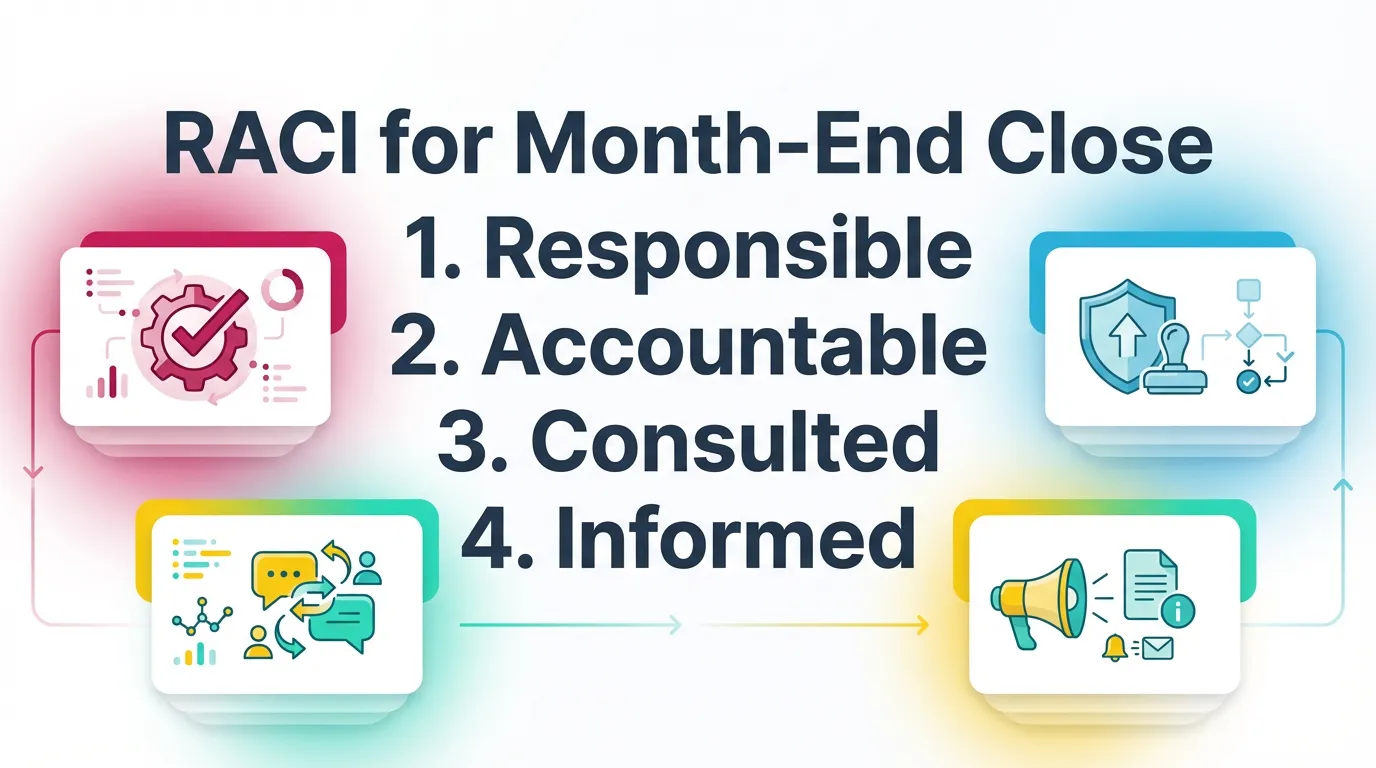
A simple RACI makes ownership visible. It also makes handoffs explicit.
Use these definitions:
- Responsible: prepares and completes the work
- Accountable: signs off and owns the outcome
- Consulted: provides inputs and context
- Informed: receives reporting and status
Month-End Close RACI by Workstream
Keep RACI lightweight. Use it to remove guesswork.
Then enforce it with your close calendar.
Month-End Close Roles and Responsibilities
You can assign many accounting close responsibilities by job function. However, always tie them back to accounts and review gates. That is where quality lives.
Staff Accountant / GL Accountant (Core Accounting Close Responsibilities)
Staff and GL accountants carry most close execution. They make or break balance sheet integrity.
Common responsibilities:
- Post recurring entries and standard accruals
- Prepare and tie-out balance sheet reconciliations
Cash, prepaid, accruals, intercompany, clearing accounts - Maintain schedules and workpapers with clear support
- Resolve review notes quickly and document conclusions
Evidence that helps reviewers:
- A recon that ties to the GL as of month-end
- A list of reconciling items with dates and owners
- Clear support saved with the recon, not in inboxes
Practical standard I use:
If a new accountant cannot reperform the recon next month, it is not done.
Accounts Payable (AP) Specialist / AP Lead
AP controls cutoff risk and completeness risk. It also drives accrual quality.
AP close responsibilities:
- Confirm invoice capture completeness and cutoff
- Provide accrual inputs for unbilled spend
Services received, utilities, freight, contractor time - Perform vendor statement reviews when you need them
- Support AP aging review and explain unusual balances
Best AP habit:
Track “received not invoiced” spend. Do not guess it on day three.
Accounts Receivable (AR) Specialist / Billing
AR owns subledger integrity and cash application reality. AR also drives revenue inputs in many companies.
AR close responsibilities:
- Close AR subledger and validate aging integrity
- Complete cash application and clean up unapplied cash
- Provide billing run support and credit memo detail
- Maintain dispute logs and collectability notes
Hand off risk items to the controller
Payroll Specialist / HR Ops (Close Inputs)
Payroll creates timing issues fast. It also touches multiple accounts.
Payroll and HR inputs:
- Confirm payroll posting timing and cutoff
Match pay dates and work dates to periods - Provide benefits accruals and true-ups when applicable
- Provide PTO liability support if you accrue PTO
- Provide headcount changes that affect allocations
Tip that saves time:
Agree on a payroll cutoff calendar with HR each year. Then reuse it.
Revenue Accountant
Revenue accounting reduces risk in high-volume billing. It also helps close faster by controlling the logic.
Revenue close responsibilities:
- Prepare revenue recognition entries and schedules
- Maintain deferred revenue rollforwards
- Reconcile billing to revenue to cash metrics
- Coordinate with RevOps or Sales Ops for contract changes
FP&A (Finance Team Close Structure Support)
FP&A supports the finance team close structure. FP&A should not become the backdoor accounting team.
FP&A responsibilities in close:
- Share variance expectations early
What should move and why - Own management reporting views and narrative
- Align close calendar with forecasting cadence
- Surface anomalies fast for accounting to validate
FP&A adds value when they engage on day two.
They add less value when they ask questions on day five.
Accounting Manager
The accounting manager makes the close run like a system. They keep the team ahead of review.
Accounting manager responsibilities:
- Run the close calendar and daily status checks
- Review reconciliations for quality and completeness
Not just “done” - Enforce documentation standards across preparers
- Escalate blockers early and remove dependency risk
A real-world example:
I have seen teams cut one close day by moving review earlier.
The manager reviewed cash and AR on day two. Not day four.
Errors dropped. Rework dropped. Reporting stabilized.
Controller Month-End Close Role (Primary Close Owner)
The controller month end close role centers on accountability. The controller owns the final integrity of the financials.
Controller responsibilities:
- Stay accountable for accurate, complete financial statements
- Approve material JEs, accruals, and key estimates
- Own final balance sheet integrity and flux explanations
- Drive close ownership in accounting
Who owns which accounts, by when, with what evidence - Sign off that the reporting package is ready for the CFO
Controllers should not review everything. They should design review.
They should also focus on the highest-risk accounts and estimates.
CFO / VP Finance (Final Accountability + Communication)
The CFO owns business-level accountability. They also own the communication layer.
CFO responsibilities:
- Ensure close outputs meet stakeholder needs
Board, leadership, lenders, investors - Challenge reasonableness and material movements
- Align close timing with decision cycles
- Own external messaging and internal narrative with FP&A
The CFO should not fix reconciliations. However, they should pressure-test.
They should ask, “What changed. What drove it. What is next.”
The Close Ownership Framework: Assigning Responsibility by Account
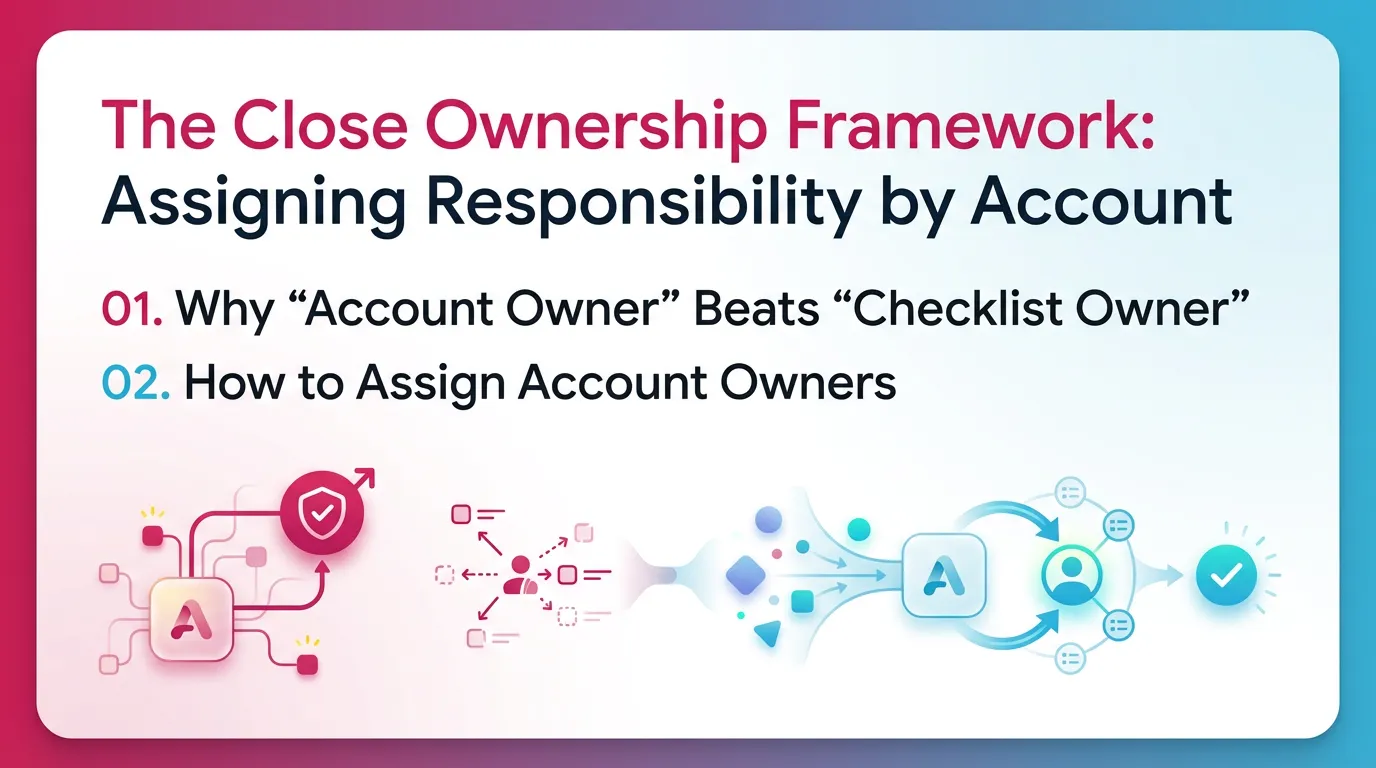
Why “Account Owner” Beats “Checklist Owner”
Account ownership beats checklist ownership because balances can still be wrong. A checklist can go green while an account drifts for months.
Account ownership creates a clear standard:
- This balance makes sense.
- This balance ties to support.
- This balance has clear reconciling items.
- This balance includes the right cutoff.
Therefore, you reduce “late surprises in review.”
You also improve consistency across preparers.
How to Assign Account Owners (Step-by-Step)
Use a simple method. Then keep it stable month to month.
- List all balance sheet accounts
Add the highest-risk P&L accounts. - Group accounts into buckets
Cash, AR, AP, accruals, payroll, fixed assets, deferred revenue, taxes. - Assign a preparer and reviewer per account
Separate duties where possible. - Define minimum support
Recon format, tie-out rules, and evidence expectations. - Set review deadlines before reporting deadlines
Review must happen early. - Create escalation rules
Define what happens when an account cannot clear.
A practical escalation rule:
- If an item stays unreconciled for 60 days, escalate to the controller.
- If it stays for 90 days, require a write-off or reclass memo.
Account Ownership Matrix
Keep the matrix short enough to use. One page helps.
However, cover every material balance.
Model 1: Small Team (1–3 People)
In a small team, people wear many hats. You still need role clarity.
How to structure it:
- One person prepares most accounts.
- A second person reviews the highest-risk accounts.
- If you have no second person, use an external reviewer.
For example, a fractional controller or firm partner.
Minimum separation that still helps:
- Preparer writes the recon.
- Reviewer signs off and asks questions.
- Preparer resolves and documents the answer.
Model 2: Mid-Market Team (4–10 People)
This model supports specialization. It also supports faster closes.
Typical structure:
- AP, AR, and payroll own their subledgers and cutoff.
- Staff accountants own balance sheet buckets.
- The accounting manager runs the calendar and first review.
- The controller owns final review and sign-off.
This structure scales because it prevents bottlenecks.
It also improves training and repeatability.
Model 3: Multi-Entity / High Volume (Shared Services + Specialists)
Multi-entity close needs standardization. It also needs formal handoffs.
A scalable structure:
- A central close calendar with entity owners
- Standardized reconciliation packs across entities
- Formal handoffs from subledgers to GL to reporting
- Shared services for repeatable work
For example, cash app, AP processing, fixed assets support
Key rule:
Do not let each entity invent its own recon format. Standardize it.
Month-End Close Workflow: What Happens When (Role-Based Timeline)
Standard Close Timeline (Day 0–Day 5 Example)
A role-based timeline prevents last-minute review. It also clarifies who is waiting on whom.
A common Day 0–Day 5 close:
- Day 0–1: cutoff + subledger readiness
AP, AR, payroll, revenue inputs - Day 1–3: reconciliations + accruals
GL and account owners - Day 3–4: reviews + flux explanations
Accounting manager and controller - Day 4–5: reporting package + leadership review
FP&A and CFO
The key is sequencing.
Review should start as soon as the first accounts finish. Not at the end.
Best Practices for Month-End Close Roles
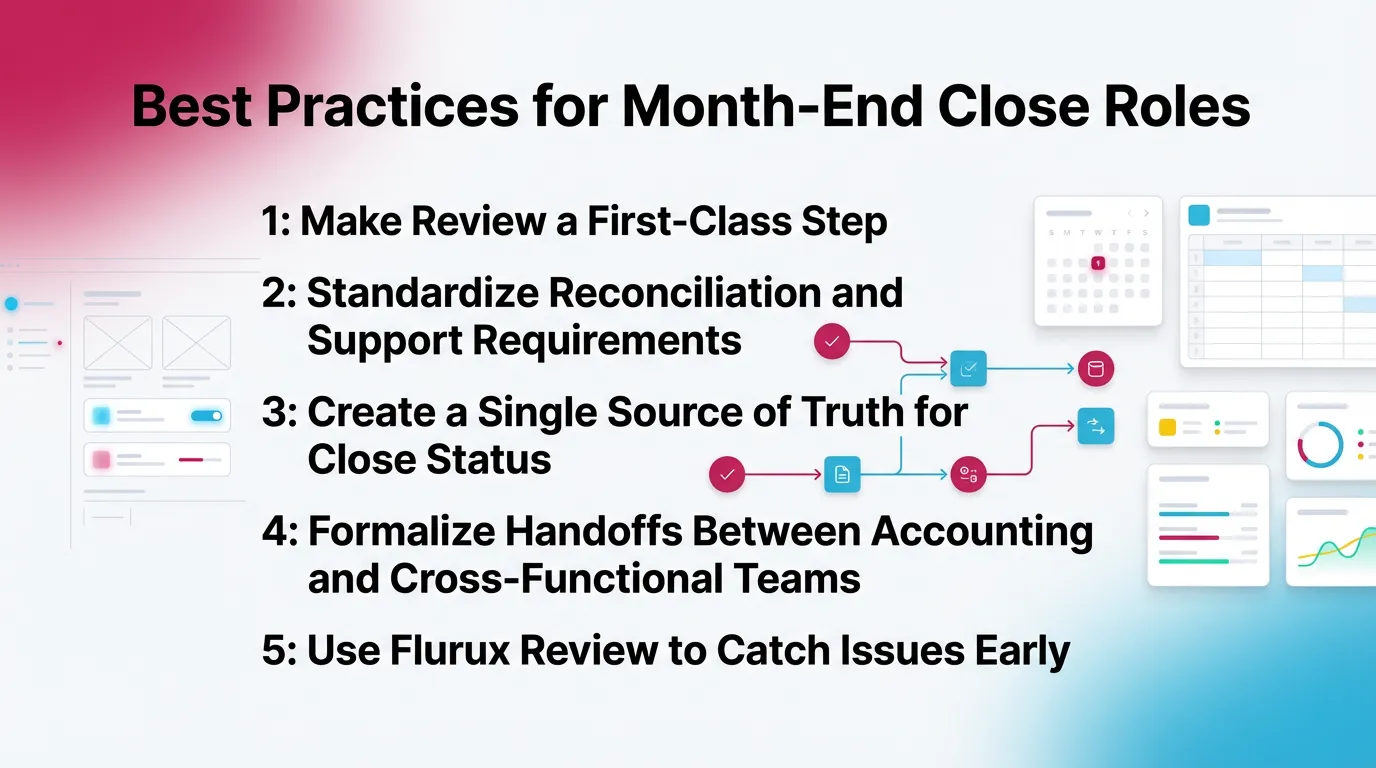
Best Practice 1: Make Review a First-Class Step (Not a Last-Minute Event)
Make review an explicit step with a deadline. Review should not be a vibe.
Review sequence that works:
- Reconcile
- Explain variances
- Resolve review notes
- Then lock and report
Define “review complete” criteria:
- Ties to GL
- Reconciling items listed and aged
- Support attached or linked
- Material movements explained in writing
Best Practice 2: Standardize Reconciliation and Support Requirements
Standardization speeds up review. It also reduces training time.
Standardize:
- One recon template for balance sheet accounts
- Consistent file naming
Account number, name, period, entity - A consistent tie-out approach
Always tie to the trial balance date
Set documentation expectations:
- Materiality thresholds for explanations
- When screenshots work and when they do not
- What “support” means for each account type
Best Practice 3: Create a Single Source of Truth for Close Status
Close status should not live in Slack threads and inboxes. It should live in one place.
A good status view shows:
- What is pending
- What is blocked and why
- Who owns it
- When it is due
- What repeatedly fails month to month
This is where many teams lose time.
They spend hours asking for status instead of moving work forward.
Best Practice 4: Formalize Handoffs Between Accounting and Cross-Functional Teams
Close depends on other teams. Therefore, set deadlines for inputs.
Common handoffs:
- HR → payroll changes and benefit invoices
- RevOps → contract changes and approvals
- Procurement → PO receiving and invoice timing
- Operations → inventory counts or usage data
Write these deadlines into the close calendar.
Do not leave them as informal asks.
Best Practice 5: Use Flux Review to Catch Issues Early
Flux review should start before the close ends. It should not be a post-close exercise.
Use three comparisons:
- Current month vs prior month
- Actual vs budget
- Actual vs forecast
Require written explanations for material movements.
Assign explanations to the account owner. Not to the controller.
Common Mistakes in Close Role Design (And Their Consequences)
These mistakes create late nights. They also create fragile reporting.
Common issues:
- “Controller reviews everything”
Creates a bottleneck. Standards become inconsistent. - No account ownership
Accounts drift. Issues show up late. - Checklist completion mistaken for balance integrity
Tasks close. Accounts stay wrong. - Too many approvers or none
Too many slows you down. None increases risk. - Evidence scattered across inboxes and spreadsheets
No repeatability. No clean handoffs.
If you fix only one thing, fix timing of review.
Early review prevents late rework.
How Xenett Supports Clear Close Ownership and Review-First Month-End Execution
Modern close teams need an operational layer. They need structure for execution, review, and evidence. Xenett supports that workflow without turning the close into an audit process.
Xenett does not provide audit services. Xenett is not an audit tool.
It supports accounting workflow and close management.
Turning “Roles and Responsibilities” Into Enforced Standards
Xenett helps teams turn role definitions into repeatable routines.
It keeps ownership tied to accounts and review quality.
This matters because close ownership in accounting fails without enforcement.
A doc in a folder does not run your close. The workflow does.
You can map:
- Account owners
- Reviewers
- Due dates
- Evidence expectations
- Review gates
Close Task and Checklist Management (Without Losing the Accounting Thread)
Many tools track tasks. Close teams need more than task tracking.
They need work tied to what must be true in the accounts.
Xenett helps you:
- Organize close work around account integrity
- Use standardized checklists linked to owners and due dates
- Reduce tribal knowledge with reusable expectations
This supports consistent accounting close responsibilities across the team.
It also improves onboarding and coverage during PTO.
Review and Approval Workflows That Follow the Accounting Logic
Review should follow a prepare → review → resolve loop.
Xenett supports that loop in a structured way.
What that looks like in practice:
- Preparers submit reconciliations and support
- Reviewers leave notes tied to the work item
- Preparers resolve notes and document the outcome
- Reviewers sign off only when standards are met
This supports separation of responsibilities where possible.
It also reduces “drive-by approvals.”
Visibility Into Close Status and Bottlenecks
Controllers and accounting managers need real-time status.
They need to see blockers early.
Xenett gives visibility into:
- What is pending
- What is blocked
- What is overdue
- What fails repeatedly
Therefore, you can intervene on day two. Not day five.
That helps the finance team close structure stay predictable.
FAQ: Month-End Close Roles
Who is responsible for month-end close?
The Controller or Accounting Manager typically owns month-end close. Accounting staff execute the work. The CFO provides final oversight and business-level review.
In practice, define both:
- A process owner for the close calendar
- Account owners for key balances
What is the controller’s role in the month-end close?
The controller month end close role is accountability for accurate financials. The controller approves key entries and estimates, ensures reviews happen, and signs off that reporting is ready.
Controllers should also:
- Enforce account ownership
- Set evidence standards
- Require timely flux explanations
What are the main month-end closing tasks?
The main tasks are recording remaining activity, posting accruals, reconciling key balance sheet accounts, completing review and flux analysis, and preparing the reporting package.
You can group tasks into:
- Cutoff and subledger closes
- GL entries and reconciliations
- Review, flux, and reporting
What’s the difference between “preparer” and “reviewer” in close responsibilities?
The preparer completes the work and gathers support. The reviewer validates completeness, reasonableness, and documentation quality before sign-off.
A good reviewer:
- Checks tie-outs
- Challenges unusual reconciling items
- Confirms cutoff logic
- Requires clear explanations
How should a finance team close structure change as you scale?
As you scale, you move from shared ownership to specialization. You add a formal close calendar, standardized recon packs, and defined review gates.
Typical changes:
- Dedicated AP, AR, payroll, and revenue roles
- An accounting manager to orchestrate
- Clear account owner and reviewer assignments
What is “close ownership in accounting”?
Close ownership in accounting means every key workstream and account has a named owner and reviewer. It also means clear deadlines and support standards.
This prevents:
- Orphaned accounts
- Late review surprises
- Rework that delays reporting
What reports are generated at month-end?
At minimum, generate a P&L and balance sheet. Many teams also generate a cash flow, budget vs actuals, KPI dashboards, variance explanations, and key rollforwards.
Common rollforwards include:
- Deferred revenue
- Fixed assets
- Accrued expenses
- Debt and interest
Conclusion
If your close depends on memory and heroics, your roles need a reset. Start with two documents. Build a RACI by workstream. Then build an account ownership matrix with evidence standards. Move review earlier.
Next step: take your last close. Pick the three accounts that caused the most rework. Assign a named account owner and reviewer. Add a review deadline that happens before reporting.
If you want to operationalize that structure, set up your close workspace in Xenett. Build the calendar, assign account owners, and enforce the prepare → review → resolve loop.


.webp)