.svg)

Month-End Close Process Improvement: How to Build a More Efficient Close

Ask questions, get summaries, or uncover key takeaways from this article.
Blog Summary / Key Takeaways
- Month end close process improvement fails when review happens late.
- Reduce month end close rework by shifting review earlier.
- Standardize “definition of done” by account class.
- Track a small set of month end close KPIs every period.
- Fix 1–2 root causes per month. Verify results next close.
What Is Month-End Close Process Improvement?
Month-end close process improvement is the disciplined practice of
measuring, analyzing, and systematically upgrading close activities to
increase accuracy, reduce rework, and shorten the time to issue reliable
financials—without creating more risk.
What “Improvement” Means in a Close Context
Improvement means you ship better financials with less friction. Speed
matters. Control matters more.
Focus on goals that show true accounting process improvement:
- Reduce month-end close rework
- Increase month-end close process efficiency
- Improve review consistency across accounts and clients
- Improve predictability with fewer late changes
Why speed alone is a trap:
A faster close with more post-close fixes is not improvement. It is
compressed chaos. You just move the mess to next week.
A good close has three traits:
- It finishes on time.
- It holds up after sign-off.
- It scales across staff changes and client growth.
Why Month-End Close Optimization Usually Stalls
The Core Constraint: Review Happens Too Late
Most teams stall for one reason. They review at the end.
If review happens after “completion,” reviewers find issues. Preparers
reopen reconciliations. Adjusting entries cascade. The close stretches.
Therefore, the best lever is earlier detection.
Fix first: shift-left review. Review while work happens. Catch
issues before the last day.
The 5 Most Common Sources of Close Rework
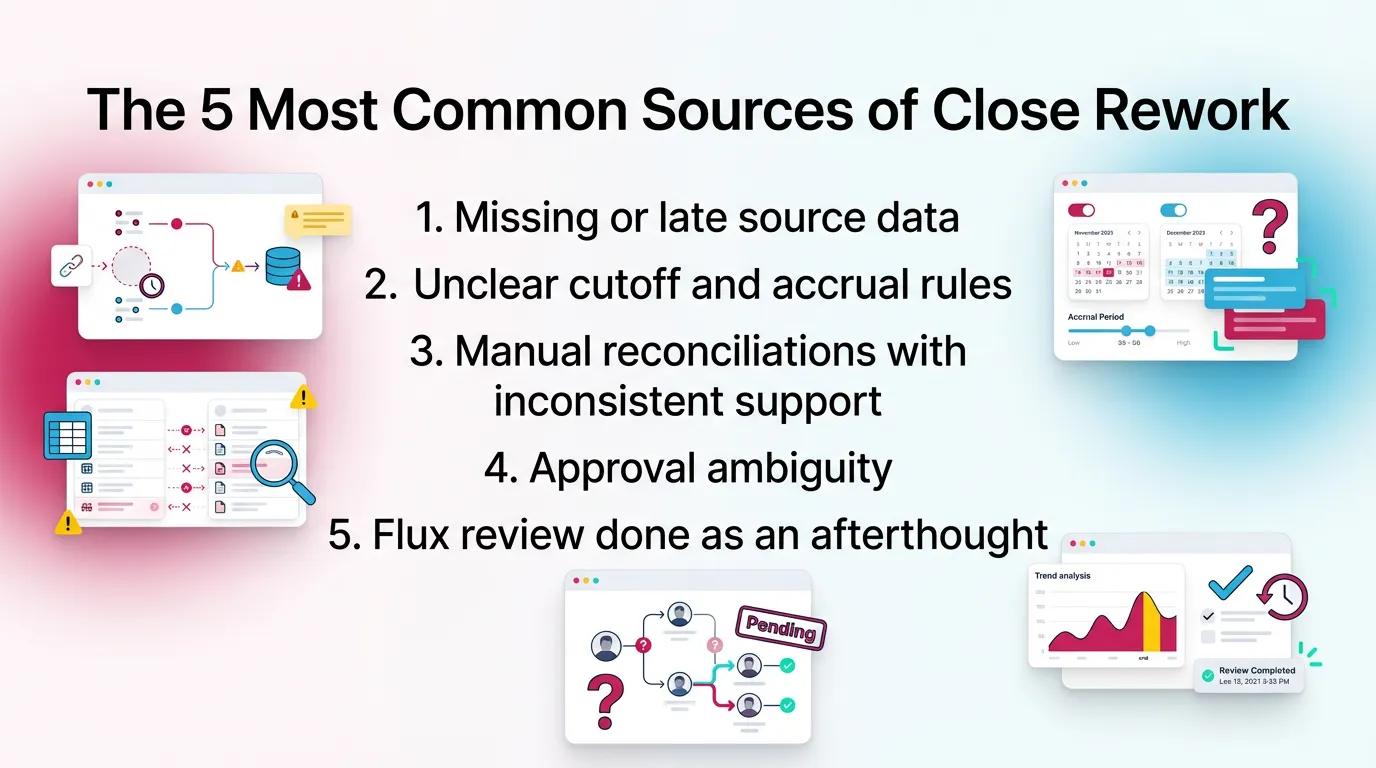
Rework comes from predictable places. You can see them in almost every
controller seat and every CAS firm.
- Missing or late source data
- Bank feeds lag.
- Subledgers lock late.
- Payroll posts after day 3.
- Inventory counts show up after review starts.
- Unclear cutoff and accrual rules
- Different preparers use different logic.
- Accrual thresholds drift by person and client.
- Manual reconciliations with inconsistent support
- No schedule.
- No tie-out.
- No explanation for reconciling items.
- Approval ambiguity
- No clear owner for sign-off.
- “Looks fine” replaces standards.
- Flux review done as an afterthought
- Variance checks happen late.
- Nobody agrees on thresholds.
- Explanations live in email threads.
If you want to improve month end close process results, start here. Do
not start with new templates. Do not start with automation. Start with
review timing and clarity.
A Structured Framework for Continuous Improvement in the Month-End Close
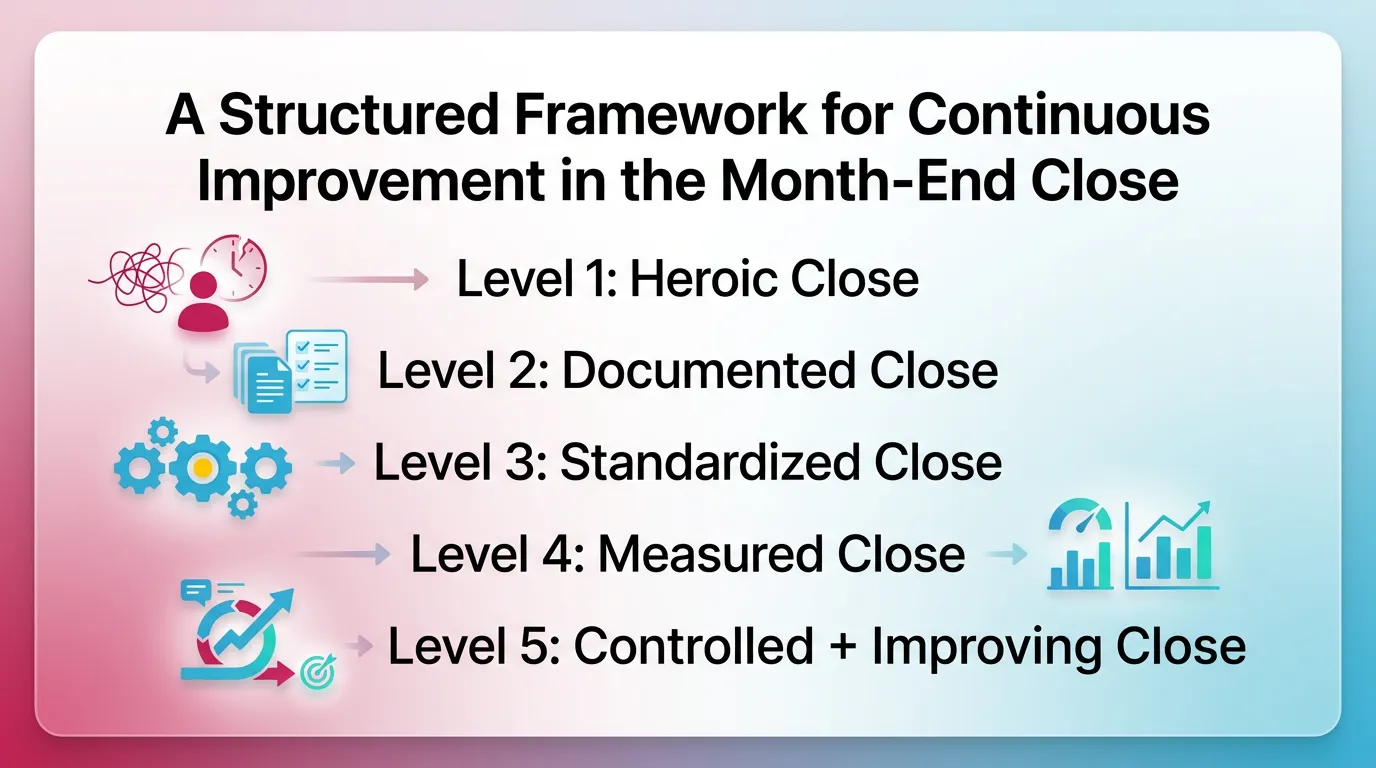
The Close Maturity Model
This model helps you locate your constraint. It also helps you pick the
next fix. Do not jump levels. Build in order.
- Level 1: Heroic Close
You depend on heroes. You run late nights. You use tribal knowledge.
Outcomes vary month to month. - Level 2: Documented Close
You have checklists. However, quality still depends on the reviewer.
Two reviewers produce two different results. - Level 3: Standardized Close
You define “done.” You standardize by account class. You can repeat
the close across staff and clients. - Level 4: Measured Close
You track month end close KPIs. You see bottlenecks. You manage
capacity with data, not vibes. - Level 5: Controlled + Improving Close
You remove root causes. Review findings trend down. The close gets
easier over time, not harder.
Self-assessment: Which level are you?
Check the first statement that matches your reality.
- We rely on specific people to finish the close.
- We have checklists, but review still finds the same issues.
- We use clear “definition of done” rules for key accounts.
- We track KPIs and use them in close leadership meetings.
- We reduce recurring issues month over month with verified fixes.
The 30-60-90 Day Improvement Plan
First 30 Days: Stabilize the Close
Stabilize first. Then improve. Variability hides root causes.
Do these steps:
- Define close scope. Define what “done” means.
- Set “definition of done” by account class.
- Publish a close calendar with cutoffs.
- Capture a baseline KPI snapshot. Manual is fine.
Practical example from the field
In a prior controller role, we fought recurring cash rework. The team
reconciled cash early.
Then payments cleared late. Review reopened the
account every month.
We fixed it by setting a bank cutoff time and a “post-cutoff clearing”
rule.
We also required a short clearing schedule.
Reopens dropped within two closes. The team felt it right away.
Days 31–60: Measure and Remove Recurring Rework
Now you can target the repeat offenders.
Do these steps:
- Track rework causes. Tag issues during review.
- Standardize high-rework reconciliations. Require support.
- Add pre-close checks. Prevent last-day pileups.
A simple method that works:
- Create five rework tags.
- Force every review note into one tag.
- Trend the top two tags each close.
Days 61–90: Optimize and Automate the Right Steps
Optimize after you standardize. Otherwise you automate inconsistency.
Do these steps:
- Automate high-volume, low-judgment tasks.
- Add reminders and recurring entries where appropriate.
- Operationalize flux review with thresholds by account type.
- Formalize governance. Set owners, approvers, and escalations.
If you manage multiple clients, this is where month end close
optimization starts to scale. You stop reinventing the close per file.
How to Improve Month-End Close Process Efficiency
Standardize Inputs: Cutoffs, Dependencies, and Data Readiness
Improve month end close process efficiency by stabilizing inputs. Teams
cannot close cleanly if the data arrives late or changes mid-stream.
Standardize these inputs:
- Bank and credit card finalization
Lock a cutoff. Define what you do with late clears. - Subledger close timing
Set deadlines for AP, AR, payroll, and inventory.
Link these deadlines to the close calendar. - Required schedules and support
Define what must exist before review starts.
For example, require an AP aging tie-out or a prepaid roll forward.
Shift-Left Review: Review While Work Is Happening
Shift-left review reduces late surprises fast. Review in the first
half of the close. Do not wait for “everything done.”
Replace end-stage review with:
- Account-level checks early in the cycle
- Progressive completion of reconciliations
- Mid-close review of high-risk accounts
High-risk accounts usually include:
- Cash and clearing
- Revenue recognition drivers
- Payroll liabilities
- Intercompany
- Inventory and COGS
This approach reduces rework because reviewers stop finding issues after
dependencies pile up.
Design the Close Around Accounts
Tasks help you track work. Accounts drive financial risk.
Design the close by account classes. That creates repeatability across
clients and entities:
- Cash and clearing accounts
- AR/AP and intercompany
- Accruals and prepaids
- Revenue/COGS and margin drivers
- Payroll liabilities
- Fixed assets and depreciation
For example, treat “cash” as a standard playbook:
- Reconcile.
- Explain reconciling items.
- Tie to bank activity.
- Review unusual movements.
- Sign off with support attached.
This structure improves month end close process efficiency because staff
stop guessing what “good” looks like.
Root-Cause Analysis: How to Stop the Same Close Issues from Coming Back
A Simple Root-Cause Workflow
Root-cause work must stay light. If it feels like a project, teams skip
it. Use this six-step loop.
- Log the issue
Capture account, period, and symptom. - Classify the failure type
- data late or missing
- rule unclear
- reconciliation weak
- approval unclear
- tool limitation or manual workaround
- Ask “Why?” 3–5 times
Stay tied to evidence. Avoid blame. - Decide the fix type
- policy change
- template or support requirement
- training or role clarity
- automation or system control
- Assign an owner + due date
If nobody owns it, it returns next month. - Verify next close
Confirm the metric moved. If not, adjust the fix.
The “Rework Tax”
Rework hides in calendars and inboxes. Make it visible. Then you can
reduce it.
Track these rework signals:
- Reopened tasks
- Late adjustments
- Post-close corrections
- Review findings by account category
When you quantify the rework tax, you unlock capacity. You also reduce
burnout. That alone can improve retention on close teams.
Month-End Close KPIs: What to Measure
The KPI Set That Signals True Process Improvement
Track a small set of month end close KPIs. Use them every month. Keep
definitions consistent.
If you want a benchmark mindset, note this:
Industry surveys often show many teams still close in 6 to 10 business
days. Best-in-class teams trend faster, with stronger controls.
However, your target should match complexity and risk.
KPI Operating Rhythm
KPIs only matter if you use them. Keep the operating rhythm short.
- Weekly during close: track stage delays and blockers.
- Post-close: trend rework causes and top accounts driving findings.
- Monthly: choose 1–2 fixes, not 10.
This rhythm supports continuous improvement month end close programs
because it creates follow-through. It also keeps leaders aligned on the
real constraint.
Close Governance: Ownership, Accountability, and Review Standards
Define Clear Roles
Governance reduces ambiguity. Ambiguity creates rework.
Define roles like this:
- Preparer: owns reconciliation and support completeness.
- Reviewer: validates account behavior and policy adherence.
- Approver: owns sign-off standards and escalation decisions.
Keep it simple. Put names next to roles in the close calendar.
“Definition of Done” for Reconciliations
A definition of done stops “almost finished” work from entering review.
Use this checklist:
- Required support attached or linked
- Reconciling items explained and aged
- Flux explanation documented when threshold exceeded
- Reviewer sign-off recorded with who and when
- Exceptions logged with a resolution path
If you lead a firm, apply this per client tier. Higher risk clients get
tighter thresholds and stronger support rules.
Step-by-Step: A Repeatable Month-End Close Improvement Checklist
Pre-Close
Pre-close sets up the close. It prevents avoidable blockers.
- Confirm calendar, dependencies, and cutoffs
- Validate data readiness
- banks
- subledgers
- payroll
- inventory
- Run early account checks on historically noisy accounts
A practical trick:
Create a “known noise” list by account and client. Review it on day -2.
You will catch problems before they spread.
During Close
During close, sequence matters. Do risk order, not convenience order.
- Complete reconciliations in risk order
- Perform rolling review
- Log issues with standardized categories for root-cause trending
This supports month end close optimization because it shortens the
feedback loop. Review drives prep, not the other way around.
Post-Close
Post-close is where accounting process improvement happens. Keep it
short and consistent.
Run a 30-minute retrospective:
- What caused rework?
- What delayed review?
- Which accounts drove findings?
Then:
- Pick 1–2 fixes.
- Assign owners.
- Set due dates before next close.
Best Practices for Month-End Close Process Improvement
Best Practices That Reduce Month-End Close Rework
Top teams reduce month end close rework with clear rules. They do not
rely on memory.
They do this:
- Build account-level review rules
- thresholds
- expected patterns
- required support
- Standardize recurring close entries and schedules
- Keep a living exception log and close it out
For example, require a clearing account schedule. Do not accept “it will
clear next month” without an owner and an aging rule.
Best Practices That Improve Month-End Close Process Efficiency
Efficiency comes from flow. It also comes from fewer restarts.
Use these practices:
- Stage-gate the close
Inputs → reconciliations → review → approval - Use stop-the-line logic
Unresolved exceptions block sign-off - Centralize visibility
Keep work out of inboxes and hidden spreadsheets
If you manage many clients, central visibility prevents “silent failure.”
Silent failure causes last-day firefighting.
Best Practices for Continuous Improvement Month End Close Programs
Continuous improvement month end close work must stay focused. Teams
cannot fix everything at once.
Do this:
- Track KPIs consistently, even if imperfect
- Improve one constraint at a time
- Treat documentation as a control, not an archive
Common Mistakes That Break Month-End Close Optimization
These mistakes show up in both industry and firms. Avoid them.
- Optimizing checklists while ignoring review quality
This creates faster chaos. - Automating before standardizing definitions of done
You scale inconsistency. - Tracking too many KPIs and acting on none
You create noise, not insight. - Letting approvals be informal
“Looks fine” is not a standard. - Treating recurring reconciling items as normal
That is process debt. It grows with time.
How Xenett Supports Repeatable Month-End Close Improvement
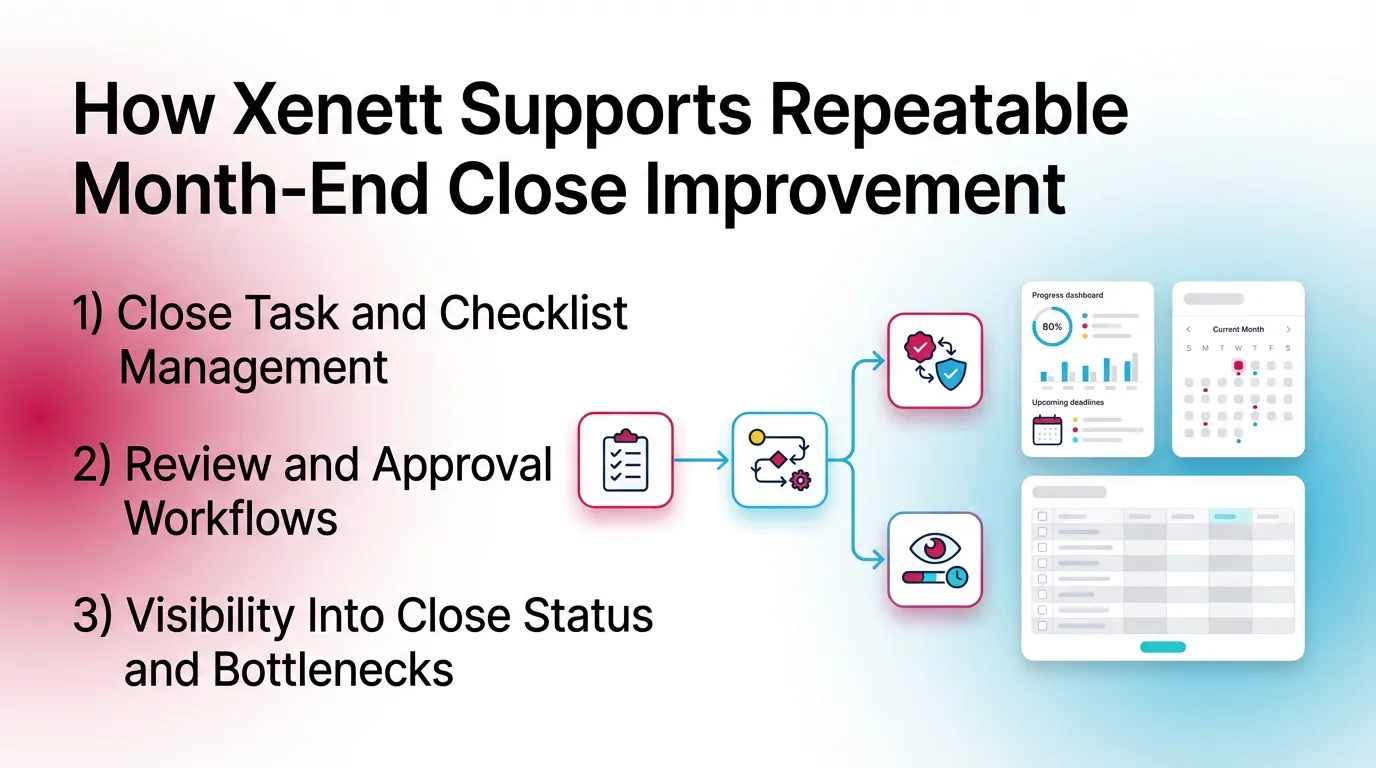
Where Xenett Fits in a Modern Close Improvement Program
Xenett acts as a review-first accounting system. It helps you run a
more consistent close. It also helps you resolve findings before you
sign off.
Xenett supports month end close process improvement. It does not
replace accounting judgment. It also does not provide audit services.
It supports accounting workflow, review, and close management.
1) Close Task and Checklist Management
Xenett helps teams structure close work around what accounts show. It
does not rely on a static list alone.
It helps you:
- Keep recurring close steps consistent across periods and clients
- Sequence work in a predictable way
- Tie work to review outcomes, so prep fixes real issues
2) Review and Approval Workflows
Xenett supports consistent review logic. It helps teams apply the same
standards across reviewers.
It supports:
- Standardized review across P&L and balance sheet accounts
- Recorded sign-offs and accountability
- Alignment to expectations like thresholds and required support
3) Visibility Into Close Status and Bottlenecks
Close leaders need visibility. Without it, work hides.
Xenett makes progress visible by account and category. This helps you
see where the close stalls:
- data readiness
- reconciliation
- review
- resolution
That visibility supports month end close process efficiency. It also
supports better staffing decisions during peak days.
FAQ: Month-End Close Process Improvement
What Is Included in the Month-End Close Process?
It includes finalizing transactions, posting adjusting entries,
reconciling key accounts, performing account-level review, and completing
approvals before issuing financials.
Most teams also run flux and anomaly checks as part of review.
How Do You Improve the Month-End Close Process?
Measure performance with month end close KPIs. Identify recurring rework.
Standardize reconciliation and review requirements. Assign owners. Run
a monthly improvement loop: retro → fixes → verify next close.
What Are the Most Important Month-End Close KPIs?
Close cycle time, rework rate, on-time task completion, review findings
count, late adjusting entries, reconciliation exceptions, and aging of
reconciling items.
Track them with consistent definitions each close.
What Causes Month-End Close Rework?
Late or missing inputs, inconsistent cutoff rules, weak reconciliation
support, unclear approvals, and reviews done too late.
These causes create reopen loops near the end of close.
How Can Automation Help With Month-End Close Optimization?
Automation helps when it reinforces standards. It reduces manual
handoffs. It improves visibility into status. It flags anomalies
earlier so teams resolve issues before sign-off.
What’s the Best Way to Run Continuous Improvement for the Month-End Close?
Keep it simple. Track a small KPI set every close. Categorize review
issues. Select 1–2 root-cause fixes per month. Assign owners. Confirm
the metric moved next close.
Conclusion
Month End Close Process Improvement works when you treat close like a
system. You standardize inputs. You shift review earlier. You define
done. You track month end close KPIs. You fix root causes one at a
time.
Use the maturity model to find your level. Then run the 30-60-90 plan
to improve month end close process results without losing control.