
.svg)

What Is Financial Consolidation in Accounting?

Ask questions, get summaries, or uncover key takeaways from this article.
.webp)
Financial consolidation in accounting is the process of combining financial results from multiple entities into one unified report. It helps you see the true financial position of an entire business group.
When a company owns subsidiaries, each entity records its own transactions separately. Financial consolidation brings those numbers together so you can understand performance at the group level.
During financial consolidation, you adjust data to follow the same accounting rules and reporting structure. This ensures consistency and makes comparisons meaningful across all entities.
You also remove internal transactions, such as intercompany sales or loans. However, this step is critical because internal activity can inflate revenue and expenses if left untouched.
In many cases, financial consolidation includes currency conversion for global operations. Therefore, all financial data appears in one reporting currency for clarity.
The goal of financial consolidation is simple. It gives you a single, accurate financial picture that stakeholders, investors, and regulators can trust.
What Is Financial Consolidation and Close?
Financial consolidation and close is the process of collecting, adjusting, and finalizing financial data from multiple entities into one complete set of reports. It connects daily accounting work to accurate, on-time financial statements.
In practice, financial consolidation and close happens at the end of a month, quarter, or year. You gather data from subsidiaries, standardize accounts, and prepare group-level reports such as income statements and balance sheets.
However, consolidation alone is not enough. The close process ensures every adjustment, review, and approval is completed before numbers are shared with decision-makers.
For example, intercompany transactions must be removed so revenue is not overstated. Currency conversions are also applied, so global results appear in a single reporting currency.
Financial consolidation and close often relies on financial consolidation software instead of spreadsheets. Therefore, teams can reduce manual work, meet deadlines, and produce audit-ready reports with confidence.
Together, financial consolidation and close turn raw financial data into a clear, compliant view of business performance.
What Is the Financial Consolidation Process?
The financial consolidation process brings financial data from all subsidiaries into one unified set of statements. It shows the group as a single business and supports accurate reporting and better decisions.
At a high level, the financial consolidation process focuses on consistency and clarity. You align data, remove internal activity, and prepare group-level financial statements that follow reporting standards.
However, managing this process manually can be slow and error-prone. Therefore, many teams rely on financial consolidation software to streamline each step and reduce risk.
Key Steps in the Financial Consolidation Process
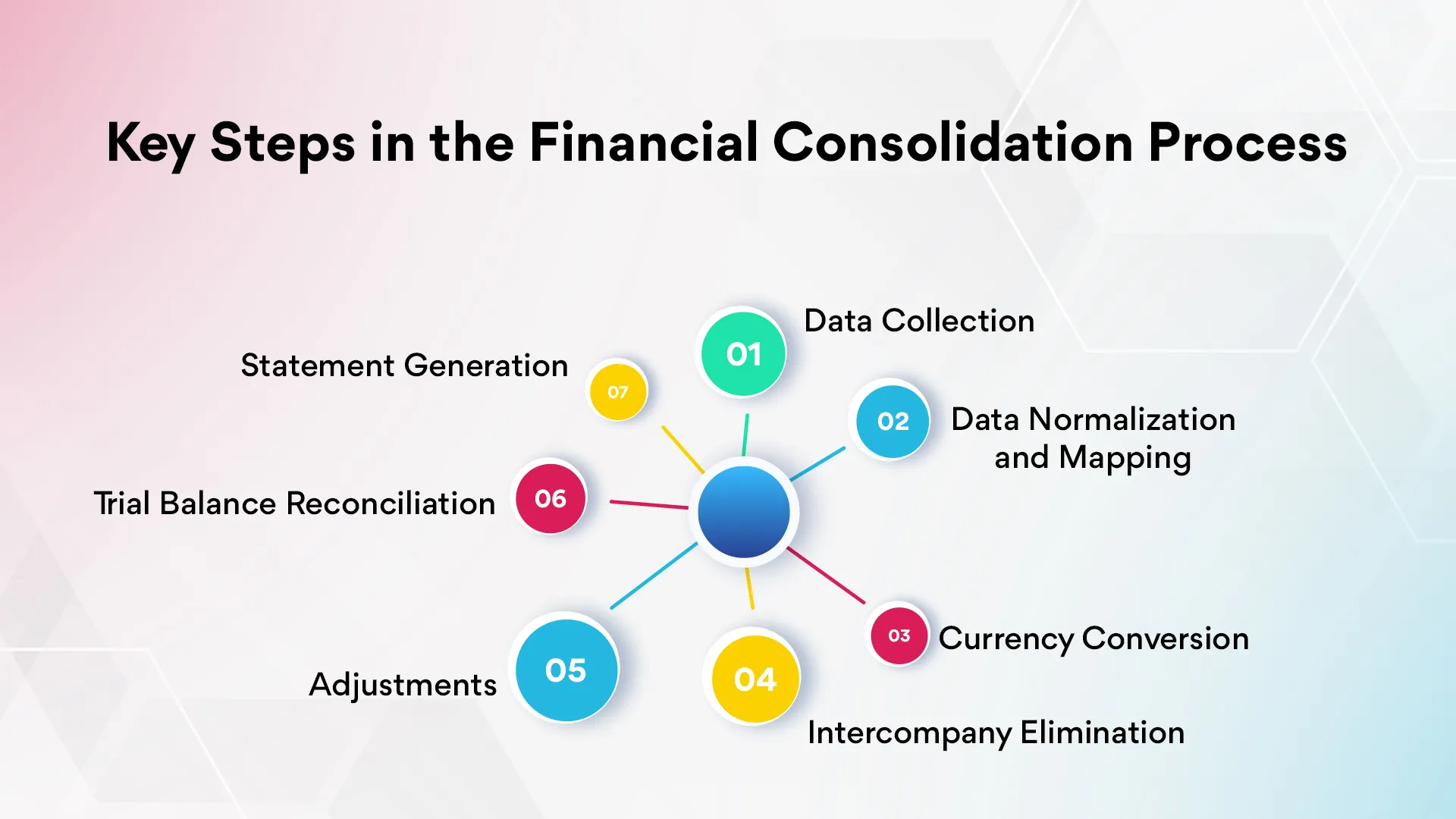
Data Collection
You start by gathering trial balances and financial data from every subsidiary. This step ensures no entity is left out of the consolidation.
Data Normalization and Mapping
Next, you standardize the data by mapping different charts of accounts to one structure. For example, expense categories must align before totals make sense.
Currency Conversion
If your business operates globally, foreign balances must be translated into one reporting currency. This step keeps results consistent across regions.
Intercompany Elimination
You remove transactions between related entities, such as internal sales or loans. However, skipping this step can significantly distort revenue and expenses.
Adjustments
You then record consolidation-specific journal entries. These may include ownership adjustments or asset revaluations for accurate reporting.
Trial Balance Reconciliation
Before finalizing reports, you confirm that the consolidated trial balance balances. Therefore, errors are caught before statements are shared.
Statement Generation
Finally, you generate consolidated financial statements, including the balance sheet, income statement, and cash flow statement.
The financial consolidation process matters because it delivers a clear, compliant view of financial performance. It helps you meet reporting requirements and confidently explain results to stakeholders.
How to Prepare Consolidation of Financial Statements (With Examples)
To prepare the consolidation of financial statements, you combine financial data from a parent company and its subsidiaries into one report. This approach helps you understand the full financial position of the business group.
I start by collecting financial statements from all subsidiaries for the same reporting period. For example, this includes income statements, balance sheets, and cash flow statements.
Next, you align accounting policies and reporting formats across entities. However, differences in charts of accounts must be standardized before numbers can be combined.
You then remove intercompany transactions, such as internal sales or balances. Therefore, group revenue and expenses reflect only external activity.
A well-known example is PepsiCo. You might know PepsiCo as a soda company, but it also owns Frito-Lay and Quaker Oats. Its consolidated financial statements help shareholders understand overall performance and risk.
Alphabet Inc, Google's parent company, follows a similar approach. Alphabet consolidates financial results from its many subsidiaries to present a complete financial picture.
At the same time, Alphabet may disclose separate segment information. For example, this helps investors see how individual business units perform within the group.
Using financial consolidation software makes this process more reliable. Therefore, you reduce manual effort and create accurate consolidated financial statements faster.
Common Challenges in the Consolidation of Financial Statements
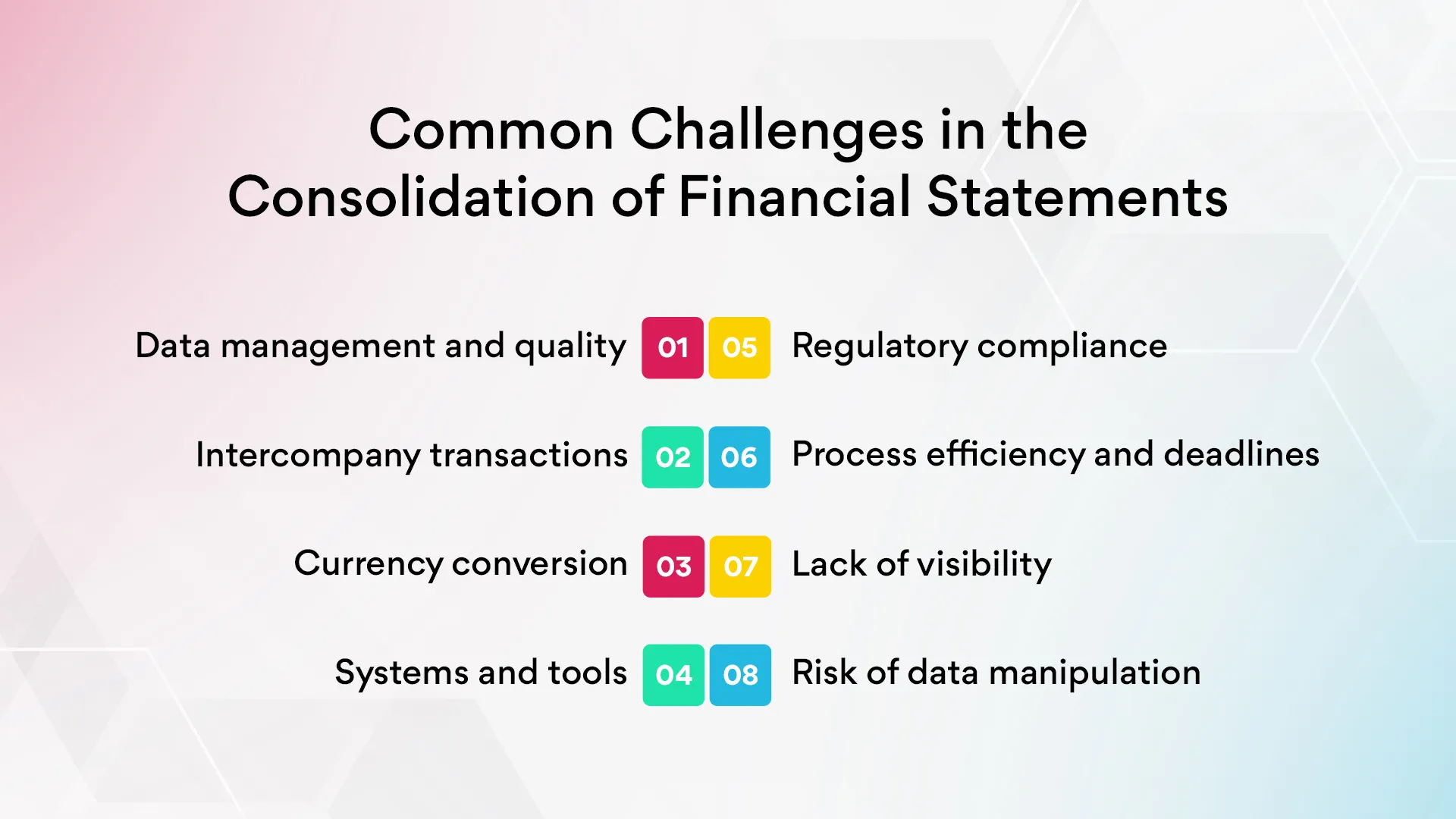
The consolidation of financial statements often becomes difficult because data comes from many sources. I've seen how small inconsistencies quickly turn into major reporting problems.
Data management and quality
Many teams rely on manual data entry or spreadsheets. However, inconsistent systems and poor standardization lead to errors, delays, and unreliable results.
Intercompany transactions
Reconciling transactions between subsidiaries is time-consuming. For example, internal loans or sales must match perfectly before elimination can happen.
Currency conversion
Managing multiple currencies adds another layer of complexity. Exchange rate changes can create inaccuracies if conversions are not handled carefully.
Systems and tools
Using spreadsheets or disconnected tools slows down consolidation. Therefore, collaboration becomes difficult and errors are harder to track.
Regulatory compliance
Different accounting standards increase the challenge. For example, aligning GAAP, IFRS, and local rules requires careful review and adjustments.
Process efficiency and deadlines
Manual consolidation takes time and resources. However, tight month-end and year-end deadlines leave little room for error.
Lack of visibility
Without a centralized system, you struggle to see the full financial picture. This limits analysis and informed decision-making.
Risk of data manipulation
Manual processes often lack strong audit trails. Therefore, the risk of errors or manipulation increases.
These challenges explain why many teams turn to financial consolidation software. It simplifies the consolidation of financial statements and improves accuracy.
How Automation Is Changing Financial Consolidation
Automation is changing financial consolidation by replacing manual, repetitive tasks with faster and more accurate systems. I've seen teams move from spreadsheets to automation and cut days off their close cycle.
One major change is speed. Automated data collection and validation reduce delays at month-end. Therefore, you complete financial consolidation faster without rushing at the last minute.
Automation also improves accuracy and compliance. However, manual entry often leads to errors, while automated workflows apply consistent rules and create clear audit trails.
Intercompany transactions become easier to manage with automation. For example, centralized platforms automatically match and eliminate internal balances across entities.
Reporting and visibility also improve significantly. Automated dashboards provide real-time insights, helping you spot issues before they affect consolidated results.
Automation allows finance teams to focus on strategy instead of data entry. Therefore, you spend more time analyzing results and less time fixing errors.
Scalability is another key benefit. As organizations grow, automated financial consolidation handles added complexity without increasing manual workload.
Technologies like robotic process automation and artificial intelligence support this shift. They connect systems, reduce silos, and strengthen financial consolidation software capabilities.
In the end, automation transforms financial consolidation from a bottleneck into a strategic advantage.
Key Statistics and Trends in Financial Consolidation
Financial consolidation continues to grow more complex as businesses expand globally. I've noticed that traditional tools struggle to keep up with increasing data volume and reporting expectations.
Many finance teams still rely on manual processes. However, studies show that spreadsheet-based consolidation increases the risk of errors and reporting delays, especially during month-end close.
According to Gartner, more than 50 percent of enterprise-critical data is created outside centralized systems. Therefore, consolidation becomes harder as data spreads across teams and platforms.
Speed is now a major priority. Organizations feel pressure to close books faster while still maintaining accuracy and compliance with reporting standards.
Automation adoption is rising across finance teams. For example, companies using modern financial consolidation software report shorter close cycles and improved data consistency.
Real-time visibility is another growing trend. Finance leaders want instant access to consolidated results instead of waiting for static reports.
Regulatory complexity also continues to increase. However, businesses now expect consolidation tools to support compliance without adding manual effort.
These trends show a clear shift. Financial consolidation is moving away from manual work toward smarter, connected, and more scalable solutions.
Comparison Table: Manual vs. Automated Financial Consolidation
Also, go through for more - Financial Close Automation: How Technology Is Changing The Year-End Process
Financial consolidation doesn't have to be complicated or time-consuming. When you understand the process and use the right tools, you gain clarity, accuracy, and control over your financial data.
FAQ’s
Financial consolidation combines financial data from multiple entities into one unified set of statements.
It provides a clear and accurate view of a company’s overall financial health.
Financial consolidation combines data, while the close ensures all reviews and approvals are completed.
Any business with multiple entities or subsidiaries needs financial consolidation.
Manual processes, intercompany eliminations, and currency conversions create the most issues.


