Deferred Revenue Examples: Journal Entries by Client Type

Ask questions, get summaries, or uncover key takeaways from this article.

Key Takeaways
- Common thread: Every example is cash received before the work is done, recorded as a liability.
- Different release patterns: Subscriptions release evenly. Retainers follow usage. Tickets release on the event date.
- Five examples: Subscription, consulting retainer, construction deposit, event tickets, and gift cards, each with entries.
- Review check: Match the release pattern to how the client delivers, not to the payment date.
Almost every definition of deferred revenue is clear. The trouble starts when a client's actual transaction doesn't look like the textbook example.
A deposit gets applied to an invoice, a retainer is used unevenly, and tickets sell for three months before they're delivered in a single day. Each needs a different release and fails in a different way.
This guide walks through five examples by client type, with the entries and the review check for each. For the core concept, start with our deferred revenue guide.
What Are Examples of Deferred Revenue?
Any payment received before the work is delivered. Common examples are annual subscriptions, advance retainers, customer deposits, event tickets, gift cards, memberships, and prepaid maintenance contracts.
The accounting is the same each time. Credit a liability when cash arrives, then release it to revenue as the work is delivered. What changes is the release pattern.
Which Clients Carry Deferred Revenue?
Any client that bills or collects before delivery. The table shows common client types, what triggers the balance, and how it releases.
For rent paid in advance, see our guide on deferred income, which walks through that case in detail.
How Do You Record Deferred Revenue? Five Examples
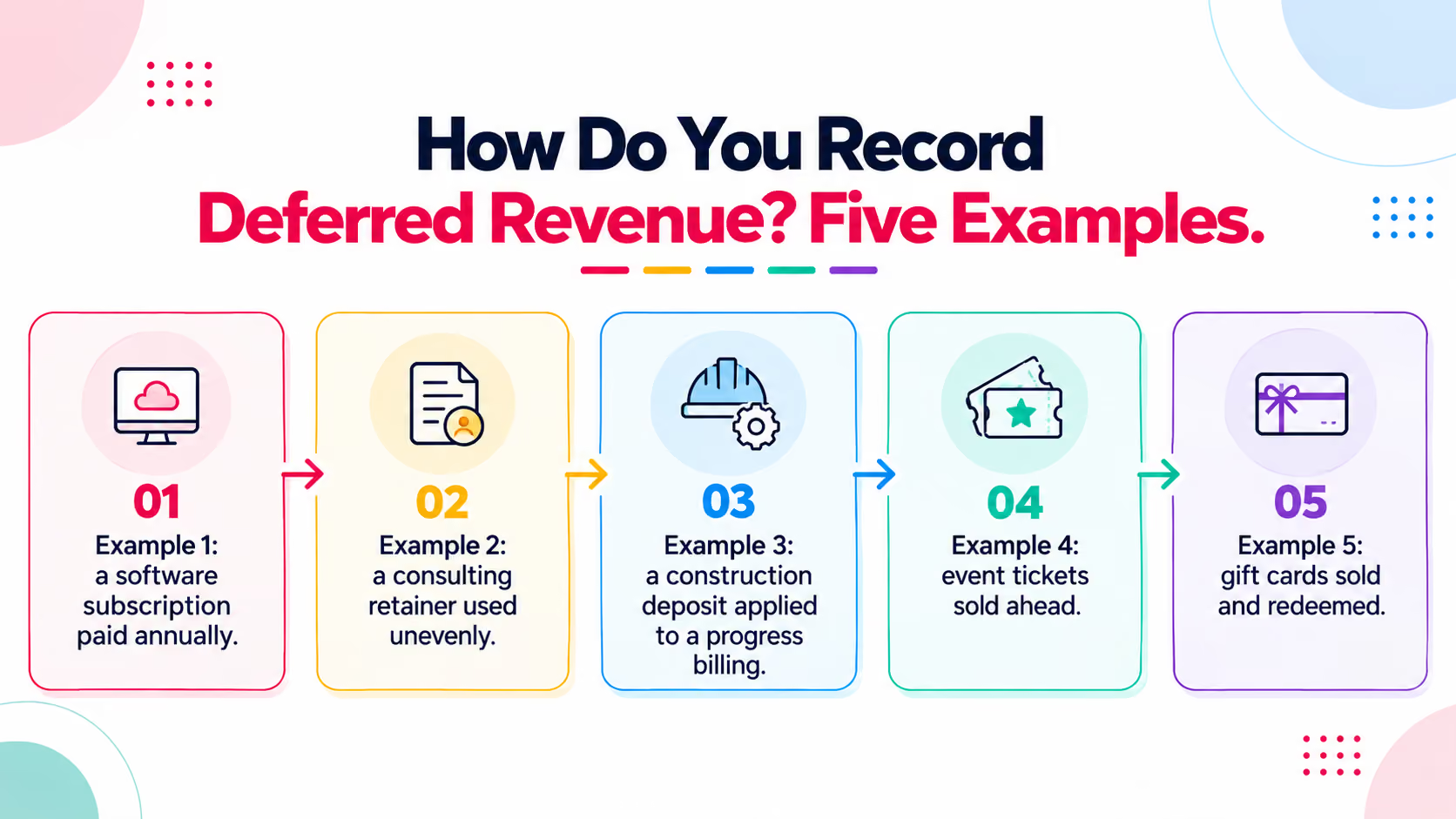
Credit a liability on receipt, then release it on the right pattern. These five examples cover most client files. For the debit and credit basics, see the deferred revenue journal entry guide.
Example 1: a software subscription paid annually
A client pays $2,400 on April 1 for a 12-month plan. That's $200 a month. At the December 31 year-end, nine months are earned and three are not.
The $600 on the year-end Balance Sheet is a current liability. Review check: the balance should equal the months left times $200.
Example 2: a consulting retainer used unevenly
A client pays a $10,000 advance against hourly work. Revenue follows hours delivered, not the calendar.
Review check: tie each month's release to the time log, not to a fixed amount. If the client never uses the full retainer, read the agreement before releasing the rest.
One note on law firms. Advance fees are often held in a client trust account under state bar rules, which changes the entries. Confirm the treatment for the client's jurisdiction before you record anything.
Example 3: a construction deposit applied to a progress billing
A contractor receives a $20,000 deposit on signing. The first progress billing is $50,000, and the deposit applies against it. Assume revenue equals the work completed on that billing.
Review check: the deposit should disappear from the liability when the invoice is issued, not stay as a stray balance. For how receivables and deferred revenue interact, see deferred revenue vs accounts receivable.
Example 4: event tickets sold ahead
A venue client sells $12,000 of tickets in September and $18,000 in October for a November 15 event. Nothing is earned until the event takes place.
Review check: at the October close, the P&L should show no event revenue. If it does, ticket sales were booked as income.
Example 5: gift cards sold and redeemed
A retail client sells $10,000 of gift cards in November. Customers redeem $6,500 in December and $2,000 in January. The rest is unredeemed.
The $1,500 stays as a liability until redeemed or until the client recognizes breakage. ASC 606 addresses unused balances. Confirm the policy with the client's accountant, and see Selden Fox's overview of ASC 606 for background.
When Does Each Example Release?
The release depends on how the client delivers value. Choosing the wrong pattern moves revenue between months, even when the total is right.
For methods, schedules, and mid-term contract changes, read how to recognize deferred revenue. For the wider concept, see deferral accounting.
Where Do These Examples Go Wrong?
Add these checks to your month-end close checklist, grouped by client type.
What happens when the client refunds or cancels?
A refund on an unearned balance reduces the liability. It does not reduce revenue, because no revenue was recognized yet. Debit Deferred Revenue and credit Cash or Accounts Receivable.
Take the event example. If the November 15 event is canceled and the full $30,000 is refunded, the entry is a debit to Deferred Revenue and a credit to Cash for $30,000. The liability clears and revenue stays at zero.
Partial cases need more care. A client who cancels a retainer after $3,500 of work has earned that part. The unused $6,500 is refunded against the liability, and the $3,500 already released stays in revenue.
Check the contract for cancellation fees or non-refundable terms before you post. If part of the payment is kept, that part may be recognized sooner than the original schedule says.
In every case, update the schedule on the day the terms change. A liability that outlives its contract is one of the easier errors for a reviewer to miss.
Many Industries, One Review: Main Accounting Services
Main Accounting Services works with growing law firms across the United States. Law firm clients bring trust accounting rules and tight compliance, so classification mistakes carry real cost.
The team uses Xenett's AI-assisted error detection, and corrections sync with QuickBooks Online in real time, so a fix doesn't need a second round of data entry.
This case study doesn't cover deferred revenue, and we're not stretching it to. What applies is the review habit: a deposit or ticket sale sitting in the wrong account is a general ledger inconsistency that a systematic check should surface early. The full story is in the Main Accounting Services case study.
How Xenett Can Help
A firm with a mix of these clients carries five different release patterns, and each one has to be right every month.
Xenett's AI Accruals for deferred revenue scans the GL for advance invoices and proposes a recognition schedule. The reviewer approves it, so the accounting judgment stays with them.
- AI Accruals, Deferred Revenue: finds advance invoices and builds the schedule
- Anomaly detection: flags unusual revenue patterns, like a spike in the month cash arrived
- Client portal: lets you raise a question with the client when a deposit or retainer's terms are unclear
Conclusion: Read the Contract Before the Calendar
Each of the five examples starts the same way, with a liability on receipt. They differ only in what triggers the release, and that trigger comes from the contract or the delivery record, not the calendar.
If you want to see how Xenett handles mixed client types, start the free 14-day trial. No credit card is required, and setup takes under 10 minutes.
FAQ: Deferred Revenue Examples
What is an example of deferred revenue?
A client pays $2,400 on April 1 for a 12-month software subscription. The business records a $2,400 liability and moves $200 to revenue each month. By December 31, $600 is still deferred revenue.
What are other examples of deferred revenue?
Advance retainers, customer deposits, event tickets sold before the event, gift cards, annual memberships, prepaid tuition, and prepaid maintenance contracts. Each is cash received before the work is done.
Are gift cards deferred revenue?
Yes. A gift card sale is recorded as deferred revenue and recognized as the card is redeemed. If some value is expected to go unused, the business may recognize that breakage, subject to the client's accounting policy.
Are customer deposits deferred revenue?
Usually, yes. A deposit received before the work is done is a liability. It becomes revenue when the work is delivered, or it is applied against a later invoice.
How do you record deferred revenue for an annual subscription?
Debit Cash and credit Deferred Revenue for the full payment. Each month, debit Deferred Revenue and credit Subscription Revenue for one twelfth. The balance reaches zero at the end of the term.
Is a retainer deferred revenue?
Yes, if it's an advance for work not yet done. It's a liability until the work is delivered. Trust accounting rules may change the entries for law firms and similar clients.
Is rent received in advance deferred revenue?
Yes. Rent paid ahead is a liability until the rental period passes. Some people call it deferred income or unearned rent. The entries are the same.
FAQ: Deferred Revenue Examples
A client pays $2,400 on April 1 for a 12-month software subscription. The business records a $2,400 liability and moves $200 to revenue each month. By December 31, $600 is still deferred revenue.
Advance retainers, customer deposits, event tickets sold before the event, gift cards, annual memberships, prepaid tuition, and prepaid maintenance contracts. Each is cash received before the work is done.
Yes. A gift card sale is recorded as deferred revenue and recognized as the card is redeemed. If some value is expected to go unused, the business may recognize that breakage, subject to the client's accounting policy.
Usually, yes. A deposit received before the work is done is a liability. It becomes revenue when the work is delivered, or it is applied against a later invoice.
Debit Cash and credit Deferred Revenue for the full payment. Each month, debit Deferred Revenue and credit Subscription Revenue for one twelfth. The balance reaches zero at the end of the term.