.svg)

Bookkeeping Services List: What Services Do Bookkeepers Offer?

Ask questions, get summaries, or uncover key takeaways from this article.
Blog Summary / Key Takeaways
- A bookkeeping services list works best when you group work by frequency. Daily flow, monthly controls, and year-end readiness.
- Categorization alone does not protect accuracy. Reconciliations and review do.
- Most businesses need three things. Transaction processing, account controls, and a month-end close routine.
- “Done” must mean reconciled, reviewed, and documented. Not just posted.
- Tools like Xenett help teams run close work the same way every month. With clear owners and approvals.
Quick Answer: What Do Bookkeeping Services Include?
Bookkeeping services include the day-to-day recording and organization of financial transactions plus recurring monthly close tasks (reconciliations, review, reporting support). Most businesses need a mix of transaction processing, account controls, and month-end review to keep financials reliable.
Bookkeeping services include recording transactions (income, expenses, bills, invoices), reconciling bank and credit card accounts, maintaining the general ledger, and supporting monthly financial reporting. Depending on complexity, services may also include payroll support, sales tax tracking, and cleanup/catch-up work.
A practical bookkeeping services list helps you buy the right help. It also sets clear expectations for close timing and report quality. Therefore, it reduces rework at tax time.
What Is Bookkeeping?
Bookkeeping means you record, organize, and support financial activity. You do it in a consistent way so month-end close does not turn into a rescue mission.
Bookkeeping usually includes:
- Systematically recording and categorizing financial activity into the general ledger
- Maintaining supporting documentation (receipts, invoices, statements)
- Producing clean inputs for monthly reporting and tax prep
In practice, “clean inputs” matter most. For example, one missing merchant fee can skew cash and revenue. That small miss can trigger bigger errors later.
Bookkeeping vs. Accounting: What’s the Difference?
Bookkeeping focuses on the record and the controls. Accounting focuses on interpretation and compliance.
Here is the clean split most teams use:
- Bookkeeping: recording + categorizing + reconciliation + operational control
- Accounting: interpretation + adjusting entries + tax strategy + compliance filings + advisory (often CPA-led)
Many businesses blur the line. However, scope clarity prevents missed deadlines. It also prevents “I thought you handled that” moments in February.
If you want a simple test, ask this. “Is this task about entering and proving data, or judging it?”
- Entering and proving data usually sits with bookkeeping.
- Judging, adjusting, and filing usually sits with accounting.
A Categorized Bookkeeping Services List
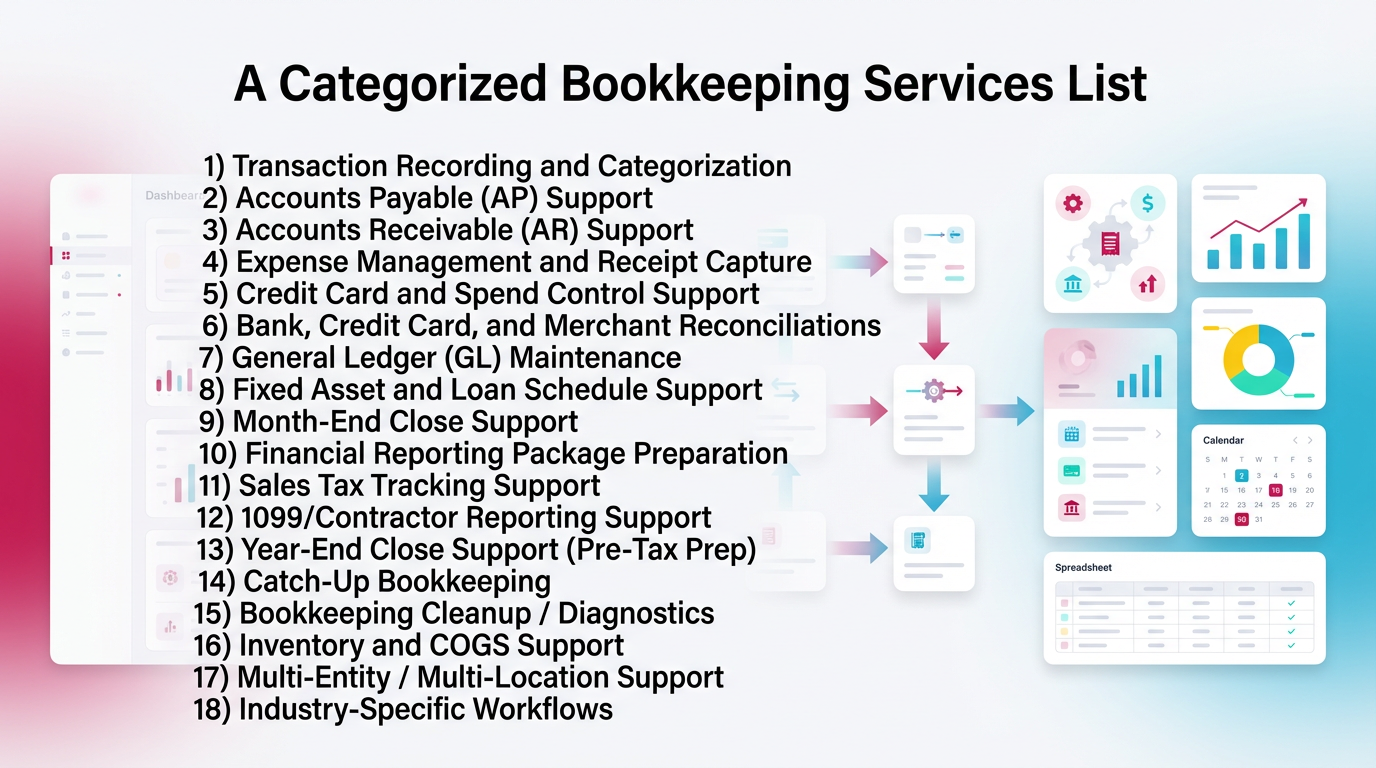
This section gives you the core list of bookkeeping services. It matches how real teams run the work. It also maps to what bookkeeping services include across most industries.
Daily/Weekly Bookkeeping Tasks and Services
These bookkeeping tasks and services keep the books current. They also reduce month-end surprises. Therefore, they reduce cleanup time.
1) Transaction Recording and Categorization
You must record activity with consistent rules. You must also keep categories stable over time.
Typical work:
- Post income and expense activity into the GL
- Apply consistent category rules and class/location tracking when used
Practical insight: your chart of accounts cannot fix weak rules. If your team codes “software” five ways, your P&L loses meaning.
2) Accounts Payable Support
AP support keeps vendor bills organized and payable on time. It also helps you avoid duplicate payments.
Typical work:
- Capture and code vendor bills
- Schedule payments (ACH/check)
- Track due dates and vendor balances
AP support often includes basic vendor hygiene. For example, consistent names and terms. That makes aging reports usable.
3) Accounts Receivable Support
AR support keeps invoices moving and cash collected. It also keeps revenue posting aligned to what you billed.
Typical work:
- Create and send customer invoices
- Record deposits and customer payments
- Track open invoices and aging
AR errors usually show up as “cash is fine, but revenue looks wrong.” That often comes from misapplied payments or missing invoices.
4) Expense Management and Receipt Capture
Receipt capture prevents “mystery charges” later. It also supports a clean audit trail for internal review.
Typical work:
- Receipt matching and documentation rules
- Employee reimbursements coding support
A real-world example: I have seen teams close late every month. The cause was simple. They chased receipts in Slack on day 28. A basic receipt rule fixed it.
5) Credit Card and Spend Control Support
Card activity moves fast. If you do not control documentation, you lose visibility.
Typical work:
- Post card transactions
- Ensure documentation and correct coding for card activity
This work becomes essential once you add more cards. It also matters when managers buy tools directly. Shadow spend breaks budgets quickly.
Monthly Bookkeeping Services
Monthly bookkeeping services protect accuracy. They also make reporting predictable. Therefore, this is where professional bookkeeping services add the most value.
6) Bank, Credit Card, and Merchant Reconciliations
Reconciliations prove your balances. They also catch duplicates and missing items.
Typical work:
- Reconcile to statements (bank/credit card/Stripe/PayPal)
- Investigate unmatched items, duplicates, missing deposits/fees
Merchant reconciliation matters more now. Many businesses collect in multiple places. For example, Stripe plus Shopify plus Amazon. You must tie deposits to sales and fees.
7) General Ledger Maintenance
GL maintenance keeps your chart clean and consistent. It also prevents “misc expense” from becoming a junk drawer.
Typical work:
- Review and cleanup of mispostings
- Ensure consistent mapping (COA hygiene)
A strong bookkeeper reviews trends. For example, a sudden jump in “repairs” might be equipment. That impacts fixed assets and taxes later.
8) Fixed Asset and Loan Schedule Support
This support keeps loans and assets from drifting. It often requires coordination with an accountant.
Typical work:
- Track asset purchases, loan payments, interest splits (often coordinated with accountant)
Bookkeepers commonly post what the lender statement shows. Accountants often decide depreciation policy. You need both roles aligned.
9) Month-End Close Support
Month-end close support makes the work repeatable. It defines what “closed” means.
Typical work:
- Close calendar support (who does what, when)
- Validate completeness (missing bills, unrecorded deposits, unreconciled accounts)
Practical insight: close fails when nobody owns cutoffs. For example, “When do we stop coding last month?” You must set a date.
10) Financial Reporting Package Preparation
Bookkeepers usually deliver management reports from the system. They do not certify statements.
Typical work:
- Provide P&L, Balance Sheet, cash summary
- Basic variance notes
Use the right words with stakeholders. Say “monthly reporting package.” Avoid implying CPA-level financial statements.
Quarterly/Annual Bookkeeping Services
These types of bookkeeping services support compliance. They also reduce year-end panic. However, they usually do not replace CPA work.
11) Sales Tax Tracking Support
Sales tax support keeps coding accurate. It also helps your accountant file with clean data.
Typical work:
- Taxable vs non-taxable coding integrity
- Reconcile sales to filings prepared by accountant or platform
Sales tax rules vary by state. Therefore, bookkeeping focuses on tracking. Filing often sits with a tax pro or a tax engine.
12) 1099/Contractor Reporting Support
1099 support starts with vendor setup. It ends with clean totals by vendor.
Typical work:
- Vendor W-9 collection tracking
- Contractor totals and categorization hygiene for year-end filing support
Most 1099 problems come from one issue. Someone pays contractors via a personal card. That breaks reporting unless you capture it.
13) Year-End Close Support
Year-end close support makes tax prep faster. It also reduces adjusting entry back-and-forth.
Typical work:
- Final reconciliations for all balance sheet accounts
- Cleanup of suspense/uncategorized balances
- Documentation package for CPA/tax preparer handoff
A good handoff package includes support. For example, bank recs, loan statements, and a list of open questions. That saves billable time.
Catch-Up and Cleanup Bookkeeping
Catch-up and cleanup restore trust in the numbers. They also fix process issues that created the mess.
14) Catch-Up Bookkeeping
Catch-up means you post missed history in order. You also reconcile each period so errors do not roll forward.
Typical work:
- Back-posting transactions for missed months
- Reconcile historically (in sequence) to prevent compounding errors
Experience-based warning: teams try to “catch up” by importing everything. Then they skip reconciliations. That creates false confidence. You must reconcile month by month.
15) Bookkeeping Cleanup / Diagnostics
Cleanup fixes what is wrong. Diagnostics explains why it went wrong.
Typical work:
- Identify root causes: duplicate bank rules, unreconciled accounts, misclassified activity
- Rebuild key schedules (AR/AP, loans, inventory mappings where applicable)
A common root cause is duplicate automation. For example, you import bills from an app. You also create bank rules. You can double count expenses fast.
Optional “Higher Complexity” Bookkeeping Services Offered
These bookkeeping services offered vary by industry. They also require tighter policies. Therefore, scope must stay clear.
16) Inventory and COGS Support
Inventory workflows change everything. You must align posting to your valuation method.
Typical work:
- Inventory valuation method alignment (often accountant-led)
- Posting purchase/adjustment entries per process
Inventory usually needs system discipline. For example, purchase orders and receiving. Without that, COGS becomes guesswork.
17) Multi-Entity / Multi-Location Support
Multi-entity books require consistent coding. They also require clean intercompany logic.
Typical work:
- Intercompany coding discipline (where required)
- Class/location tracking consistency checks
The risk is not only errors. It is time. A weak structure creates monthly rework across every entity.
18) Industry-Specific Workflows
Some workflows sit next to bookkeeping. However, they depend on accounting policy.
Typical examples:
- Job costing (construction)
- Billable time tracking
- Deferred revenue (SaaS)
- Grant tracking (nonprofits)
Emphasize this early: these workflows must match the accounting policy. Otherwise, reports mislead leaders.
What Bookkeeping Services Are Essential vs. Optional?
Essential bookkeeping services protect cash, accuracy, and reporting. Optional services add depth when complexity grows.
Essential for Most Small Businesses
Most businesses need these no matter the industry:
- Transaction categorization
- Bank and credit card reconciliation
- AR/AP tracking (even if owner-led payments)
- Month-end close cadence + basic reporting package
Even if you pay bills yourself, you still need AP tracking. Otherwise, you lose visibility into obligations and due dates.
Optional But Common As You Grow
These become common as transaction volume rises:
- Cleanup and catch-up
- Sales tax support
- Inventory and job costing
- Multi-entity close coordination
Mini decision rule:
If you have >100 transactions/month, multiple payment channels, or any AR/AP, you need monthly reconciliation + close support at minimum.
Bookkeeping Services for Small Business: Choosing the Right Scope
You need scope that matches risk and volume. You also need scope that matches how fast you want reports.
A Simple Scoping Framework
Use these levels to decide what professional bookkeeping services should cover. It also helps you compare providers fairly.
Level 1: “Keep It Organized”
This level keeps books tidy. It supports tax prep. It does not support deep management reporting.
Scope:
- Categorization + monthly bank reconciliation + basic reports
Good fit when:
- Low volume
- Simple revenue streams
- Few balance sheet accounts
Level 2: “Close-Ready”
This level makes monthly reporting dependable. It also reduces year-end cleanup.
Scope:
- Level 1
- AR/AP tracking
- Monthly review of balance sheet accounts
- Issue resolution cadence
Good fit when:
- You manage cash weekly
- You have invoices and vendor bills
- You want reports by a set day each month
Level 3: “Control + Complexity”
This level focuses on controls and consistency. It prevents repeated errors. It supports a faster close.
Scope:
- Level 2
- Stronger documentation standards
- Structured close checklist
- Recurring cleanup prevention
Good fit when:
- Several payment channels exist
- Multiple teams code transactions
- Investors or lenders expect clean reporting
Checklist: Questions to Ask Before Hiring Professional Bookkeeping Services
Ask these before you sign. You will avoid scope gaps later.
- Which systems are in play? (QBO/Xero + payroll + merchant processors)
- Who owns payments vs. posting? (controls separation)
- What’s the expected close date each month?
- Which balance sheet accounts must reconcile every month?
- What does “done” mean: reconciled, reviewed, documented, approved?
Practical example: if the owner pays bills, the bookkeeper still needs AP detail. Otherwise, expenses hit the bank feed with no context. Coding gets sloppy fast.
Common Mistakes When Using a Bookkeeping Services List
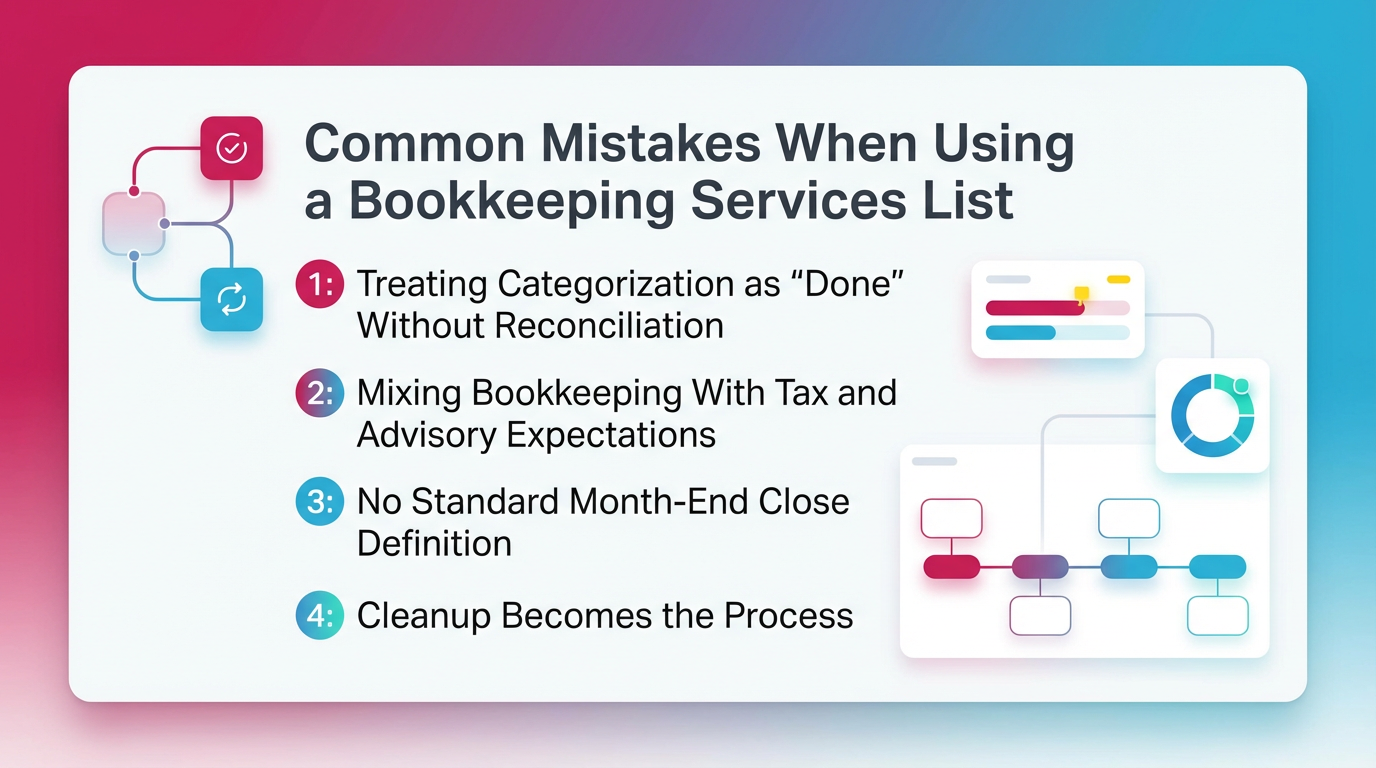
A list of bookkeeping services helps. However, teams misuse it. These mistakes show up in late closes and unreliable reports.
Mistake 1: Treating Categorization as “Done” Without Reconciliation
Categorization alone does not validate cash or liabilities. Reconciliation does.
- Why it fails: uncaught duplicates, missing deposits, misapplied fees
- What to do instead: reconcile monthly, then review exceptions
If you only fix one thing, fix this. Reconciliations turn data entry into reliable balances.
Mistake 2: Mixing Bookkeeping With Tax and Advisory Expectations
Bookkeeping and tax have different deliverables. They also have different calendars.
- Why it fails: scope confusion, missed deadlines, unclear ownership
- What to do instead: define who posts adjustments, and who files
A clean handoff to the CPA beats last-minute scrambling. Therefore, keep roles clear in writing.
Mistake 3: No Standard Month-End Close Definition
A “close” must have a finish line. Otherwise, it becomes a feeling.
- Why it fails: inconsistent financials month to month, rework during tax time
- What to do instead: define required reconciliations, review steps, and approvals
Teams often say, “We closed.” Then they change last month later. That breaks trust in reporting.
Mistake 4: Cleanup Becomes the Process
Some teams live in cleanup mode. They never stabilize the workflow.
- Why it fails: you’re always behind; issues are found late under pressure
- What to do instead: fix root causes, then add controls to prevent repeats
For example, if bank rules cause miscodes, fix the rules. Then add an exception review each week.
Best Practices for Bookkeeping Tasks and Services

Predictable close comes from simple controls. It does not come from heroics. These best practices apply across the main types of bookkeeping services.
Best Practice 1: Reconcile Every Balance Sheet Account That Can Reconcile
Reconcile what ties to an external source. Review what cannot reconcile.
Minimum set:
- Bank and credit cards
- Loans and lines of credit
- AR and AP subledgers
- Clearing accounts
If an account holds money or obligations, treat it as critical. Therefore, reconcile it monthly.
Best Practice 2: Standardize a Monthly Close Calendar
A calendar makes close repeatable. It also sets expectations with leaders.
Include:
- Cutoffs for expenses and revenue
- Due dates for receipts and approvals
- Reconciliation deadlines
- Review timing and handoff to accountant
Many teams aim for a 10-business-day close. Some get to five days with strong discipline. The right target depends on complexity.
Best Practice 3: Use Documentation Standards (Audit Trail Without “Audit”)
You need support for decisions. You also need a trail for internal clarity.
Do this:
- Store statements, key reports, and explanations for large items
- Tie support to accounts, not to inbox threads
Do not do this:
- Rely on “ask Bob” as documentation
- Keep support only in chat messages
This is not an audit process. It is basic operational hygiene.
Best Practice 4: Build Review Into the Process
Review must happen before you call the close done. It must also follow a repeatable checklist.
Include quick checks:
- Unusual swings in expenses
- Negative balances where they should not exist
- Old reconciling items
- Suspense and uncategorized balances
Route approvals for material adjustments only. Do not bottleneck on small items.
Best Practice 5: Prevent Repeat Errors With Rules + Exceptions
Automation helps, but only with controls. Therefore, pair rules with exception reporting.
Use:
- Bank rules with controls
- Exception reporting for unusual activity
Example exceptions:
- Large transactions over a threshold
- New vendors
- Categories rarely used
- Backdated entries
Monthly Close Minimum Control Set
How Xenett Helps Teams Operationalize a Strong Bookkeeping and Close System
Bookkeeping services work best when you run them as a system. Xenett helps teams standardize that system. It supports execution, visibility, review, and accuracy.
Turning “Bookkeeping Services” Into a Repeatable Monthly Close
Teams often deliver the same bookkeeping services offered each month. However, they deliver them in a different order. That creates drift.
Xenett helps teams:
- Define a consistent close sequence
- Move from transaction work to reconciliations to review
- Reduce dependence on memory or senior staff availability
This approach matters for firms and internal teams. It makes close outcomes repeatable.
Close Task and Checklist Management
Checklists fail when they live in spreadsheets. Owners change. Steps vanish. Close quality drops.
Xenett helps you:
- Standardize month-end close checklists across clients or entities
- Create specific tasks for known review requirements
- Make close status visible day by day
For more on structured close execution, see: Month End Close Checklist
Review and Approval Workflows
Review must follow the same logic every month. It must also include documented findings and resolution.
Xenett supports:
- Structured review of P&L and Balance Sheet accounts
- Documented questions and findings tied to accounts
- Clear approvals before you call the close complete
This is not an audit workflow. It is a monthly close and financial review discipline.
Visibility Into Close Status and Bottlenecks
Visibility prevents last-minute scrambles. It also helps managers allocate work early.
Xenett provides:
- Clear view of what’s complete and what’s blocked
- Reasons for delays, like missing support or unreconciled accounts
- Better management across multiple clients or entities
FAQ: Bookkeeping Services List
What Are Bookkeeping Services?
Bookkeeping services are the recurring tasks that record, organize, and reconcile financial transactions so your general ledger and monthly reports are accurate. They also support a consistent month-end close.
What Are Some Bookkeeping Services Offered by Professionals?
Professional bookkeeping services often include transaction categorization, AP and AR support, reconciliations, month-end close support, and reporting package preparation. Many also offer catch-up and cleanup services.
What Bookkeeping Services Include Monthly Close?
Monthly close bookkeeping typically includes bank, credit card, and merchant reconciliations, GL review, balance sheet integrity checks, and delivery of monthly management reports. Some scopes also include variance notes.
What Are the Most Important Bookkeeping Tasks for a Small Business?
For most small businesses, focus on accurate categorization, monthly reconciliations, AR/AP tracking when needed, and a consistent close cadence with documented support. These steps keep reports reliable.
What Is Bookkeeping Cleanup?
Bookkeeping cleanup corrects historical errors, reconciles accounts that were not reconciled, and fixes misclassifications so financials become reliable again. Cleanup should also identify the process issue that caused the errors.
How Often Should Bookkeeping Be Done?
Post transactions weekly in most businesses. Post daily if volume is high. Reconcile and review monthly at minimum.
Is Payroll Part of Bookkeeping Services?
Payroll can sit inside bookkeeping as support, like posting payroll entries and reconciling payroll liabilities. Payroll processing and filings often sit with a payroll provider, depending on scope.
Do Bookkeepers Prepare Financial Statements?
Bookkeepers often deliver monthly management reports like a P&L and Balance Sheet from the accounting system. Formal financial statements and compliance reporting usually sit with an accountant or CPA.
Summary: The Practical Bookkeeping Services List to Use When Scoping Help
Use this recap to scope bookkeeping services for small business. It also helps you compare a list of accounting and bookkeeping services across providers.
If you only do five things, do these:
- Categorize consistently
- Reconcile monthly
- Review key accounts
- Document exceptions
- Run a standard close checklist
Conclusion
Use this bookkeeping services list to define “done” in plain terms. Then confirm owners, timing, and review steps. If you want a smoother close, document your minimum control set and run it every month.