
.svg)

Financial Close Management Best Practices 2026

Ask questions, get summaries, or uncover key takeaways from this article.

I’ll be honest!
I’ve been through enough month-end closes to know exactly how draining they can be.
Every year, new tools promise “faster closes” or “real-time visibility,” yet somehow we end up with more spreadsheets, more last-minute adjustments, and more late-night Slack messages.
If you’ve ever reconciled accounts at 11 p.m., chased missing entries from multiple departments, or waited on one approval that holds up the entire close, you know the feeling. It’s not just stressful, it's unnecessary in 2026.
Because this year feels different. Financial close management is no longer about simply completing checklists.
It’s about designing intelligent systems that prevent errors, surface insights instantly, and support the way finance actually works today.
Modern platforms, like Xenett, aren’t just speeding up the close. They’re reshaping it into a cleaner, more predictable, and more collaborative process. And once you experience it, you don’t go back.
So let’s break down what really matters in the financial close, why it’s still so critical in 2026, and how leading teams are transforming it into their strategic advantage.
What Is the Financial Close Process?
If you’ve ever tried pulling together a month-end report while five systems tell five different stories, you know the struggle. You also know the financial close is simply a structured way to bring everything together.
At its core, the financial close is a recurring routine where accountants gather, reconcile, and validate every transaction for the period. Whether it’s month-end, quarter-end, or year-end, the goal stays the same produce clean, reliable financial statements.
This includes updating journal entries, reconciling accounts, reviewing variances, booking accruals or depreciation, generating trial balances, and preparing the core statements. Once everything ties up, the period can officially close.
I often call the close the “moment of truth” for finance teams. It’s where every number must align, and every assumption gets tested. When done right, it becomes one of the strongest sources of financial clarity.
Common Challenges in the Month-End Close Process
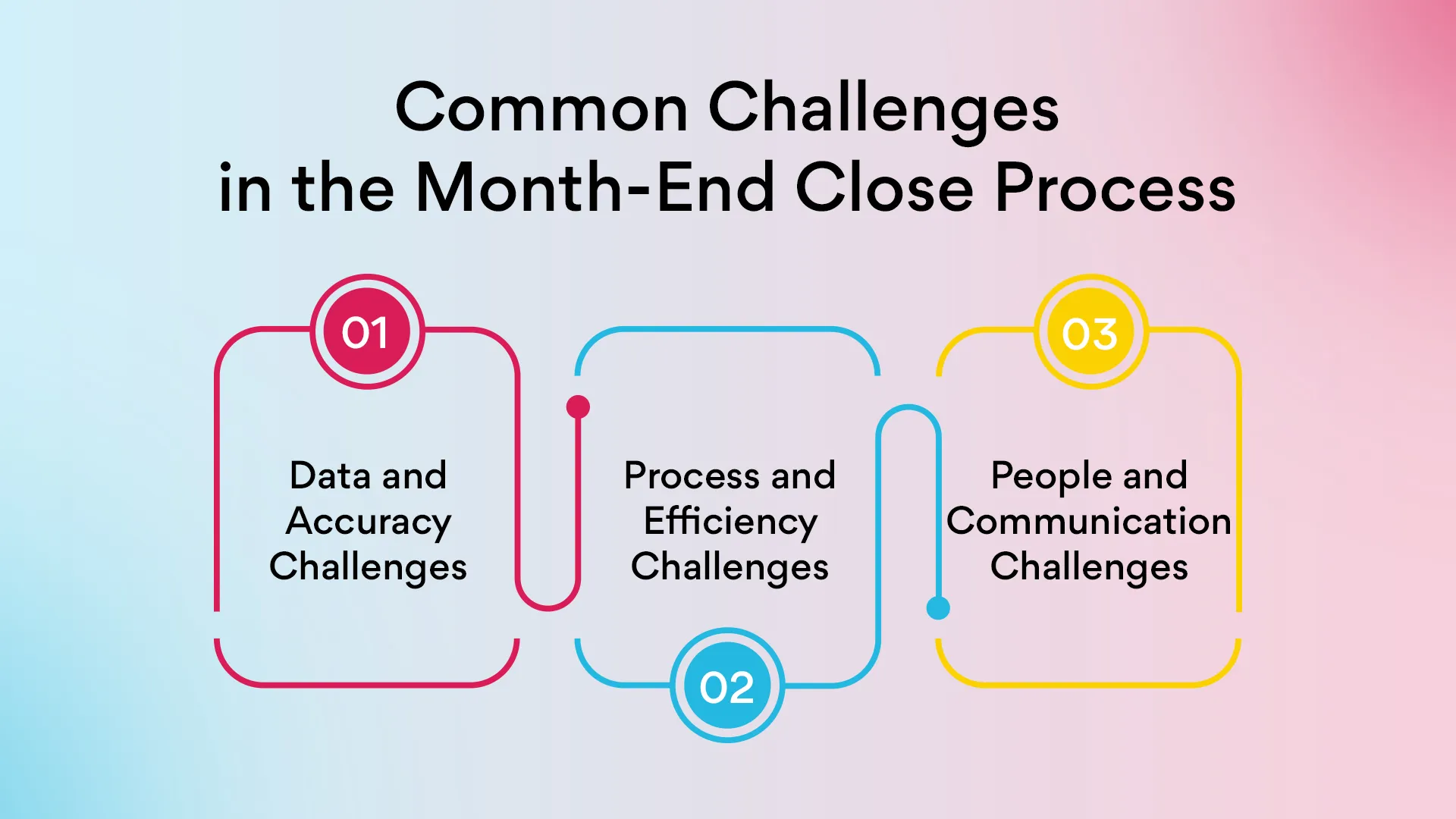
Most close problems fall into three buckets: data, processes, and people. And almost all of them get worse when manual work and tight deadlines collide.
1. Data and Accuracy Challenges
Manual data entry creates the biggest headaches. One mistyped number can throw off an entire reconciliation and lead to hours of backtracking. It’s a small mistake with a big price.
Data quality is another concern. When information comes from multiple places, it’s hard to be sure everything is accurate and consistent. Bad data early in the process always leads to messy financials later.
Disconnected systems make this even harder. Many teams still pull numbers from ERPs, spreadsheets, and operational tools that don’t talk to each other. This creates data silos and forces accountants to stitch everything together manually.
Missing documentation doesn’t help either. When invoices, receipts, or approvals are incomplete, reconciliations slow down and audit risks creep in.
And of course, some reconciliations are simply complex. High-volume bank feeds, credit card transactions, or intercompany accounts can turn into time-consuming puzzles.
2. Process and Efficiency Challenges
Month-end close always comes with time pressure. Deadlines don’t move, so teams often rush to deliver accurate numbers fast. That rush increases the chance of errors.
A lack of standardized procedures makes things worse. When everyone follows their own version of the process, you lose consistency and control. Tracking progress becomes difficult, too.
Many organizations also wait until the end of the month to start reconciling. This reactive approach leads to last-minute surprises and unnecessary stress.
Finance leaders often operate without real-time visibility. They can’t easily see which tasks are done, which are stuck, or where bottlenecks are forming. This slows down decision-making.
3. People and Communication Challenges
Cross-department communication is one of the biggest obstacles. Sales, HR, and operations all play a role in the close, but delays in sharing information can stall everything.
Segregation of duties is another risk area. When one person prepares, posts, and approves a transaction, errors and compliance issues become more likely.
Then there’s “tribal knowledge.” When only a few senior team members truly know the close steps, the entire process becomes vulnerable if those people are unavailable.
Finally, skill gaps can cause misclassifications or compliance issues. Without proper training on standards and internal policies, small mistakes accumulate quickly.
Why the Financial Close Process Breaks (and Why It Matters in 2026)
If we’re honest, the financial close doesn’t usually fall apart because accountants lack skill. It breaks because the systems and processes supporting them simply weren’t built for today’s pace or complexity.
Why the Financial Close Process Breaks
Most issues start with outdated, manual workflows. Spreadsheets still do a lot of heavy lifting, and that creates slowdowns and errors that are almost impossible to avoid.
A lack of standardization adds to the problem. When teams rely on “how we’ve always done it” instead of documented procedures, everyone follows their own version of the process. Consistency disappears.
Then there’s the tech stack. Data often lives across ERPs, CRMs, expense tools, and spreadsheets that don’t sync. By the time everything is gathered and reconciled, teams are already behind schedule.
Limited visibility makes the closure even harder. Without real-time dashboards, it’s tough to see which tasks are stuck, which accounts haven’t been reconciled, or where bottlenecks are building.
And of course, communication delays slow everything down. Finance ends up chasing departments for invoices, receipts, and approvals that should have been shared days earlier.
Add tight deadlines on top of all this, and burnout becomes almost guaranteed. Teams rush, shortcuts happen, and errors slip through.
Why It Matters in 2026
In 2026, these breakdowns carry higher stakes than ever. Regulators expect stronger controls, clear audit trails, and faster access to evidence. Falling behind can lead to penalties that no company wants to risk.
Leadership also needs real-time insights to make quick decisions. Cash flow planning, spend reviews, and forecasting all depend on clean, timely data. A slow close means slower thinking at the top.
Timely financials also build trust with auditors, investors, and boards. When reporting is consistently late or inconsistent, confidence drops, and that impacts everything from valuation to fundraising.
Modern finance teams know the close isn’t just a compliance requirement. When the process runs smoothly, teams free up hours to focus on forward-looking work like analysis and planning. That shift creates a real competitive advantage.
And as organizations grow, complexity grows with them. Multi-entity structures, new accounting standards, and higher transaction volumes make manual processes impossible to scale safely. Automation becomes the only sustainable path.
This is why many teams are moving toward a continuous close model, reconciling throughout the month instead of sprinting at the end. With automation and unified platforms, the close becomes faster, cleaner, and audit-ready every day, not just at month-end.
When Does the Financial Close Happen?
The financial close happens at the end of every accounting period, and it’s the moment when businesses turn weeks of activity into accurate financial statements. Depending on your process, it can take a few days or several stressful weeks.
Monthly Close
This is the cycle most teams feel the most. Each month, accountants review the prior period, reconcile balances, book adjustments, and prepare reports. A strong automated process can finish in three to five days, while manual teams often need a full week or more.
Quarterly Close
Quarter-end brings everything from the monthly close plus deeper reviews and expanded reporting. Because it covers three months of activity, it naturally requires more time and coordination across departments.
Annual Close
Year-end is the marathon. This is when teams finalize the fiscal year for audits, tax filings, and major external reporting. With heavier scrutiny and broader adjustments, annual closes can stretch well beyond ten days without automation.
What Actually Happens During the Close
First, all transactions for the period are reviewed and recorded. Then accountants reconcile bank accounts, subledgers, and general ledger balances to ensure everything matches.
After that, adjustments like accruals, amortization, and depreciation are posted. Once the numbers tie out, the general ledger is formally closed.
For companies with subsidiaries, consolidation happens next…combining financials across entities into one clean view. Finally, the team prepares the Balance Sheet, Income Statement, and Cash Flow Statement for internal and external stakeholders.
Timing and Efficiency Factors
Most companies benchmark a monthly close at around six business days. Automation can shorten this significantly by eliminating manual data entry and reducing reconciliation time. However, manual processes, data mismatches, and complex entity structures can delay even the most disciplined teams.
In simple terms, the financial close is the heartbeat of the accounting cycle. It brings clarity to the period, supports accurate reporting, and keeps the business financially transparent.
Where the Financial Close Happens: Systems, Tools & Integrations
The financial close lives inside your ERP and general ledger, but it’s the automation layer on top, including platforms like Xenett, that brings speed, accuracy, and consistency to the process. These tools streamline tasks, reconciliations, and approvals while connecting data from CRM, billing, procurement, and other operational systems. Solutions such as Xenett, BlackLine, or HighRadius centralize workflows, strengthen controls, and create a single source of truth. When the ERP, close software, and source systems all work in sync, the close becomes dramatically faster, more accurate, and far less manual.
How to Execute an Efficient Financial Close in 2026
Efficiency in 2026 comes from eliminating spreadsheets, automating reconciliations, and standardizing every repeatable task. AI handles matching and anomaly detection, while integrated controls ensure audit readiness with zero extra effort. Real-time dashboards give CFOs and Controllers instant visibility into progress and risks, allowing teams to close faster and focus on analysis instead of chasing data.
How Top Finance Teams Are Reinventing the Close
Leading teams are shifting from manual, reactive work to automated, proactive processes. They use AI-driven tools to catch issues early, streamline journal entries, and reduce reconciliation time. The biggest shift is toward a continuous close—updating and reviewing data throughout the month instead of sprinting at the end—giving organizations cleaner numbers, fewer surprises, and better decision-making every day.
Common Mistakes to Avoid in 2026
Even strong finance teams struggle with the close when old habits get in the way. Most delays and errors come from a few predictable mistakes that are easy to spot but harder to fix without intention.
Relying on Manual Processes
Spreadsheets still dominate many accounting workflows, but they slow everything down. Manual entry, copy-paste reconciliations, and outdated templates almost guarantee errors and rework.
No Standardized Checklist
Without a clear, documented close plan, tasks get missed, responsibilities overlap, and bottlenecks show up at the worst possible moments. A structured checklist solves most of this instantly.
Waiting Until Month-End
When reconciliations pile up, issues stay hidden until the deadline hits. Catching mistakes earlier—daily or weekly—relieves pressure and leads to cleaner numbers.
Poor Communication Across Teams
Finance often gets stuck waiting on invoices, reports, or approvals from other departments. When communication breaks down, the entire close slows down with it.
Missing Accruals and Deferrals
Skipping or misclassifying these entries distorts revenue and expenses. The statements may look complete, but the underlying picture won’t reflect reality.
Weak Internal Controls
A lack of segregation of duties or proper approval workflows increases risk. Errors slip through quietly, and audits become far more stressful than they need to be.
Not Investing in Technology
Relying on outdated systems limits speed and accuracy. As transaction volume grows, teams outgrow manual tools quickly. Modern automation is no longer optional… it’s essential.
Poor Documentation and Training
When processes live in someone’s head instead of a shared SOP, new team members struggle and consistency disappears. Strong documentation creates stability and makes audits smoother.
At Last..
If your team still runs the close with manual checklists, endless emails, and spreadsheet juggling, upgrading isn’t a luxury anymore… It’s survival.
The finance teams winning in 2026 are the ones leaning into AI-driven automation and smart workflows that anticipate issues before they appear.
And if I had to choose one platform that delivers both accuracy and simplicity, it’s Xenett.
Because the close doesn’t have to feel chaotic. With the right technology behind you, it finally becomes calm, clear, and predictable.


.webp)
.webp)
