.webp)
.svg)

Bookkeeping Cleanup: Step-by-Step Guide with Checklist

Ask questions, get summaries, or uncover key takeaways from this article.
Blog Summary / Key Takeaways
- Bookkeeping cleanup corrects existing records. Catch-up fills missing periods.
- Start with the balance sheet. Reconcile cash first.
- Never force reconciliations. Fix root causes and posting methods.
- Tie A/R and A/P to subledgers. Tie payroll to filings and payments.
- Deliver a cleanup packet. Save rec reports, tie-outs, and notes.
- Turn cleanup into month end bookkeeping cleanup routines.
- Use tools like Xenett to standardize tasks, reviews, and documentation.
Quick Take: What You’ll Get From This Guide
- What “bookkeeping cleanup” means (and what it doesn’t)
- When cleanup vs catch-up is the right call
- A step-by-step bookkeeping cleanup process that works in QBO/Xero
- A detailed bookkeeping cleanup checklist you can copy into your close workflow
- Common bookkeeping errors + how to fix them without creating new problems
- When to use professional bookkeeping cleanup services (and what to ask for)
- What to charge / how fees are typically structured (for bookkeepers & firms)
What Is Bookkeeping Clean Up?
Bookkeeping clean up corrects and reconciles what already exists. The goal is accurate financial statements for a defined period. The outcome is books you can defend with support.
Bookkeeping clean up is the process of reviewing, correcting, and reconciling financial records so the P&L, balance sheet, and supporting ledgers reflect what actually happened for a period.
What “clean” books look like
Clean books show proof, not vibes. You can tie balances to statements and schedules. You can explain changes month to month.
Observable criteria:
- Bank and credit card accounts reconciled to statements
- A/R and A/P subledgers tie to the balance sheet
- No unexplained balances in suspense, clearing, or undeposited funds
- Payroll and taxes tie-out to reports, filings, and payments (if applicable)
What cleanup is not
Cleanup fixes accuracy. It does not “make the P&L look better.” It also does not replace professional assurance work.
Cleanup is not:
- Not “reclass everything until the P&L looks right”
- Not a substitute for tax strategy, assurance, or audit work
Bookkeeping Clean Up vs Bookkeeping Catch Up vs Month-End Close
Catch-up vs cleanup depends on what exists. Month-end close keeps problems small. Therefore you avoid big rebuilds.
- Catch-up bookkeeping: missing months or transactions need entry
- Cleanup bookkeeping: data exists but is inaccurate or misaligned
- Month end bookkeeping cleanup: light cleanup during close to prevent future cleanups
This is why people search “bookkeeping catch up and cleanup.” Many files need both. For example, missing March bank activity needs catch-up. Wrong April recs need cleanup.
Signs You Need to Clean Up Messy Bookkeeping (Diagnosis Checklist)
If books do not tie to reality, you need cleanup. Look for rec issues, subledger issues, and unstable reporting. These symptoms usually point to fixable root causes.
Diagnosis checklist:
- Bank balance in books doesn’t match statement after “reconcile”
- Reconciliations were forced (plug entries or unexplained adjustments)
- Duplicate income or expenses (bank feed plus manual entry)
- A/R shows old invoices that were paid (or the opposite)
- A/P shows bills paid but still “open”
- Undeposited funds keeps growing with no clear reason
- Credit cards show negative balances or “payments” that don’t tie to bank
- Payroll liabilities don’t clear or don’t match filings
- Equity accounts drift month to month without owner activity
- Reports change when you click around or refresh
Mini decision tree:
Before You Start: Cleanup Guardrails That Prevent Rework
Guardrails stop endless changes. They also protect closed periods and prior filings. However many cleanups fail because teams skip this step.
Lock Down the Scope (So the Cleanup Doesn’t Expand Forever)
Set scope first. Put it in writing. Then work inside that box.
Do this:
- Define the cleanup period. Example: Jan–Dec last year.
- Establish the target standard. Close-quality or tax-basis.
- Confirm cash vs accrual basis. Keep it consistent.
Practical note from the field:
If you clean prior years, treat filed returns as a boundary. Ask before you change anything that could affect tax filings. Keep a list of potential “tax-impact” changes.
Gather Source-of-Truth Documents (Minimum Viable Packet)
You cannot do accounting clean up without support. You need statements and system reports. Therefore request these up front.
Minimum viable packet:
- Bank statements for the entire period
- Credit card statements for the entire period
- Merchant statements (Stripe, Square, Shopify payouts)
- Loan statements and amortization schedules (if applicable)
- Payroll reports, tax filings, and payment confirmations
- Sales tax returns and payment confirmations (if applicable)
- Prior-year tax return and year-end entries (for prior years)
Backups + Change Control (Especially in QuickBooks Cleanup)
QuickBooks cleanup often fails due to uncontrolled edits. Save before-and-after reports. Control who can change past periods.
Do this before edits:
- Export baseline reports: P&L, balance sheet, trial balance
- Export reconciliation reports you already have
- Note closed periods and closing date password status
- Decide who can edit prior periods during cleanup
The Bookkeeping Cleanup Process
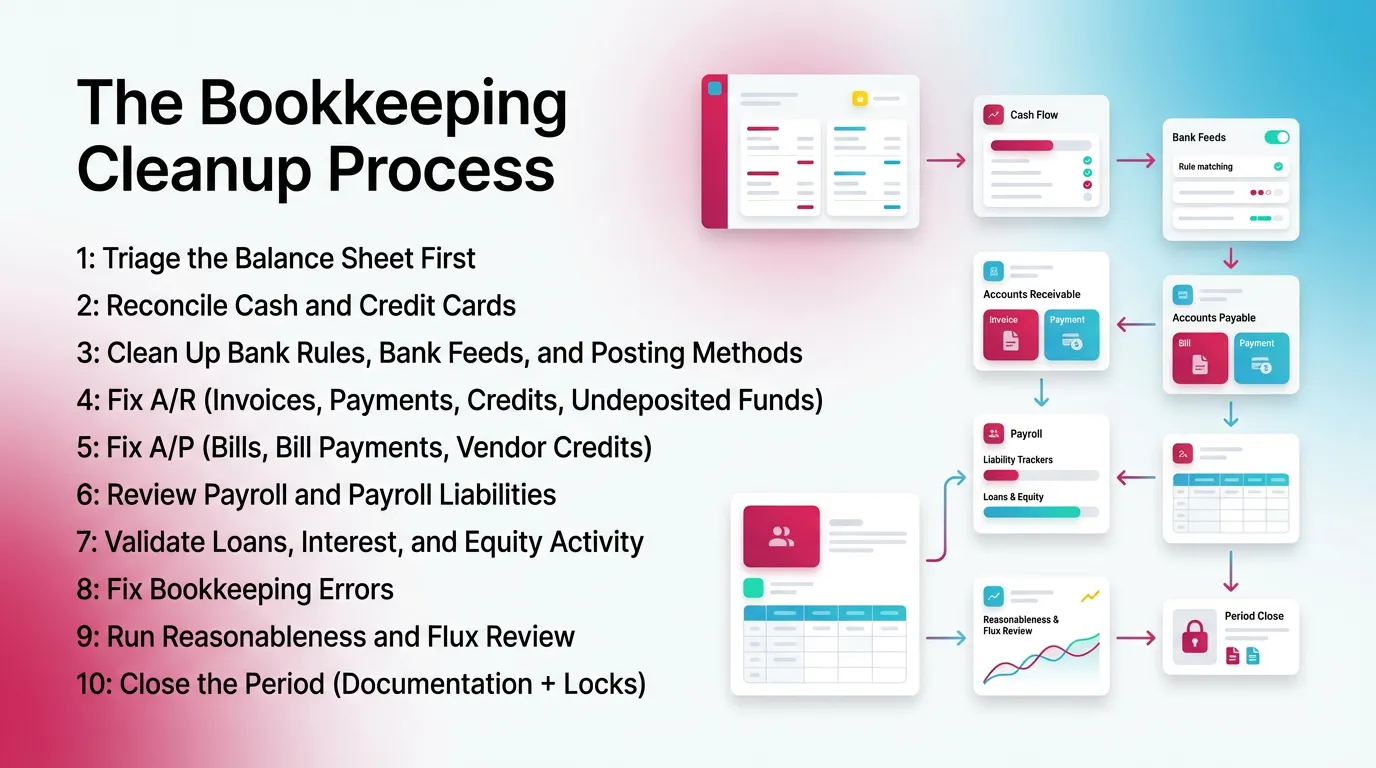
Start from the balance sheet. Reconcile to third-party proof. Then validate income and expenses. This bookkeeping cleanup process avoids “P&L whack-a-mole.”
Goal: restore integrity from the balance sheet “up,” then validate the P&L.
Step 1: Triage the Balance Sheet First (Stop Guessing From the P&L)
List every balance sheet account. Classify it by how you prove it. This tells you what to reconcile and what to schedule.
Tag accounts as:
- Statement-tied: bank, credit cards, loans
- Subledger-tied: A/R, A/P, inventory
- Schedule-tied: fixed assets, debt, payroll liabilities, taxes payable
- Review-only: equity and retained earnings (still explainable)
Output:
- A tie-out plan by account
- A list of “must reconcile” accounts
- A list of “out of scope” accounts with approval
Step 2: Reconcile Cash and Credit Cards (Per Statement, Per Month)
Reconcile oldest to newest. Do not skip months. One bad month breaks everything after it.
Method:
- Start with the oldest open month.
- Reconcile to the exact statement ending balance.
- Investigate every difference. Do not plug.
- Repeat month by month to the present.
Patterns to look for:
- Missing transactions
- Duplicate transactions
- Wrong posting dates
- Transfers coded as income or expense
- Payments recorded to the wrong card or bank
Output:
- A full set of saved reconciliation reports
- A list of unresolved items by account and month
Step 3: Clean Up Bank Rules, Bank Feeds, and Posting Methods
Fix the machine that created the mess. Otherwise you will clean the same books again. This matters for online accounting services for small business teams that rely on bank feeds.
Standardize:
- Choose a posting method per flow. Stay consistent.
- Bills for A/P workflows
- Invoices and payments for A/R workflows
- Bank feed for simple cash expenses
- Remove duplicate or conflicting bank rules
- Check payee mapping and auto-categorization
Practical example:
I often see teams enter a bill, then also accept a bank feed match to expense.
That creates duplicates. The bank rec “works” only if someone forces it.
Step 4: Fix A/R (Invoices, Payments, Credits, Undeposited Funds)
Fix A/R next because it drives revenue integrity and cash application. Tie the A/R aging to the balance sheet A/R before you touch revenue accounts.
Do this:
- Tie A/R aging to balance sheet A/R
- Review unapplied payments and credits
- Apply payments to the correct invoices
- Clear old credits with documentation
Undeposited funds steps:
- Identify batches that should equal bank deposits
- Match deposits by date and amount
- Rebuild batches when needed
- Avoid “deposit to income” shortcuts
If you use processors:
- Record gross sales, fees, refunds, and chargebacks correctly
- Ensure deposits match payout reports, not sales totals
Step 5: Fix A/P (Bills, Bill Payments, Vendor Credits)
Fix A/P to restore vendor truth. Tie A/P aging to the balance sheet A/P. Then repair the open items list.
Common A/P cleanup work:
- Bills entered after payment, creating duplicates
- Payments posted directly to expense instead of the bill
- Vendor credits left unapplied
- Checks recorded twice due to bank feeds
Do this:
- Tie A/P aging to balance sheet A/P
- Match bill payments to the correct bills
- Apply vendor credits with notes and support
Step 6: Review Payroll and Payroll Liabilities (Don’t “Plug” These)
Payroll needs exact tie-outs. Do not plug payroll liabilities. A plug hides a compliance risk.
Tie-outs:
- Tie payroll expense to payroll reports
- Tie liabilities to filings and payment confirmations
- Identify mis-posted payroll journal entries
- Check for duplicate payroll runs
- Confirm payroll accounts map correctly
If you use a provider, use their reports as source of truth.
For example, use the payroll liability report and tax payment history.
Step 7: Validate Loans, Interest, and Equity Activity
Loans and equity drive balance sheet credibility. Fix splits and classifications. Then confirm ending balances.
Loans:
- Tie ending loan balance to lender statement
- Split principal vs interest correctly
- Confirm payment frequency and timing
Equity:
- Classify owner draws and contributions correctly
- Avoid running owner items through expense
- Explain retained earnings movement
Step 8: Fix Bookkeeping Errors (Structured Error Types + Remedies)
Fix bookkeeping errors with the smallest clean correction. Preserve the audit trail. Keep support attached or referenced.
Error categories:
- Classification and coding errors
- Timing errors (wrong period)
- Duplication
- Missing transactions
- Reconciliation “force” errors
Preferred approach:
- Make targeted entries that restore tie-outs
- Add notes for every material change
- Keep a change log with links to support
Avoid:
- Mass reclass with no documentation
- Bulk edits that cross closed periods without approval
Step 9: Run Reasonableness and Flux Review
A flux review catches what tie-outs miss. It also explains results to owners and controllers. Therefore it finishes the story.
Do this:
- Compare month-to-month swings by account
- Investigate top changes and outliers
- Check margins and expense spikes
- Review clearing accounts and unusual balances
A simple method that works:
- Sort P&L by change from prior month
- Review the top 10 increases and decreases
- Write one sentence for each explanation
Step 10: Close the Period
Close the period when you finish. Save proof. Lock the month so it stays stable.
Create a “cleanup packet”:
- Reconciliation reports for all statement-tied accounts
- Tie-out schedules for A/R, A/P, payroll, loans
- List of adjustments, why they happened, and support
- Known open items and next steps
Then:
- Set closing date and permissions in the accounting file
- Store packet in a shared folder with clear naming
- Schedule the next month-end close
Bookkeeping Cleanup Checklist
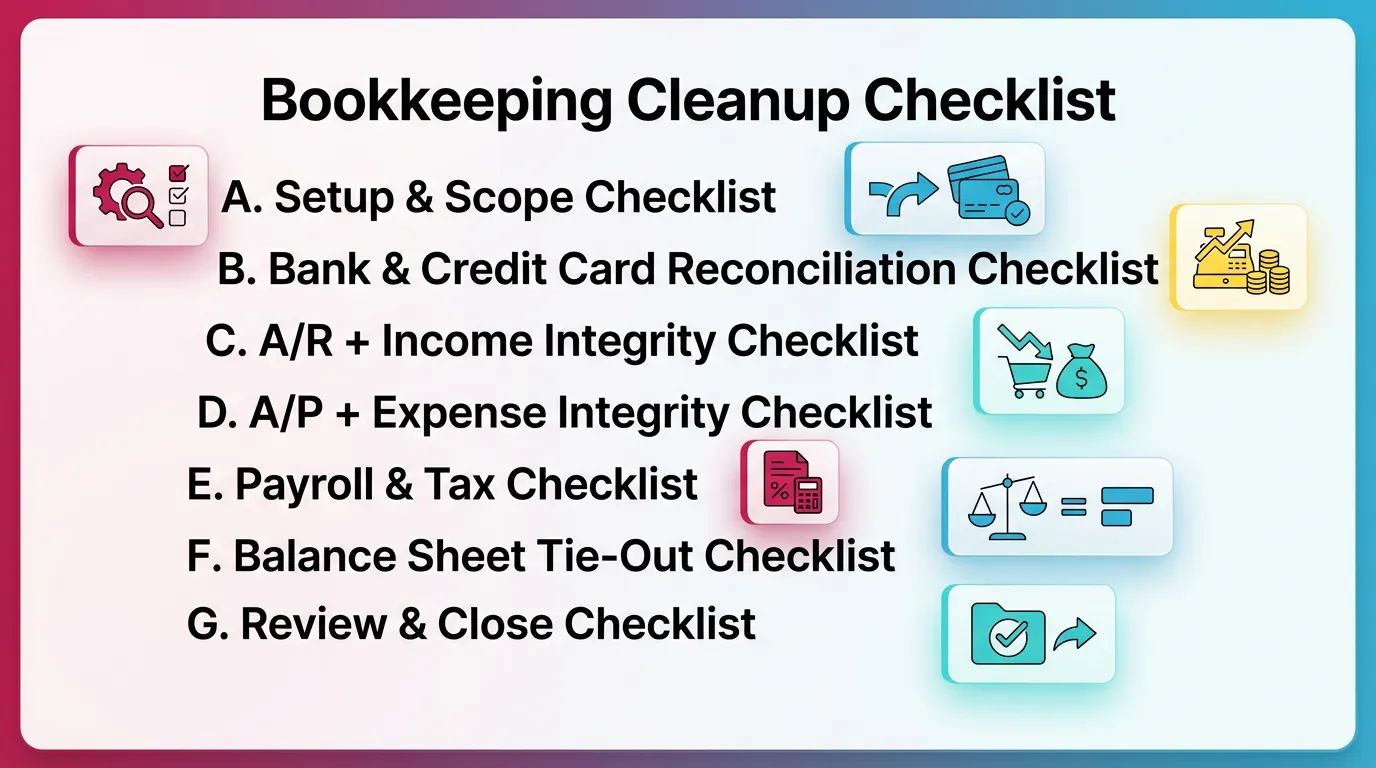
Use this bookkeeping cleanup checklist as a project plan. It also works as a recurring close checklist. Copy it into your SOP tool.
A. Setup & Scope Checklist
- Define cleanup period and reporting basis
- Collect statements (bank, CC, loan, merchant, payroll)
- Export baseline reports (P&L, BS, TB)
- Confirm chart of accounts structure (duplicates, unused accounts)
B. Bank & Credit Card Reconciliation Checklist
- Reconcile every account, every month, oldest to newest
- Resolve duplicates and missing items
- Confirm transfers are coded as transfers (not income or expense)
- Confirm opening balances aren’t overwritten
C. A/R + Income Integrity Checklist
- A/R aging ties to balance sheet A/R
- Customer payments applied to correct invoices
- Undeposited funds cleared to match bank deposits
- Processor fees and chargebacks recorded consistently
D. A/P + Expense Integrity Checklist
- A/P aging ties to balance sheet A/P
- Bill payments matched to bills (no duplicates)
- Vendor credits applied and documented
E. Payroll & Tax Checklist
- Payroll expense matches payroll reports
- Payroll liabilities tie to filings and payments
- Sales tax payable ties to returns (if applicable)
F. Balance Sheet Tie-Out Checklist (Non-Negotiables)
- Loans tie to lender statements
- Fixed assets tie to schedule (or clearly out of scope)
- Clearing and suspense accounts explained or zeroed
- Equity activity categorized and supported
G. Review & Close Checklist
- Flux review performed and outliers explained
- Final P&L, BS, TB saved
- Reconciliation reports saved
- Cleanup notes stored in a shared location
- Period locked or closed (as appropriate)
Common Mistakes During a Bookkeeping Clean Up (And How to Avoid Them)
.webp)
Most cleanup failures come from shortcuts. These shortcuts create fragile books. The file looks fine until the next bank rec.
Avoid these mistakes:
- Cleaning the P&L before reconciling balance sheet accounts
- Forcing reconciliations and adding mystery adjustments
- Fixing symptoms instead of posting methods
- Mixing cash and accrual behavior within the same period
- Posting adjustments without notes, support, or repeatable rules
- Skipping closing discipline so the books re-mess in 30–60 days
If you want one rule:
If it does not tie to a statement, subledger, or schedule, it is not done.
Month-End Bookkeeping Cleanup: How to Prevent Future “Big Cleanups”
Month end bookkeeping cleanup prevents the next big project. Add a small routine each month. You reduce risk and rework.
A Lightweight Monthly Cleanup Routine (10–20% Extra Effort, 80% Less Pain)
Do these every close:
- Reconcile cash and credit cards monthly, on schedule
- Tie A/R and A/P monthly, not quarterly
- Review clearing accounts every close
- Run a simple flux review (top 10 changes by account)
- Document unusual items while context stays fresh
- Close and lock the month when complete
Monthly Close vs Cleanup Work
When to Use Professional Bookkeeping Cleanup Services (And What to Ask)
Use bookkeeping cleanup services when risk is high or time is short. Also use them when you inherit a messy file. The goal stays the same: accurate books with support.
Who Typically Needs Cleanup Services
These teams often need bookkeeping clean up services:
- Owners behind on bookkeeping, with catch-up plus cleanup
- Firms onboarding a new client with inconsistent prior work
- Businesses preparing for tax filing, financing, or a sale
What “Bookkeeping Clean Up Services” Should Include (Scope Checklist)
Quality bookkeeping cleanup services include proof and process. They do not just “make numbers look right.”
Scope checklist:
- Statement-based reconciliations with saved rec reports
- Subledger tie-outs for A/R and A/P when used
- Clear list of adjustments with support
- Stabilized month-end process to keep books clean
Questions to Ask a Cleanup Provider (Quality Filters)
Ask these to filter providers:
- How do you prevent forced reconciliations?
- Will you provide a cleanup packet with recs and tie-outs?
- How do you handle changes to closed periods?
- What is your approach to flux and anomaly review?
If the provider cannot explain their method, expect surprises later.
Bookkeeping Clean Up Fees: How Pricing Is Usually Structured
Bookkeeping clean up fees vary by scope and complexity. Pricing usually follows time and risk. This section supports owners and also bookkeepers pricing projects.
This section supports both search intents: business owners evaluating cost and bookkeepers pricing cleanup projects.
Common Pricing Models
Most bookkeeping clean up services use one of these models:
- Hourly (often with a scoped cap)
- Fixed fee by months or years in scope (tiered by complexity)
- Hybrid: diagnostic plus fixed cleanup plus ongoing close
The hybrid model often works best. You price the unknowns in the diagnostic.
Then you price execution with clearer scope.
What Drives Cleanup Cost (Pricing Variables)
These variables drive bookkeeping clean up fees:
- Number of months in scope
- Transaction volume and number of accounts
- Reconciliation state (clean, forced, missing)
- Complexity: payroll, inventory, multi-entity, loans, sales tax
- Quality of source documents and statement access
How Much to Charge for Bookkeeping Clean Up (Practical Estimation Framework)
Start with a paid diagnostic. Estimate by account and by month. Then apply complexity and documentation time.
A practical framework:
- Diagnostic. Review rec status, A/R, A/P, payroll, loans.
- Estimate hours per month. Include recons and subledgers.
- Apply complexity multiplier. Low, medium, high.
- Add documentation time. Cleanup packet and handoff.
Cleanup Effort Estimator (for outline writers to populate with ranges)
Practical note:
If you quote fixed fee without a diagnostic, you price blind. You either overprice
and lose the job, or underprice and lose margin.
How Xenett Supports a More Repeatable Cleanup-and-Close Standard (Without Relying on Heroics)
Cleanup works best when you execute the same review every month. Xenett helps teams operationalize that standard. It supports execution, visibility, and review.
Xenett does not provide audit services. It also does not act as an audit tool.
It supports accounting workflow and close management.
How Xenett fits into bookkeeping cleanup and close:
- Close task and checklist management: Turn the bookkeeping cleanup checklist
into recurring close tasks by period. You assign owners and due dates. - Review and approval workflows: Route account reviews and findings to the
right person. You avoid silent fixes and inconsistent standards. - Visibility into close status and bottlenecks: See which accounts block
close. For example, unreconciled cash or undeposited funds.
Key operational idea:
Systems enforce review standards. People apply judgment to resolve findings.
That keeps cleanup AI-assisted, not AI-led.
FAQ: Bookkeeping Clean Up
What is clean up in bookkeeping?
Bookkeeping cleanup is the process of correcting and reconciling existing accounting records so account balances and financial statements match supporting documents like statements, subledgers, and schedules.
How do I clean up messy bookkeeping in QuickBooks Online?
Start with statement-based bank and credit card reconciliations from oldest to newest. Then fix A/R, A/P, undeposited funds, payroll liabilities, and loans. Finish with a flux review and lock the period.
What’s the difference between bookkeeping catch up and cleanup?
Catch-up records missing transactions for past periods. Cleanup fixes errors, duplicates, and reconciliation issues in periods that already exist but are not accurate.
What are the most common bookkeeping errors to fix during cleanup?
Unreconciled accounts, duplicates, misapplied A/R and A/P, undeposited funds buildup, transfers coded as expenses, and payroll liabilities that do not tie to filings.
How long does a bookkeeping cleanup take?
Time depends on months in scope, volume, and rec quality. Light cleanups may take days. Heavy rebuilds across many months can take weeks.
How much do bookkeeping clean up services cost?
Costs depend on scope, volume, and complexity like payroll, sales tax, and loans. Providers usually price hourly, fixed-fee per period, or a diagnostic plus fixed cleanup.
How much should I charge for bookkeeping clean up as a bookkeeper?
Base pricing on a diagnostic. Estimate hours to reconcile accounts and repair subledgers and tie-outs. Apply a complexity multiplier. Include documentation and handoff time.
What should I deliver at the end of a cleanup project?
Deliver reconciliation reports, tie-out schedules for key accounts, an adjustments list with support, and a documented month-end process so the books stay stable.
Conclusion
Bookkeeping clean up works when you stop guessing and start tying everything out. Reconcile cash first. Repair A/R and A/P next. Then validate payroll, loans, and equity. Finish with flux review and a locked close.
If you need to clean up messy bookkeeping, start with the checklist above. If the scope feels large, run a paid diagnostic and define the cleanup packet you will deliver. Then decide if you will handle it in-house or use bookkeeping cleanup services.
Next step: copy the bookkeeping cleanup checklist into your close workflow. Assign owners, due dates, and review steps. Then run it monthly as month end bookkeeping cleanup, not once a year as a crisis.