.svg)

Automated Account Reconciliation Software: Best Tools Compared (2026)
.jpg)
Ask questions, get summaries, or uncover key takeaways from this article.
.webp)
Blog Summary / Key Takeaways
- Automated account reconciliation software eliminates the manual matching of GL balances to supporting documentation. The system compares balances, flags differences, and documents exceptions in minutes instead of hours.
- There are six primary categories of reconciliation tools: specialized reconciliation platforms (Numeric, Uncat), enterprise solutions (FloQast, BlackLine), integrated practice management platforms (Xenett), and point-solution tools (Keeper).
- The right tool depends on your firm size, account complexity, and whether you need reconciliation as a standalone tool or integrated with practice management and close automation.
- For firms managing 30+ clients: reconciliation automation is mandatory. The ROI measured in hours saved, errors caught, and close acceleration pays for the tool in the first month.
- This guide compares six leading platforms. By the end, you will know which tool aligns with your firm's needs.
What is Automated Account Reconciliation?
Automated account reconciliation is the process of using software to systematically match general ledger account balances to supporting documentation (such as AR aging, AP aging, fixed asset schedules, or clearing schedules) automatically, flag exceptions for review, and document the reconciliation without manual comparison or data entry.
Traditional manual reconciliation requires a bookkeeper to spend 30-90 minutes per account comparing GL balance to a supporting schedule line-by-line, identifying differences, and investigating variances.
Automated reconciliation software completes this process in 2-10 minutes. The system:
- Pulls the GL balance automatically from your accounting system.
- Pulls the supporting documentation automatically from your sub-ledger, vendor portal, or customer aging.
- Matches transactions by date, amount, and description.
- Flags unmatched items for human review.
- Documents the reconciliation with all supporting detail.
The result: Reconciliations that take hours are completed in minutes. Errors that would be missed are caught automatically. Close cycles are compressed by 2-3 days.
Why Account Reconciliation Automation Matters
The Problem: Reconciliation is Slow
An accounting firm with 40 clients and an average of 8 balance sheet accounts per client (AR, AP, fixed assets, accruals, clearing accounts, etc.) needs to complete 320 account reconciliations per month.
At 45 minutes per reconciliation (average), that is 240 hours of reconciliation work per month. For a firm with 10 bookkeepers, reconciliation consumes 24 hours of labor per person per month. Over a year, that is a full month of each person's time spent on reconciliation alone.
Manual reconciliation is also a bottleneck to close. If reconciliation is not done, review cannot start. If review cannot start, close is delayed.
The Solution: Automate the Routine Work
Automated reconciliation software reduces the 45-minute manual process to 5 minutes of exception handling. Instead of matching transactions manually, the team reviews flagged exceptions and documents decisions.
ROI Calculation:
- 320 reconciliations per month.
- Manual time: 45 minutes per reconciliation = 240 hours/month.
- Automated time: 5 minutes per reconciliation + 10 minutes review = 80 hours/month.
- Hours saved: 160 hours/month = 1,920 hours/year.
- At $50/hour (fully loaded): $96,000 in annual labor savings.
- Tool cost: $10,000-30,000 per year.
- Net annual savings: $66,000-86,000.
Add in errors caught before close and days of close cycle saved, and the ROI is compelling.
Types of Reconciliation Tools
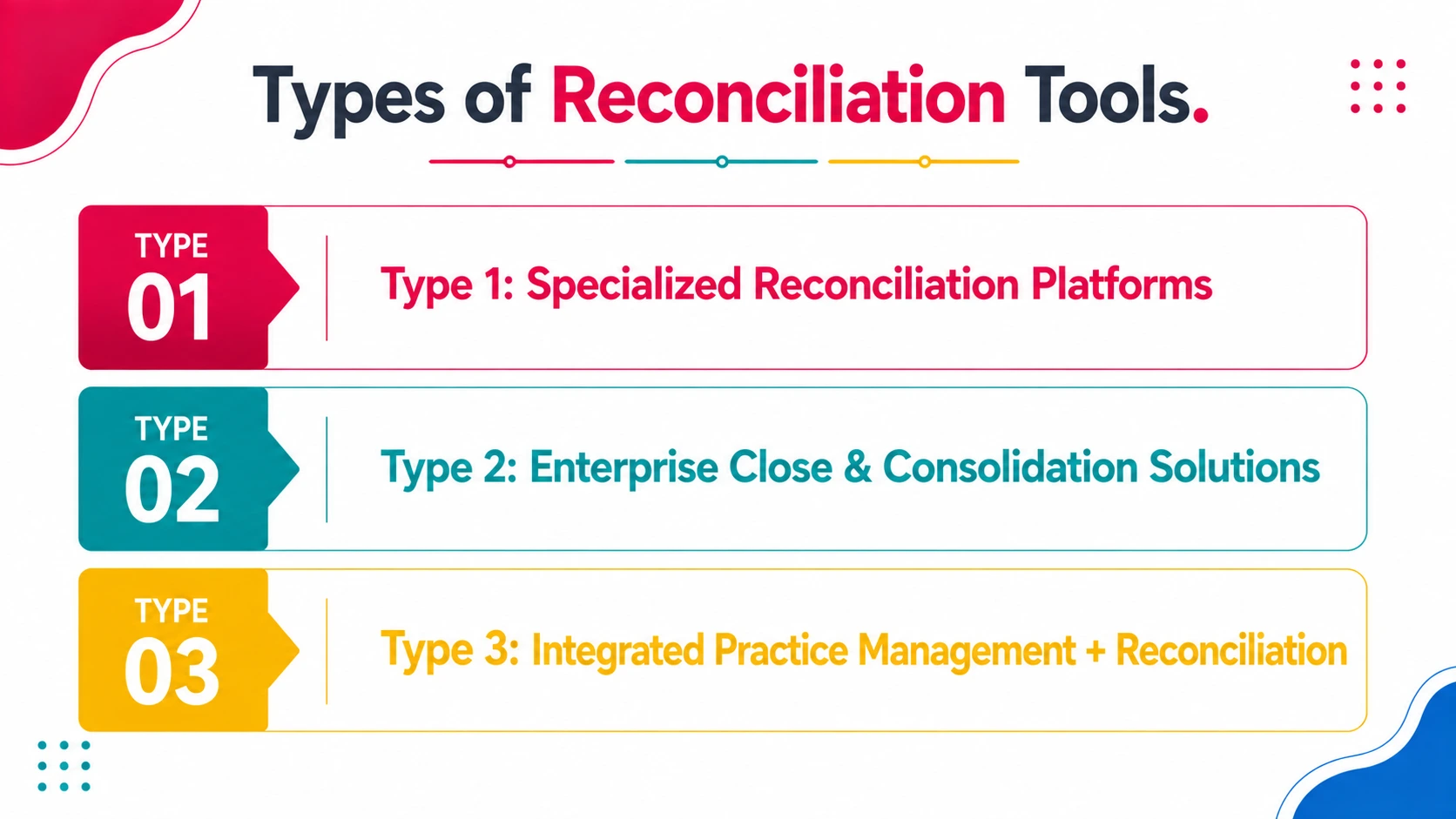
Type 1: Specialized Reconciliation Platforms
Examples: Numeric, Uncat, Keeper
Focus: Reconciliation only. These tools are purpose-built for the reconciliation workflow.
Strengths:
- Laser focus on reconciliation (no bloat from unrelated features).
- Deep expertise in matching and exception handling.
- Lower cost (often per-account or per-client pricing).
- Quick implementation (4-8 weeks).
Weaknesses:
- Standalone tools require integration with your practice management platform.
- Do not include workflow, task management, or close process tracking.
- No client portal or communication features.
Best for: Firms that already have practice management tools (like Karbon or Canopy) and need a dedicated reconciliation specialist.
Type 2: Enterprise Close & Consolidation Solutions
Examples: FloQast, BlackLine
Focus: Reconciliation + close + consolidation + financial reporting.
Strengths:
- Comprehensive close platform (reconciliation is one module).
- Multi-entity consolidation support.
- Workflow and approval management.
- Strong audit trail and regulatory compliance.
Weaknesses:
- Complex implementation (12-24 weeks).
- Significant costs ($50,000-200,000+ annually depending on firm size).
- May include features you do not need.
- Steep learning curve.
Best for: Firms with 100+ employees, complex consolidation requirements, or highly regulated environments.
Type 3: Integrated Practice Management + Reconciliation
Examples: Xenett
Focus: Practice management, close workflow, and reconciliation in one platform.
Strengths:
- Reconciliation is integrated into the close dashboard (no separate system to learn).
- Practice management, task tracking, and reconciliation in one platform.
- Faster close (2-3 day acceleration typical).
- Lower cost than enterprise solutions ($5,000-20,000 annually).
- Purpose-built for mid-market accounting firms (20-50+ clients).
Weaknesses:
- Not a consolidation tool (for multi-entity clients, you may need a separate tool).
- Newer to the market than FloQast or BlackLine (but 1,000+ firms are using).
- May not integrate with all third-party tools.
Best for: Accounting firms managing 20-100+ clients who want practice management and reconciliation integrated.
Detailed Tool Comparison Table
Best For: By Firm Size
Firms with 5-15 Clients
Recommendation: Uncat or Keeper
At this scale, reconciliation is manageable but time-consuming. A low-cost, lightweight tool is appropriate.
Uncat is excellent for catching GL anomalies (uncategorized entries, mispostings). Keeper is simple and inexpensive.
Cost: $2,000-8,000 per year.
Firms with 15-40 Clients
Recommendation: Numeric or Xenett
At this scale, reconciliation becomes a significant bottleneck. You need a purpose-built tool.
Numeric is a specialist reconciliation tool with strong AR/AP functionality. Xenett integrates reconciliation with practice management and close workflow.
Cost: $5,000-20,000 per year.
Firms with 40-100+ Clients
Recommendation: Xenett or FloQast
At this scale, reconciliation must be automated and integrated into the close process. Standalone tools are insufficient.
Xenett is built for this scale with an integrated close dashboard and task management. FloQast is enterprise-grade with consolidation and regulatory compliance features.
Cost: $15,000-50,000+ per year.
Enterprise Firms (100+ Employees, Complex Structures)
Recommendation: FloQast or BlackLine
These are built for large, regulated firms with consolidation requirements. Reconciliation is one module in a comprehensive close platform.
Cost: $50,000-200,000+ per year.
Implementation & Learning Curve: By Tool
Takeaway: Specialized tools (Numeric, Uncat, Keeper) implement in weeks. Enterprise platforms (FloQast, BlackLine) implement in months. Xenett splits the difference (weeks, not months).
Pricing Comparison
Best value for mid-market: Xenett and Numeric offer the best price-to-feature ratio for firms with 20-50 clients.
How Xenett Compares
Xenett is built specifically for accounting firms that want to consolidate practice management, close workflow, and reconciliation into a single platform.
Xenett's Advantages:
Integrated Close Dashboard - Reconciliation status is visible in real-time alongside other close tasks. Which accounts are complete, which have exceptions, which are overdue all in one view.
Practice Management + Reconciliation - Task management, team assignment, review workflows, and client communication are integrated. No switching between systems.
AI-Powered Matching - Xenett's AI engine matches GL entries to supporting documentation with 99%+ accuracy. Exceptions are flagged for review, not for manual matching.
Flexible Reconciliation Types - AR, AP, fixed assets, accruals, clearing accounts, intercompany, custom schedules, Xenett handles all account types in a single workflow.
Fast Implementation - 2-3 weeks to go-live, compared to 12-24 weeks for FloQast or BlackLine.
Lower Cost - $5,000-20,000 per year, depending on firm size and number of clients. Significantly less than enterprise platforms.
Real-time Notifications - Team members are notified when their reconciliation is ready for review. Overdue items surface automatically. Nothing falls through the cracks.
Audit Ready - Every reconciliation is documented with all supporting detail. Audit trail is automatic.
Xenett's Trade-offs:
Xenett is not a consolidation tool. Firms with complex multi-entity consolidation needs may still require FloQast or BlackLine for that specific module.
Xenett is built for firms with 20-100+ clients. Very small firms (1-5 clients) may not need its scope.
Xenett is newer to the market than FloQast or BlackLine, but is used by 1,000+ accounting and bookkeeping firms.
The Bottom Line on Xenett:
If you are a mid-market accounting firm (20-100+ clients) looking to consolidate practice management and reconciliation, Xenett offers the best combination of features, implementation speed, cost, and ease of use.
Also - Learn More About Xenett's Reconciliation Features
Real Scenario: A Firm Switching from Four Tools to One
A 30-person accounting firm was managing 65 clients using four separate tools:
- Canopy (practice management)
- Numeric (reconciliation)
- Xero (accounting software)
- Slack (team communication)
The team used Canopy for task tracking and workflow, then opened Numeric to complete reconciliations, then switched back to Canopy to mark reconciliation complete, then communicated status via Slack.
Context switching cost the firm 4-6 hours per week. Mistakes happened because reconciliation status in Numeric did not automatically update in Canopy. Clients saw delayed close dates because close dependencies were split across systems.
The Problem: Lack of system integration meant:
- Manual status updates across systems (error-prone).
- Team confusion about which system held the current status.
- Review workflow was inconsistent (sometimes email, sometimes Canopy, sometimes Slack).
- Audit trail was fragmented across four systems.
The Solution: Migrate to Xenett (integrated practice management + reconciliation).
Within 3 weeks:
- All clients migrated to Xenett.
- Close process redesigned as a single workflow in the Close Dashboard.
- Reconciliation status updated in real-time (no manual updates).
- Review workflow formalized with documented approvals.
Results (first month):
- Close cycle reduced from 8 business days to 5 business days.
- Context switching eliminated.
- Errors in reconciliation status dropped to zero.
- Audit trail became automatic.
- Team morale increased (less tool chaos).
Cost impact:
- Xenett cost: $12,000/year.
- Numeric cost eliminated: $18,000/year.
- Hours saved per year: 200+ hours (from context switching elimination).
- Net savings: $12,000-15,000 per year (plus faster close).
FAQs
What is the biggest difference between these tools?
Specialized reconciliation tools (Numeric, Uncat) are laser-focused on matching and exception handling. They excel at reconciliation but do not include practice management or close workflow.
Integrated platforms (Xenett) combine reconciliation with practice management, task tracking, and close workflow in one system.
Enterprise platforms (FloQast, BlackLine) add consolidation and regulatory compliance.
Choose based on what you need: reconciliation only (specialists), or reconciliation + close workflow (integrated), or consolidation (enterprise).
How long does implementation take?
Specialized tools: 2-6 weeks. Integrated platforms: 2-3 weeks. Enterprise platforms: 12-24 weeks.
The difference is significant. If implementation speed matters, avoid enterprise platforms.
What is the typical ROI for reconciliation automation?
For a firm with 40+ clients:
- Labor saved: 160-200 hours/month = $96,000-120,000/year.
- Tool cost: $10,000-20,000/year.
- Close acceleration: 2-3 days saved = client value + team morale.
- Errors prevented: Hours of rework eliminated.
Net ROI: 300-400% in year one. Payoff period: 1-3 months.
Can I use multiple tools together?
Yes, but integration between tools is often manual (API connections or data exports). The more tools you use, the more data integration work you need.
If you want a seamless workflow, an integrated platform (like Xenett) is preferable to stitching multiple tools together.
What if I have unique account types or complex reconciliation needs?
All six tools support custom account types and reconciliation rules. Configuration is more complex, and setup time increases, but it is possible.
Discuss your specific needs with the vendor before committing. Some tools are more flexible than others.
Should I choose a cheap tool or invest in an enterprise platform?
For most accounting firms (15-100 clients), a mid-market tool (Numeric or Xenett) is the right choice. You get 95% of the functionality at 20% of the enterprise cost and 1/5 the implementation time.
Enterprise platforms are justified if you have regulatory requirements, consolidation complexity, or 100+ employees. Otherwise, you are paying for features you do not use.
How do I migrate from my current system?
Most tools provide migration support. Historical reconciliations are moved to the new system (usually as read-only records). New reconciliations start in the new system.
Migration typically takes 1-2 weeks and does not disrupt the current month's close.
Conclusion
Automated account reconciliation is non-negotiable for firms managing 30+ clients. Manual reconciliation at that scale is a bottleneck and a liability.
The right tool depends on your firm size, budget, and whether you want reconciliation integrated with practice management or as a standalone specialist tool.
For most mid-market firms, Xenett or Numeric offers the best combination of features, cost, and implementation speed.
For firms with complex consolidation needs, FloQast or BlackLine is the right choice, despite longer implementation and higher cost.
The payoff in hours saved, errors prevented, and close acceleration is substantial. Most firms recoup the investment within 3 months.
Ready to evaluate reconciliation software for your firm?
See how automated reconciliation accelerates your close.
Book a 15-Minute Demo | Start Free Trial - 14 Days, No Credit Card
Specialized reconciliation tools (Numeric, Uncat) are laser-focused on matching and exception handling. They excel at reconciliation but do not include practice management or close workflow. Integrated platforms (Xenett) combine reconciliation with practice management, task tracking, and close workflow in one system. Enterprise platforms (FloQast, BlackLine) add consolidation and regulatory compliance. Choose based on what you need: reconciliation only (specialists), or reconciliation + close workflow (integrated), or consolidation (enterprise).
Specialized tools: 2-6 weeks. Integrated platforms: 2-3 weeks. Enterprise platforms: 12-24 weeks. The difference is significant. If implementation speed matters, avoid enterprise platforms.
For a firm with 40+ clients: Labor saved: 160-200 hours/month = $96,000-120,000/year. Tool cost: $10,000-20,000/year. Close acceleration: 2-3 days saved = client value + team morale. Errors prevented: Hours of rework eliminated. Net ROI: 300-400% in year one. Payoff period: 1-3 months.
Yes, but integration between tools is often manual (API connections or data exports). The more tools you use, the more data integration work you need. If you want a seamless workflow, an integrated platform (like Xenett) is preferable to stitching multiple tools together.
All six tools support custom account types and reconciliation rules. Configuration is more complex, and setup time increases, but it is possible. Discuss your specific needs with the vendor before committing. Some tools are more flexible than others.
For most accounting firms (15-100 clients), a mid-market tool (Numeric or Xenett) is the right choice. You get 95% of the functionality at 20% of the enterprise cost and 1/5 the implementation time. Enterprise platforms are justified if you have regulatory requirements, consolidation complexity, or 100+ employees. Otherwise, you are paying for features you do not use.


%20(1).webp)