.svg)

Bookkeeping Cleanup: What It Is, What It Costs, and How to Do It Right
.jpg)
Ask questions, get summaries, or uncover key takeaways from this article.

Blog Summary / Key Takeaways
• Bookkeeping cleanup is the process of correcting and reconciling books that have fallen behind, been done incorrectly, or never been set up properly
• Most cleanup projects take two to eight weeks depending on how many months are behind and how messy the books are
• Common causes: business owner doing their own books without training, bookkeeper who left, software that was never set up correctly
• The cleanup process follows a consistent order: chart of accounts first, then reconciliations, then journal entries, then financial statement review
• Pricing typically ranges from $500 to $5,000+ depending on the scope most firms charge a flat project fee
• Xenett supports cleanup workflows with status tracking, document requests, and structured review across multiple cleanup clients
Most accounting firms have a version of this call: a business owner who has not looked at their books in eight months, or who just parted ways with a bookkeeper, or who has been doing it themselves and is not confident the numbers are right.
They want to know: can this be fixed, how long will it take, and what will it cost?
This guide answers all three and walks through exactly how a bookkeeping cleanup is done from start to finish.
What Is Bookkeeping Cleanup?
Bookkeeping cleanup is the process of reviewing, correcting, and reconciling a company's financial records that are inaccurate, incomplete, or behind.
It is not the same as ongoing bookkeeping. Ongoing bookkeeping is keeping current records accurate going forward. Cleanup is fixing what has already gone wrong transactions that were miscoded, periods that were never reconciled, bank accounts that have not been tied out in months, and accounts that do not reflect reality.
When cleanup is complete, the books are reconciled through the most recent period, financial statements are accurate, and the client is ready for either ongoing bookkeeping service or tax preparation.
Why Do Books Get Messy?
Cleanup work is consistent enough that the root causes are predictable. Understanding them helps set expectations with the client and scope the project accurately.
Signs a Client Needs Bookkeeping Cleanup
• Bank accounts have not been reconciled in more than two months
• The balance sheet has negative balances in unusual places (owner's equity is deeply negative, loan balances are wrong)
• The P&L shows large amounts in Uncategorized Income or Uncategorized Expense
• Accounts Receivable or Accounts Payable are significantly different from what the client believes they are
• The client cannot explain why their books show one profit number but their bank account reflects something very different
• QuickBooks or Xero shows a reconciliation discrepancy that has been carried forward for months
The Bookkeeping Cleanup Process: Step by Step
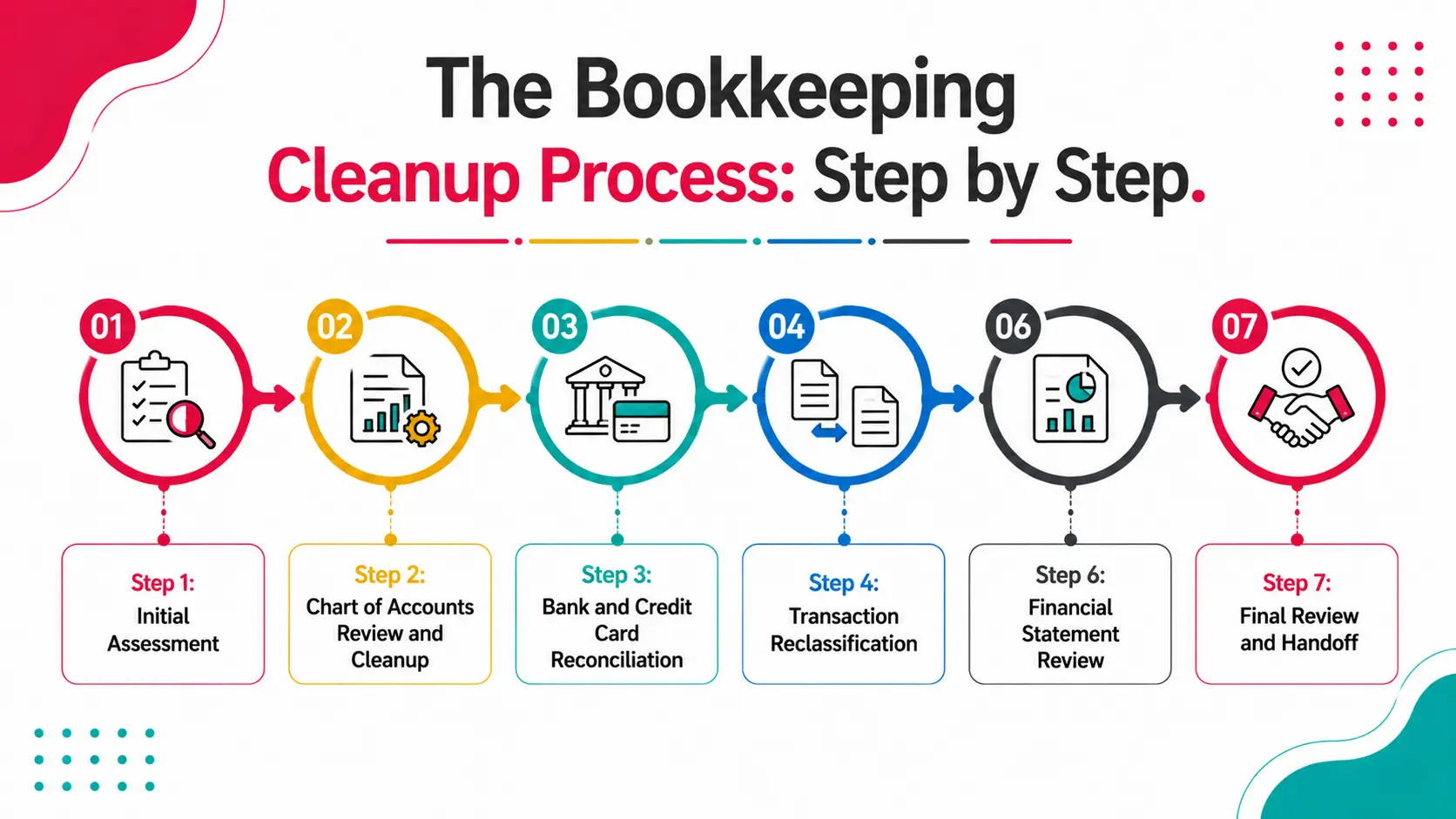
Step 1: Initial Assessment
Before quoting a price or starting work, assess the scope. Pull the trial balance, look at the last reconciled date for each account, review the chart of accounts for obvious errors, and identify how many months need cleanup.
Key questions to answer at this stage:
• How many months are behind or need to be corrected?
• How many bank and credit card accounts need reconciliation?
• Are there payroll, loans, or inventory accounts that need special attention?
• What year-end deadlines exist?
Step 2: Chart of Accounts Review and Cleanup
Start with the chart of accounts, not the transactions. If accounts are set up incorrectly, every transaction coded to them is wrong. Fix the foundation before cleaning up the entries.
• Remove duplicate accounts
• Merge accounts that should be combined (e.g., two different bank fee accounts)
• Rename accounts to be descriptive and consistent
• Move accounts to the correct account type (expense vs. asset, etc.)
• Add any missing accounts that will be needed
Step 3: Bank and Credit Card Reconciliation
Work chronologically from the last correctly reconciled period forward. Do not skip months. Every month must be reconciled in order.
For each account and each period:
• Pull the bank or credit card statement
• Reconcile the account in QBO or Xero
• Investigate and resolve all discrepancies
• Post any missing transactions as journal entries
• Document all reconciling items
This is usually the most time-consuming step. A single account behind by eight months can take several hours. Multiple accounts across multiple months is a significant project.
Step 4: Transaction Reclassification
After reconciliation, review transactions for miscoding and reclassify as needed.
• Move transactions from Uncategorized Expense or Uncategorized Income to the correct accounts
• Reclassify personal expenses that were coded to business accounts
• Correct transactions that went to the wrong account type (e.g., loan repayments coded as expenses)
• Split transactions that were coded as a single amount but should be divided
Step 5: Journal Entries and Adjustments
Once the underlying transactions are clean, post any required adjusting journal entries:
• Depreciation that was not recorded
• Loan interest that needs to be split from principal
• Prepaid expenses that were not amortized
• Accruals for unpaid bills or unearned revenue
• Owner contribution and distribution entries
Step 6: Financial Statement Review
With clean transactions and journal entries in place, review the financial statements.
• P&L: does revenue look reasonable? Are expenses categorized correctly? Are there any anomalous spikes?
• Balance sheet: does every balance have a logical explanation? Are there any negative balances that should not be?
• Cash reconciliation: does the ending cash balance match the bank statements?
Flag anything that needs client clarification. Document the cleanup with a summary of what was changed and why.
Step 7: Final Review and Handoff
Review the completed cleanup before delivering to the client. A second set of eyes a manager or partner on a cleanup project catches errors that the preparer missed.
Deliver a cleanup summary to the client: what was found, what was corrected, and what the current state of the books is. This sets the foundation for ongoing bookkeeping or tax preparation.
Bookkeeping Cleanup Pricing: What to Charge
Most firms charge a flat project fee for cleanup rather than hourly it is more predictable for the client and easier to manage for the firm.
Always scope before quoting. A client who says they are 'a little behind' may have eight accounts not reconciled for 14 months. Pull the trial balance before giving a number.
Real Scenario: A Year-End Cleanup That Became a 6-Month Project
A restaurant owner came to a bookkeeping firm in October needing their books cleaned up before their accountant prepared the tax return. They said they were 'about three months behind.'
When the firm pulled the books, they found: the last bank reconciliation was in February, eight months behind, not three. Three bank accounts, a credit card, and a loan account were all unreconciled. The chart of accounts had 14 duplicate accounts. The owner had been coding payroll taxes to wages.
What the client thought would take two weeks took six, and cost $4,200 instead of the $800 they expected.
The firm now requires a trial balance and reconciliation history review before quoting any cleanup project. It takes 20 minutes and has saved them from underpricing every large cleanup since.
How Xenett Can Help
Accounting firms running multiple cleanup projects simultaneously need a way to track status across all of them, which months are reconciled, what is in review, what is waiting on client documents.
Xenett handles exactly that.
• Close Dashboard: track cleanup progress per client, which accounts are reconciled, which have open items, which are in review
• Document request workflows: automatically request bank statements, receipts, and prior records from clients through the portal
• Recurring task templates: build a cleanup workflow template and apply it to every new cleanup engagement
• Structured review: cleanup workpapers move from preparer to reviewer to partner with comments tied to the work
• Status visibility: partners see the cleanup status for every client without asking the bookkeeper
1,000+ accounting firms use Xenett to manage complex client engagements including cleanup projects. Book a 15-minute demo at xenett.com/demo.
FAQs
What is bookkeeping cleanup?
Bookkeeping cleanup is the process of reviewing, correcting, and reconciling financial records that are inaccurate, incomplete, or behind. It involves reconciling bank accounts, reclassifying transactions, posting missing journal entries, and producing accurate financial statements from the corrected data.
How long does bookkeeping cleanup take?
Scope depends heavily on how far behind the books are and how many accounts need attention. Light cleanup (1 to 3 months, 1 to 2 accounts) typically takes one to two weeks. Full-year cleanup across multiple accounts can take four to eight weeks.
How much does bookkeeping cleanup cost?
Most firms charge a flat project fee ranging from $500 for minor cleanup to $5,000 or more for full-year multi-account projects. Always scope the project by pulling the trial balance and reviewing the last reconciled date before quoting.
Can I do bookkeeping cleanup myself?
If you have accounting knowledge and are comfortable with your software, yes. The process is straightforward reconcile in chronological order, reclassify miscoded transactions, post adjusting entries, review the financial statements. The difficulty scales with how messy the books are and how many months are behind.
What does a bookkeeper look for in a cleanup?
The key checkpoints are: last reconciled date for each account, unexplained balance sheet items (negative balances, large uncategorized buckets), chart of accounts for duplicates and incorrect account types, and any reconciliation discrepancies that have been carried forward.
What happens if I never reconcile my books?
Errors compound month over month. By year end, the cleanup is significantly more expensive than if it had been caught monthly. Tax preparation takes longer, returns are more likely to contain errors, and any audit or bank loan application will expose the unreconciled state of the books.
Should I use a bookkeeper or CPA for cleanup?
For most cleanup projects, an experienced bookkeeper is sufficient. A CPA adds value when the cleanup involves complex tax implications, multi-entity structures, or when the books will be used immediately for a tax return or audit. For straightforward catch-up reconciliation, a qualified bookkeeper is the right choice.
Conclusion
Bookkeeping cleanup is not glamorous work. It is also not optional for clients whose books are wrong.
Done right in the correct order, with documentation, and with a thorough review before delivery cleanup transforms unusable records into reliable financial data. That data supports tax preparation, bank loans, business decisions, and the ongoing bookkeeping relationship.
The firms that do this well have a structured process, clear pricing, and a way to manage multiple cleanup projects without losing track of where things stand.
See how Xenett supports bookkeeping cleanup and ongoing client management: xenett.com/demo
Bookkeeping cleanup is the process of reviewing, correcting, and reconciling financial records that are inaccurate, incomplete, or behind. It involves reconciling bank accounts, reclassifying transactions, posting missing journal entries, and producing accurate financial statements from the corrected data.
Scope depends heavily on how far behind the books are and how many accounts need attention. Light cleanup (1 to 3 months, 1 to 2 accounts) typically takes one to two weeks. Full-year cleanup across multiple accounts can take four to eight weeks.
Most firms charge a flat project fee ranging from $500 for minor cleanup to $5,000 or more for full-year multi-account projects. Always scope the project by pulling the trial balance and reviewing the last reconciled date before quoting.
If you have accounting knowledge and are comfortable with your software, yes. The process is straightforward reconcile in chronological order, reclassify miscoded transactions, post adjusting entries, review the financial statements. The difficulty scales with how messy the books are and how many months are behind
The key checkpoints are: last reconciled date for each account, unexplained balance sheet items (negative balances, large uncategorized buckets), chart of accounts for duplicates and incorrect account types, and any reconciliation discrepancies that have been carried forward.
Errors compound month over month. By year end, the cleanup is significantly more expensive than if it had been caught monthly. Tax preparation takes longer, returns are more likely to contain errors, and any audit or bank loan application will expose the unreconciled state of the books.