.svg)

Digital Marketing for Accountants: What Works in 2026
.jpg)
Ask questions, get summaries, or uncover key takeaways from this article.
Blog Summary / Key Takeaways
- Accounting is a trust-based purchase with long sales cycles (60–120 days) channels optimized for short cycles consistently underperform
- Highest-ROI channels: SEO/content (3–6 month timeline, compounds), Google Business Profile (1–3 months, most underused), email marketing (immediate on existing list)
- LinkedIn works as reputation infrastructure and referral partner channel not as a direct lead generation tool for most firms
- YouTube/video has the least competition among accounting firms right now first-mover advantage is real and achievable
- What doesn't work: ads without a lead funnel, Instagram/TikTok for most firms, generic blog content without keyword research
- A solo Nashville CPA built 60% of new business through SEO-first content over 12 months no ads, no cold outreach
A firm owner I spoke to last year was spending $1,500 a month on Google Ads.
In six months, they had received three calls. Two were from competing accountants. One was from someone looking for a tax preparer in a different state.
The problem wasn't Google Ads. The problem was running ads to a website with no clear service page, no trust signals, and no reason for a prospect to do anything other than leave.
Marketing for accounting firms fails in predictable ways. This post is about identifying them and about what actually works for firms that want a steady pipeline of good-fit clients without burning budget on channels that don't convert.
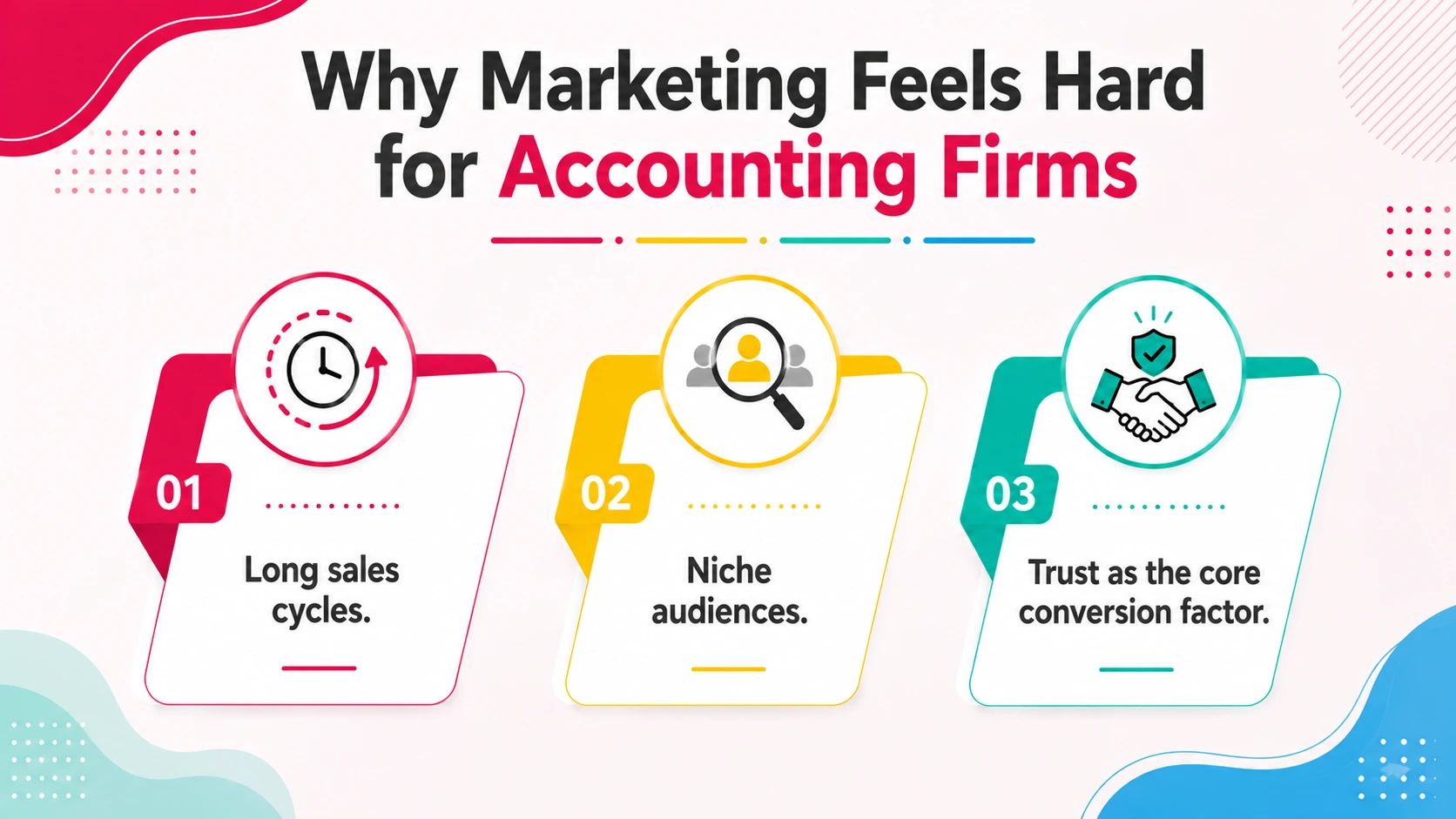
Why Marketing Feels Hard for Accounting Firms
Accounting is a trust-based purchase. Clients don't switch accountants on impulse. They research, ask for referrals, read reviews, and often wait until a specific trigger a bad experience with their current firm, a business change, a referral from someone they trust.
That makes marketing harder than it is for commodity services. You can't just put an offer in front of someone and expect a conversion. The sales cycle is long, the decision is personal, and the buyer is skeptical.
Three specific factors make traditional marketing approaches underperform for accounting firms.
Long sales cycles. Most clients take 60–120 days from first contact to engagement. Channels optimized for short cycles paid social, display ads don't align well with that timeline.
Niche audiences. "Small business owner who needs a bookkeeper" is a valuable prospect. But they look like everyone else online. Broad targeting wastes spend. Narrow targeting requires knowing exactly who you're after.
Trust as the core conversion factor. No accounting firm wins on price or speed. Clients hire firms they trust. Marketing channels that build trust over time outperform those that ask for a commitment on first contact.
Understanding this changes which channels you invest in.
The Marketing Channels That Actually Work in 2026
SEO and Content Marketing
SEO is the highest-ROI marketing channel for most accounting firms and the most underused.
When a business owner searches "CPA firm for e-commerce businesses in Denver" or "how to set up payroll for S-Corp," they have a specific need and they're looking for someone who can solve it. A well-optimized website with content that answers those questions captures that intent.
The shelf life of good SEO content is 2–3 years. A blog post or service page that ranks today will continue generating traffic and leads without ongoing spend. No paid channel delivers that.
What works specifically:
- Niche service pages. A page for "bookkeeping for restaurants" or "CPA for real estate investors" ranks faster than a generic "services" page and attracts better-fit clients.
- Long-form educational content. Posts that answer specific questions how to choose an accountant, what to look for in a bookkeeper, when to switch to accrual accounting build authority and capture search traffic.
- Local SEO. For firms serving a geographic market, optimized location pages and a strong Google Business Profile are highly effective. Most firms ignore this.
Timeline: SEO takes 3–6 months to show meaningful results. It's not fast. It compounds.
Google Business Profile
Google Business Profile is the most underused marketing tool in accounting.
When someone searches "accountant near me" or "bookkeeper in [city]," Google shows a local pack of three businesses before the organic results. Getting into that pack requires a complete, optimized Google Business Profile with consistent reviews.
Most accounting firms have a Google profile that's half-filled out, has three reviews from 2019, and hasn't been updated since the practice moved locations.
What to do:
- Complete every field: services, hours, description, photos, Q&A
- Actively ask for reviews from satisfied clients (this is legal and encouraged)
- Post monthly updates: seasonal reminders, service announcements, team additions
- Respond to every review, including negative ones
This takes four hours to set up properly and an hour a month to maintain. The return is disproportionate.
Email Marketing
Email is the highest-converting channel for firms that already have a list meaning current clients, past prospects, and referral contacts.
It doesn't acquire new clients on its own. But it keeps your firm top of mind, surfaces upsell opportunities, generates referrals, and reactivates dormant relationships.
What works:
- Seasonal newsletters. A January tax prep reminder or a September year-end planning email to current clients generates calls that wouldn't have happened otherwise.
- Educational content series. A monthly email covering one accounting, tax, or business finance topic builds authority and keeps your firm in the inbox.
- New service announcements. If you add advisory, payroll, or a new industry focus, email your existing base. Many firms generate significant new revenue simply by telling current clients what they offer.
What doesn't work: generic "Happy Tax Season!" emails with no useful content. Those get ignored.
LinkedIn works for accounting firms but not as a direct lead generation channel.
Most accountants try to generate leads through LinkedIn by posting content, connecting with prospects, and sending outreach messages. For most firms, the return on that time investment is low.
Where LinkedIn actually works:
- Thought leadership. Regular posts on accounting, tax strategy, and business finance build your reputation among your network. Referrals increase when your network thinks of you as an expert.
- Firm credibility. Prospects almost always check LinkedIn before engaging. A professional, active profile reinforces the impression your website already made.
- Referral partner relationships. Attorneys, financial advisors, bankers, and business consultants are strong referral sources. LinkedIn is a good place to maintain those relationships.
Treat LinkedIn as reputation infrastructure, not a lead channel. Adjust expectations accordingly.
YouTube and Video Content
Video is the fastest-growing channel for accounting firms right now and has the least competition.
Most accounting firms aren't producing video. That means a firm that publishes consistent, useful content on YouTube has a genuine first-mover advantage in their niche.
What works:
- Short explainer videos. "How S-Corp taxation works," "What to do when you get an IRS notice," "How to read a profit and loss statement." These get searched on YouTube and build enormous authority.
- Client FAQs. The questions you answer 10 times a week make perfect video topics. They also improve client experience when you can send a link instead of re-explaining.
- Webinars. A 45-minute webinar on year-end tax planning, promoted to your email list, generates qualified inbound interest from clients and prospects alike.
The barrier to entry is low. A decent microphone, a ring light, and willingness to appear on camera is all it takes to get started.
What's a Waste of Time for Most Firms
Paid Ads Without a Lead Funnel
Google Ads and LinkedIn Ads can work for accounting firms. But they require a specific setup to be effective.
You need: a service page designed to convert, a compelling offer (free consultation, specific lead magnet), a follow-up sequence, and enough budget to run long enough to gather data. Without all four, ads generate clicks and no clients.
Most firms run ads to their homepage and wonder why the phone doesn't ring.
If you have the budget and the funnel, ads can accelerate results. Without the funnel, they're expensive experiments.
Instagram and TikTok (for Most Firms)
Instagram and TikTok have large audiences. They don't have audiences that are actively looking for an accountant.
The exception: advisory-focused firms with a strong personal brand and a content strategy that educates business owners on financial topics. In that case, short-form video builds an audience that occasionally converts.
For a typical CPA or bookkeeping firm trying to generate new client leads, the time investment relative to return is difficult to justify.
Generic Blog Content with No SEO Strategy
Publishing blog posts without keyword research is one of the most common marketing mistakes accounting firms make.
A post titled "5 Tips for Better Bookkeeping" might be useful. But if no one is searching for it, no one finds it. It generates zero organic traffic.
Every piece of content should be built around a specific search term with measurable volume and a clear user intent. Content that isn't built that way doesn't contribute to growth it just fills a page.
The Channels Compared: ROI, Effort, and Timeline
How to Build a 90-Day Marketing Plan for Your Accounting Firm
Most firms don't need a complex marketing plan. They need to do three things well and do them consistently.
After 90 days: you have the foundation in place, early content in the index, and an email habit. The next 90 days build on that. SEO starts to move. The email list grows. Review count increases.
This is not fast marketing. It's durable marketing.
Real Scenario: How a Solo CPA Built 60% of New Business Through Content
A solo CPA in Nashville, Tennessee started publishing weekly blog posts in January 2023. Every post targeted a specific keyword: "CPA for Airbnb hosts," "how to handle crypto taxes as a freelancer," "S-Corp election deadline."
No ads. No cold outreach. No social media strategy.
By month six, three posts were ranking on page one. By month twelve, 60% of new client inquiries specifically mentioned finding the firm through a Google search.
The firm added four new clients that year worth approximately $48,000 in annual recurring revenue. Cost of the content: about 15 hours per month of the CPA's time.
That's not a unique story. It's a repeatable result for firms that commit to SEO-first content over a long enough horizon.
How Xenett Can Help
Marketing takes time. Practice management software gives you more of it.
Firms that consolidate from four tools to one tasks, documents, review, client communication recover 5–10 hours per week that were previously spent on coordination. Those hours can go into content creation, client conversations, or the marketing work that builds the pipeline.
Specifically:
- Automated recurring workflows mean you're not manually setting up the same tasks every month.
- Structured review cuts review time by 70%, returning hours to partners that currently go to email chains.
- Client portal handles document requests and communication automatically, reducing follow-up time.
When your operations run efficiently, you have the capacity to invest in marketing. When your marketing works, you have the pipeline to fill the capacity.
Book a 15-minute demo with Xenett and see what your firm looks like when operations aren't consuming every available hour.
FAQ
What is the best marketing strategy for an accounting firm? For most firms, the highest-ROI strategy is a combination of SEO-optimized content, a well-maintained Google Business Profile, and a regular email newsletter to existing clients and referral contacts. These three channels build durable pipeline without requiring ongoing ad spend.
Do accounting firms need social media? Not necessarily. LinkedIn is useful for reputation and referral relationships and is worth a modest investment of time. Instagram and TikTok have lower returns for most traditional accounting and bookkeeping firms unless there's a strong personal brand or advisory focus.
How much should an accounting firm spend on marketing? Industry guidance typically suggests 3–5% of revenue for service firms in growth mode. A firm generating $500,000 in annual revenue might budget $15,000–$25,000 per year. For small or early-stage firms, time-based marketing (SEO, email, video) often delivers better returns than paid channels.
How do accounting firms get new clients in 2026? The most common sources are referrals (from clients, attorneys, financial advisors), organic search (Google), and direct networking. Digital marketing accelerates all three: a strong website and content base makes referrals more likely to convert, SEO generates direct inbound, and consistent content supports networking relationships.
Does SEO work for small accounting firms? Yes, especially for firms with a defined niche or geography. Niche-specific content and local SEO are the fastest paths to organic visibility for smaller firms because they face less competition than broad "accountant near me" searches.
How long does it take for marketing to work for an accounting firm? SEO and content take 3–6 months to show meaningful results. Email marketing on an existing list generates results within weeks. Google Business Profile optimization can show results in 4–8 weeks. Paid advertising can generate results immediately but requires the right setup.
What's the biggest marketing mistake accounting firms make? Trying too many channels without committing to any of them. Firms that publish one blog post, run ads for a month, post on LinkedIn twice, and then stop never see results from any channel. Pick two channels, do them consistently for 6 months, and then evaluate.
Conclusion
Marketing for accounting firms isn't complicated. But it requires patience and consistency two things that are hard to sustain during busy season, tax season, or any time your operations are consuming everything.
The firms that win the marketing game aren't necessarily spending more. They're picking the right channels for their business, doing them well, and staying consistent long enough for the compound effects to show up.
SEO, Google Business Profile, and email are the foundation for most firms. Start there.
When your practice runs efficiently workflows automated, review streamlined, client communication handled you have the time to invest in marketing. That's the combination that builds a firm over time.
Book a 15-minute demo with Xenett to see how freeing up operational time changes what's possible on the marketing side
For most firms, the highest-ROI strategy is a combination of SEO-optimized content, a well-maintained Google Business Profile, and a regular email newsletter to existing clients and referral contacts. These three channels build durable pipeline without requiring ongoing ad spend.
Not necessarily. LinkedIn is useful for reputation and referral relationships and is worth a modest investment of time. Instagram and TikTok have lower returns for most traditional accounting and bookkeeping firms unless there's a strong personal brand or advisory focus.
Industry guidance typically suggests 3–5% of revenue for service firms in growth mode. A firm generating $500,000 in annual revenue might budget $15,000–$25,000 per year. For small or early-stage firms, time-based marketing (SEO, email, video) often delivers better returns than paid channels.
The most common sources are referrals (from clients, attorneys, financial advisors), organic search (Google), and direct networking. Digital marketing accelerates all three: a strong website and content base makes referrals more likely to convert, SEO generates direct inbound, and consistent content supports networking relationships.
Yes, especially for firms with a defined niche or geography. Niche-specific content and local SEO are the fastest paths to organic visibility for smaller firms because they face less competition than broad "accountant near me" searches.