.svg)

How to Choose the Right Practice Management Software for Your Firm

Ask questions, get summaries, or uncover key takeaways from this article.
Why Choosing the Right Practice Management Software Matters
Practice management is a challenge for even the most dedicated, well-optimized team. I’ve seen firms where everyone gives 110%, and still one missed task throws everything into disarray.
The truth is simple. Systems and processes are only as good as the management software supporting them. Without the right practice management software, even strong teams struggle to stay organized.
This is why understanding how to choose the right practice management software is no longer optional for accounting firms. It directly impacts efficiency, profitability, and staff sanity.
Blog Summary
Choosing practice management software is not about flashy features. It’s about firm-wide alignment, visibility, and control. The right platform centralizes workflows, improves collaboration, and reduces manual effort.
In this guide, I’ll explain how to choose the right practice management software for your firm. We’ll cover features, pitfalls, comparisons, and how modern tools support growing accounting practices.
What Is Practice Management Software for Accounting Firms?
Practice management software for accounting firms centralizes daily operations. It manages workflows, deadlines, clients, staff capacity, and reporting in one system.
Instead of juggling spreadsheets, emails, and disconnected tools, firms gain a single source of truth. Therefore, leaders can make decisions based on real-time data.
According to the AICPA, firms using integrated management tools report stronger workflow visibility and improved staff utilization .
Why Practice Management Is a Challenge for Even Strong Teams
I’ve worked with firms that had great people and solid processes. However, once client volume increased, cracks appeared almost overnight.
Manual tracking creates delays. Email-based workflows cause confusion. Therefore, teams waste time chasing updates instead of completing billable work.
Firm-wide solutions handle most processes in one place. This helps accountants remain efficient and fulfilled, while leadership maintains visibility and control.
How to Choose the Right Practice Management Software for Your Firm
What problems should practice management software solve?
The first thing I always ask firms is simple. What’s actually breaking right now? Because practice management software should fix real problems, not create new dashboards nobody checks.
Most firms struggle with missed deadlines, unclear ownership, and scattered information. Therefore, the software should eliminate guesswork around who is doing what and when.
If your team still relies on memory, emails, or spreadsheets, the software must replace those habits. Otherwise, you’re just layering technology on top of chaos.
Good practice management software creates clarity. Everyone knows priorities, deadlines stay visible, and nothing slips through the cracks when workloads spike.
How does the software support firm-wide workflows?
Firm-wide workflows matter more than individual productivity. I’ve seen star performers burn out because the system around them couldn’t keep up.
The right software connects tasks, clients, and teams across the entire firm. Therefore, work flows smoothly from preparation to review to completion.
Instead of siloed processes, firm-wide workflows ensure consistency. For example, every return follows the same steps, regardless of who starts it.
When workflows live in one place, handoffs become cleaner. That alone reduces rework, follow-up emails, and awkward “Who has this?” conversations.
Will the software scale as your firm grows?
Growth exposes weak systems fast. I’ve watched firms double their clients while their software stayed stuck in year one.
Practice management software must scale with new clients, services, and staff. Therefore, flexible workflows and configurable rules are essential.
If adding ten clients feels painful today, adding fifty will be impossible tomorrow. The right platform grows quietly in the background.
Scalable software supports growth without forcing constant process rebuilds. That keeps leadership focused on strategy instead of system maintenance.
Is the software easy for your team to adopt?
Adoption determines success. If the team avoids the software, it doesn’t matter how powerful it is.
The interface should feel intuitive from day one. Therefore, tasks, deadlines, and priorities must be visible without excessive clicks.
I’ve learned this the hard way. Even the best processes fail when staff feel overwhelmed by the tool meant to help them.
Ease of use drives consistency. Consistency drives reliable data. Reliable data drives better decisions across the firm.
Does it integrate with your existing accounting tools?
Practice management software should not exist in isolation. It must work alongside your tech stack.
Without integration, teams duplicate data. Therefore, errors increase and confidence in reports decreases over time.
For example, integration with accounting platforms reduces manual updates and keeps client records accurate. That saves time every single week.
Strong integrations turn separate tools into one ecosystem. That’s when firms start feeling truly organized.
How secure is your firm’s data?
Security is not optional in accounting. Client trust depends on how well you protect sensitive financial information.
The software must offer encryption, access controls, and audit logs. Therefore, only the right people see the right data.
Cloud-based platforms often provide stronger security than internal systems. They update continuously and monitor threats around the clock.
When security is built in, teams work confidently. Clients feel reassured. Leadership sleeps better at night.
Must-Have Features in Accounting Practice Management Software
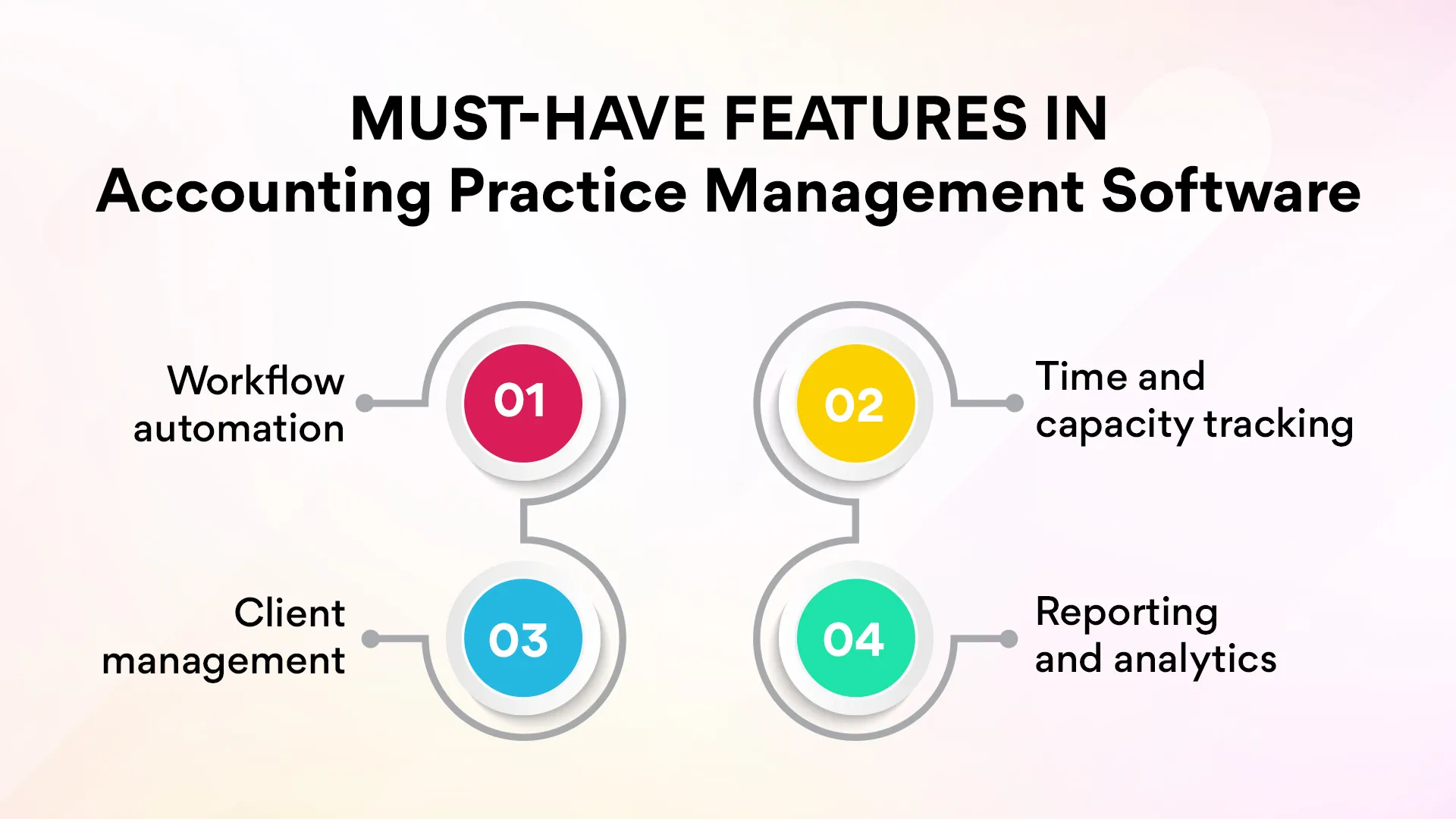
The best accounting practice management software shares a core feature set. Without these essentials, efficiency gains remain limited, even with strong teams and solid processes.
Below are the features that consistently make the biggest difference.
Workflow automation
Workflow automation ensures tasks move forward without manual reminders. Therefore, deadlines stay visible and work progresses consistently.
It reduces reliance on memory and follow-ups, especially during peak periods when details are easiest to miss.
Time and capacity tracking
Time and capacity tracking help managers balance workloads across the firm. This prevents burnout while improving realization rates.
When leaders see workload distribution clearly, they can adjust resources before problems escalate.
Client management
Client management centralizes communications, documents, and service history. Therefore, teams spend less time searching and more time advising.
A single client view also improves continuity when work changes hands within the firm.
Reporting and analytics
Reporting and analytics provide insight into profitability, turnaround times, and bottlenecks. Leaders gain clarity instead of relying on gut instinct.
Clear reporting supports better planning, pricing decisions, and long-term firm strategy.
Common Mistakes Firms Make When Choosing Practice Management Software
Even well-run firms make mistakes when choosing practice management software. I’ve seen smart partners rush decisions simply because something felt urgent.
The problem is not effort. It’s focus. Firms often choose tools for the wrong reasons, and those choices quietly create friction later.
Below are the most common mistakes I see, and why they cause trouble.
Choosing software based on price alone
This one shows up constantly. Firms look at monthly pricing first and features second. I get it. Nobody wants unnecessary overhead.
However, low-cost tools often lack depth, scalability, or automation. What you save upfront gets paid back in inefficiency later.
Cheap software usually means more manual work. Therefore, staff spend extra time tracking tasks, updating statuses, and chasing information.
Over time, that “affordable” tool becomes expensive through lost productivity and burnout.
Not involving the team in the decision
Partners often select software without asking the people who will actually use it. This is understandable, but risky.
When staff feel excluded, adoption drops immediately. They resist the tool, work around it, or quietly revert to spreadsheets.
Practice management software only works when everyone uses it the same way. Therefore, team input during selection is critical.
If the software makes daily work harder, no amount of leadership enthusiasm will fix that.
Focusing on features instead of workflows
Feature lists can be seductive. Demos show dashboards, charts, and buttons that look impressive.
However, features don’t matter if they don’t support your actual workflows. Accounting work follows patterns, not buttons.
The right question is not “What can this software do?” It’s “Does this software match how we work?”
When workflows don’t align, teams create workarounds. That defeats the purpose of practice management entirely.
Underestimating implementation and onboarding
Many firms assume implementation is quick and painless. It rarely is, especially without proper support.
Without training and onboarding, staff feel lost. Therefore, they use the software inconsistently or incorrectly.
Good practice management software includes onboarding help, documentation, and customer support. This is not optional.
Successful implementation turns a tool into a system. Failed implementation turns it into shelfware.
Ignoring reporting and visibility needs
Some firms focus entirely on task tracking and ignore reporting. This creates blind spots at the leadership level.
Without reporting, partners cannot see bottlenecks, capacity issues, or profitability trends. Decisions become reactive instead of strategic.
Practice management software should provide insight, not just organization. Therefore, reporting must be part of the evaluation process.
If leadership can’t see the whole picture, the software is only doing half its job.
Choosing software that cannot scale
This mistake often feels harmless at first. The software works fine when the firm is small.
Then the firm grows. Client volume increases. Services expand. Suddenly, the system starts creaking.
Non-scalable software forces process rewrites, data migrations, and frustrated teams. Therefore, growth becomes painful instead of exciting.
The right practice management software supports growth quietly, without demanding constant attention.
Treating practice management as “just another tool”
This is the most subtle mistake. Firms treat practice management software like a checklist item.
In reality, it becomes the backbone of the firm. It touches every client, every task, and every deadline.
When chosen casually, it creates long-term inefficiencies. When chosen intentionally, it strengthens the entire operation.
Practice management is not just software. It’s how the firm runs.
How Xenett Can Help
At Xenett, we’ve seen how fragmented systems create duplicated work and missed insights. Therefore, we built tools to support firm-wide accuracy and visibility.
Xenett helps firms identify repeated transactions instantly. This keeps financial data clean and decision-ready across all workflows.
When paired with the right practice management software, Xenett strengthens reporting, reduces reconciliation time, and improves overall confidence in firm data.
Conclusion
Choosing the right platform changes everything. The right practice management software enhances the experience for your entire firm.
It streamlines processes for you, your team, and your clients. Therefore, efficiency improves, stress decreases, and growth becomes manageable.
If you’re evaluating tools or struggling with fragmented systems, now is the time to rethink your setup. Explore how Xenett can support accurate, scalable firm operations.
Start building a cleaner, calmer practice today.
Frequently Asked Questions
The best practice management software aligns with your workflows. There is no universal answer, only the right fit for your firm.
Implementation varies by complexity. Most firms complete onboarding within a few weeks with proper training and internal champions.
Yes, reputable platforms use encryption and compliance standards. Cloud-based systems often exceed on-premise security capabilities.
Absolutely. Small firms often see faster gains because processes standardize early, preventing future operational debt.