.svg)

Accounting Lead Generation: Proven Strategies for Accounting Firms

Ask questions, get summaries, or uncover key takeaways from this article.
Blog Summary / Key Takeaways
- Accounting leads only help if they fit your delivery model. Fit beats volume.
- The best accounting lead generation starts with segmentation. Then channels.
- Qualification and follow-up create most conversion gains. Not more ads.
- Proof assets reduce trust friction for CPA leads and CAS leads.
- Delivery stability improves sales. Tools like Xenett help teams execute close.
Introduction: Why “More Leads” Usually Fails Accounting Firms
Accounting leads do not fix growth by themselves. They often create more work.
The real constraint rarely sits in lead volume. It sits in lead fit. It sits in sales cycle control. It sits in delivery capacity.
Most multi-service firms sell more than one thing. You might do bookkeeping leads. You might do tax. You might do CAS. You might do compliance.
That mix makes growth harder. It also makes random tactics fail faster.
A system solves this. It ties marketing to qualification. It ties sales to onboarding. It ties onboarding to month-end close execution.
This guide covers:
- What accounting firm leads mean for a multi-service firm
- The best channels for leads for accounting firms
- Segmentation that improves lead quality
- Qualification, lead scoring, and follow-up systems
- How to protect capacity during month-end and tax season
What Are “Accounting Leads” for a Multi-Service Firm?
Accounting leads are prospects that match your services and intent. They also fit your onboarding and recurring delivery model.
Accounting leads are prospective clients that match your firm’s service scope (bookkeeping, tax, CAS/advisory, compliance) and buying intent, with enough need, budget, and complexity to justify your onboarding and recurring delivery model.
A lead becomes useful when it clears three gates:
- They need the work.
- They can pay for the work.
- They can work your process.
How Accounting Leads Differ From Bookkeeping Leads
Bookkeeping leads often want a simple outcome. They also compare vendors on price.
CPA accounting leads usually come with risk. They fear penalties. They fear messy transitions. They need trust first.
CAS leads tend to involve more stakeholders. The owner, ops, and finance all weigh in. The sales cycle runs longer.
Here is the practical difference you feel in the pipeline:
- Bookkeeping leads: fast “can you do it and how much” calls
- CPA leads: “can I trust you with compliance and deadlines” calls
- CAS leads: “can you run the finance function and improve decisions” calls
Common “Accounting Firm Leads” Categories
Most accounting client acquisition systems work better when you label leads.
Do it by service line. Do it early.
Common categories include:
- Bookkeeping / monthly close support
- Tax preparation and tax planning
- Controller services / CAS / outsourced finance function
- Cleanup and catch-up work (often urgent and risky)
- Compliance and entity support (state filings, 1099s, sales tax)
Do not treat these as one funnel. Each one needs different proof.
Each one needs different qualification questions.
What a “Good Lead” Looks Like
A good lead fits your team and your standards. It also fits your tools.
Use these fit criteria in real calls. Do not guess.
Complexity
- Multi-entity structure
- Inventory or job costing
- Multi-location operations
- Higher AR/AP volume
- Payroll complexity and benefits
Systems
- QuickBooks Online or Xero usage maturity
- Key integrations and app sprawl
- Data hygiene and chart of accounts discipline
Behavior
- They answer questions fast
- They share documents on time
- They accept a process and follow it
Expectations
- Realistic timeline
- Clear roles and responsibilities
- Interest in advisory and better reporting
Why Accounting Lead Generation Is Harder Than Most B2B
Accounting lead generation feels harder because switching costs run high.
Most buyers also do not know how broken their books are.
That creates sales risk. It also creates onboarding risk.
The Three Constraints Most Firms Ignore
- Trust-building lag (buyers don’t switch lightly)
Accounting work touches cash, taxes, and risk. Buyers move slowly. - Data reality (messy books create onboarding drag + risk)
Many prospects show up during a crisis. For example, they missed close.
They also might have unreconciled accounts for months. - Capacity volatility (month-end + tax season crush follow-up)
You can market all year. However, follow-up collapses during peaks.
That creates ghosting and lost deals.
The fix starts with planning. You need a system that survives peak load.
The Hidden Cost of Low-Quality Leads
Low-quality accounting firm leads cost more than ad spend.
They consume senior time. They also create write-offs later.
Common costs include:
- Sales time tax on partners and senior staff
- Proposal churn and rework
- Bad-fit onboarding that turns into cleanup
- Scope creep, rework, and write-offs
A practical example from real firm life:
A “simple” cleanup lead says they need two months fixed.
You start and find 14 months unreconciled. Payroll mapping sits wrong.
Therefore, you now manage a project you never priced.
Good systems prevent this. They force earlier truth.
The Accounting Lead Generation Framework
A scalable system connects five parts. It reduces randomness.
It also improves lead quality without chasing volume.
The 5-Part System: Positioning → Pipeline → Process → Proof → Performance
- Positioning: who you serve + what you solve + what you won’t do
- Pipeline: inbound + outbound channel mix
- Process: qualification, follow-up, handoffs, SLAs
- Proof: case studies, diagnostics, sample deliverables, review standards
- Performance: metrics by stage, capacity alignment, conversion tuning
You do not need all channels. You need the right mix for your segment.
Step 1: Choose Your Market and Segmentation
Segmentation answers a simple question. Who should say yes to you fast?
If you skip this, you attract the wrong accounting leads.
SMB vs Mid-Market: Which One Are You Actually Built For?
SMB works when you can standardize. It also requires fast onboarding.
Mid-market works when you run process well. It also requires stronger QA.
SMB
- Higher volume
- Lower ACV
- Faster decisions
- More price pressure
Mid-market
- Fewer leads
- Higher ACV
- Longer sales cycles
- Higher process expectations
Be honest about your current capacity. Also be honest about your bench.
If seniors review everything, mid-market may fit better.
Niche vs General: The Lead Quality Tradeoff
Niche positioning improves conversion. It also reduces qualification load.
It makes your marketing sharper. It also makes outbound easier.
General positioning increases top-of-funnel volume.
However, it often lowers fit and increases proposal churn.
If you want better B2B accounting leads, narrow your message first.
Segmentation Checklist
Use this list before you build service pages or run ads.
- Industry vertical(s)
- Revenue band / employee count
- Entity complexity
- Tech stack (QBO/Xero + add-ons)
- Service mix (bookkeeping vs tax vs CAS)
- Geography and regulatory constraints
- Ideal engagement model (monthly, quarterly, project-to-recurring)
Write your answers down. Then build your channel plan.
Step 2: Build Inbound Channels That Produce Better-Fit Accounting Leads
Inbound works best when it matches intent. Intent drives quality.
That matters for accounting lead generation.
1) SEO and Content for Accounting Firm Marketing
SEO brings in accounting leads that already feel the pain.
Therefore, your pages must match search intent and service scope.
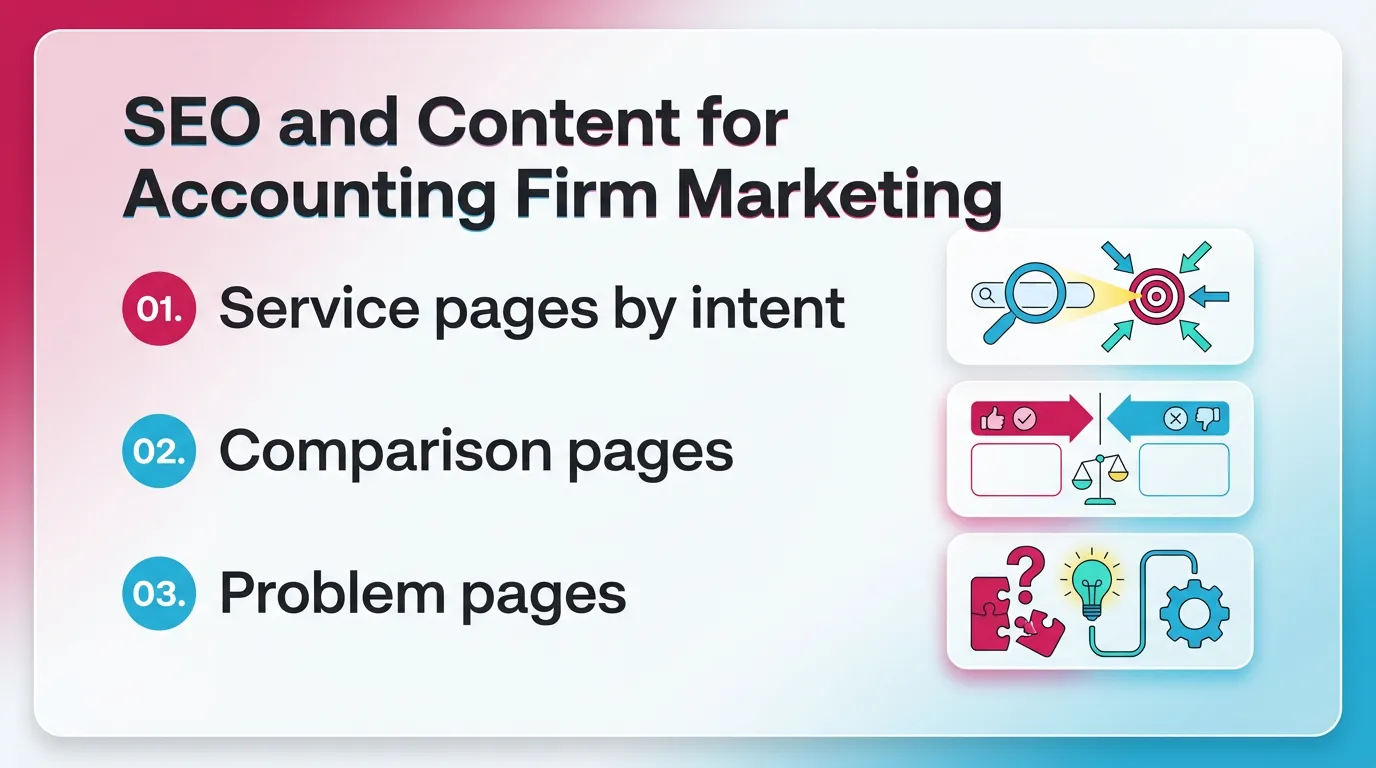
Build content around three page types:
- Service pages by intent
- “outsourced controller services”
- “CAS services”
- “QBO cleanup”
- “tax planning for [industry]”
- Comparison pages
- in-house vs outsourced accounting
- CAS vs bookkeeping
- Problem pages
- month-end close takes too long
- reconciliation backlog
- financials cannot be trusted
Add a simple next step on each page. Use a diagnostic offer.
2) Lead Magnets That Attract Higher-Value Clients
Lead magnets should screen for complexity. They should not scream “cheap.”
Use assets that only a serious buyer wants. For example:
- “Month-end close readiness assessment”
- “Cleanup risk checklist”
- “Cash flow reporting template” with advisory framing
A practical tip: gate the asset with 6 to 8 questions.
Ask about entity count, systems, and close timeline.
That step improves how to get accounting leads that fit.
3) Webinars / Workshops for CPA Leads and CAS Leads
Webinars work when you tie them to triggers. Keep them practical.
Avoid generic “accounting tips” sessions.
Better topics include:
- Year-end readiness and close cleanup planning
- Sales tax exposure basics for multi-state sellers
- Margin visibility for job costing businesses
- Audit-prep readiness for internal reporting
- Keep this non-audit. Focus on clean financials.
Record the session. Then publish clips. Then reuse as SEO content.
4) Review Sites, Directories, and Local Search
Directories can work for local buyer intent. They also help credibility.
However, they often send low-intent traffic.
Use them when:
- You operate locally or regionally
- You offer specific compliance services
- You rely on reputation-driven buyers
Avoid over-investing if you want CAS leads.
CAS buyers often come from content, referrals, and targeted outbound.
Step 3: Outbound Lead Generation for Accounting Firms
Outbound can produce B2B accounting leads. It also creates noise fast.
It works best when you target narrowly and offer a diagnosis.
What Outbound Works Best for B2B Accounting Leads?
The best outbound usually feels like insight. Not a pitch.
Tactics that work:
- Partner-led outbound to specific profiles
- LinkedIn prospecting with warm content sequences
- Email sequences tied to a diagnostic offer
- Avoid “we do bookkeeping” messages
Outbound fails when you chase everyone. Tight filters fix this.
Outbound Targeting: Who to Contact and Why
Target by segment. Also targeted by who feels the pain.
SMB
- Owner or operator
- Ops lead who deals with billing and payroll
Mid-market
- CFO or controller
- Finance manager who owns close
Look for triggers:
- Rapid growth
- New funding
- New entity creation
- System migration to QBO or Xero
- Prior accountant retirement or turnover
These triggers answer “why now.” That improves response rates.
Outbound Messaging Framework
Start with an observation. Then name the risk. Then offer a diagnostic.
Then ask for a small next step.
Framework: Observation → risk → diagnostic offer → next step
Example angles:
- “Close lag creates decision lag.”
- “Cleanup is a symptom. Review standards cause the backlog.”
- “Consistency across locations drives reliable reporting.”
Keep messages short. Ask one question. Offer one next step.
Step 4: Convert Leads With a Qualification and Follow-Up Process
Most firms lose accounting leads after the first reply.
They lose them due to slow follow-up and weak qualification.
Fixing process often beats adding new channels.
The Accounting Client Acquisition Funnel
Define stages and assign owners. Do not wing it.
- Inquiry received → Admin or coordinator
- Qualification → Sales owner or manager
- Discovery → Partner or senior
- Scoping → Service line lead
- Proposal → Partner
- Close → Partner + admin
- Onboarding → Ops lead + delivery lead
Set simple SLAs:
- Respond within 1 business day.
- Book discovery within 5 business days.
- Send scope request within 24 hours after discovery.
That alone improves accounting client acquisition.
Intake Form Must-Haves
Your intake form should protect your time. It should screen risk.
Include:
- Current system (QBO/Xero + apps)
- Entity count + revenue range
- Pain trigger + deadline
- Prior accountant situation (transition risk)
- Expectations on reporting and advisory
Also ask one behavior question:
“Who will upload documents and answer questions each month?”
That predicts success better than revenue.
Discovery Call Structure
Answer the key question in the first minutes. Why now and why you?
Use this structure:
- Confirm trigger + timeline
- Understand complexity + volume drivers
- Diagnose the “state of the books” and review gaps
- Clarify decision process + stakeholders
- Set next step (scope or data request)
A practical move that saves hours:
Ask for two reports before you quote.
- Balance sheet and P&L for the last two months
- General ledger detail for top five expense accounts
If they cannot share that, slow down. Score readiness lower.
Lead Scoring for Accounting Firm Leads
Lead scoring helps you decide fast. It also supports consistent follow-up.
Use four scores. Keep it simple. Use 0 to 3.
- Fit score (industry + complexity + engagement type)
- Readiness score (data quality + responsiveness + urgency)
- Value score (retainer potential + expansion path)
- Risk score (cleanup burden + expectation mismatch)
Lead Scoring Rubric (0–3 scale each) + “accept / nurture / decline” thresholds.
Decision thresholds (example):
- Accept: Fit 2+ and Readiness 2+ and Risk 0-1
- Nurture: Fit 2+ but Readiness 0-1
- Decline: Fit 0-1 or Risk 2-3
This rubric improves how to get leads for accounting businesses that convert.
It also reduces partner time spent on bad-fit calls.
Step 5: Improve Lead Quality With Proof and Positioning
Proof and positioning reduce doubt. They also reduce sales cycle time.
That matters for CPA leads and CAS leads.
Proof Assets That Actually Shorten the Sales Cycle
Use proof that signals process, not promises.
High-impact proof assets:
- Case studies by service line
- Before and after close timeline improvements
- Sample month-end package table of contents
- “What we check in review” overview
Keep claims modest. Use ranges and conditions.
For example, “We often reduce close time after cleanup.”
Add credible references when you talk about reporting standards.
For example, mention GAAP where it applies. Link to FASB.
Positioning Statements That Repel Bad-Fit Leads
Repelling bad-fit leads saves capacity. It also improves delivery quality.
Use boundaries like these:
- Minimum complexity thresholds
- For example, “We work best with multi-entity or growing teams.”
- Clear requirements
- For example, “We require monthly document delivery by day X.”
- Engagement model clarity
- For example, “We run a monthly close cadence with review.”
- What you do not do
- For example, “We do not take last-minute rescues without scope.”
This improves accounting firm marketing. It also improves lead quality.
Best Practices: Lead Generation for Accounting Firms That Scales
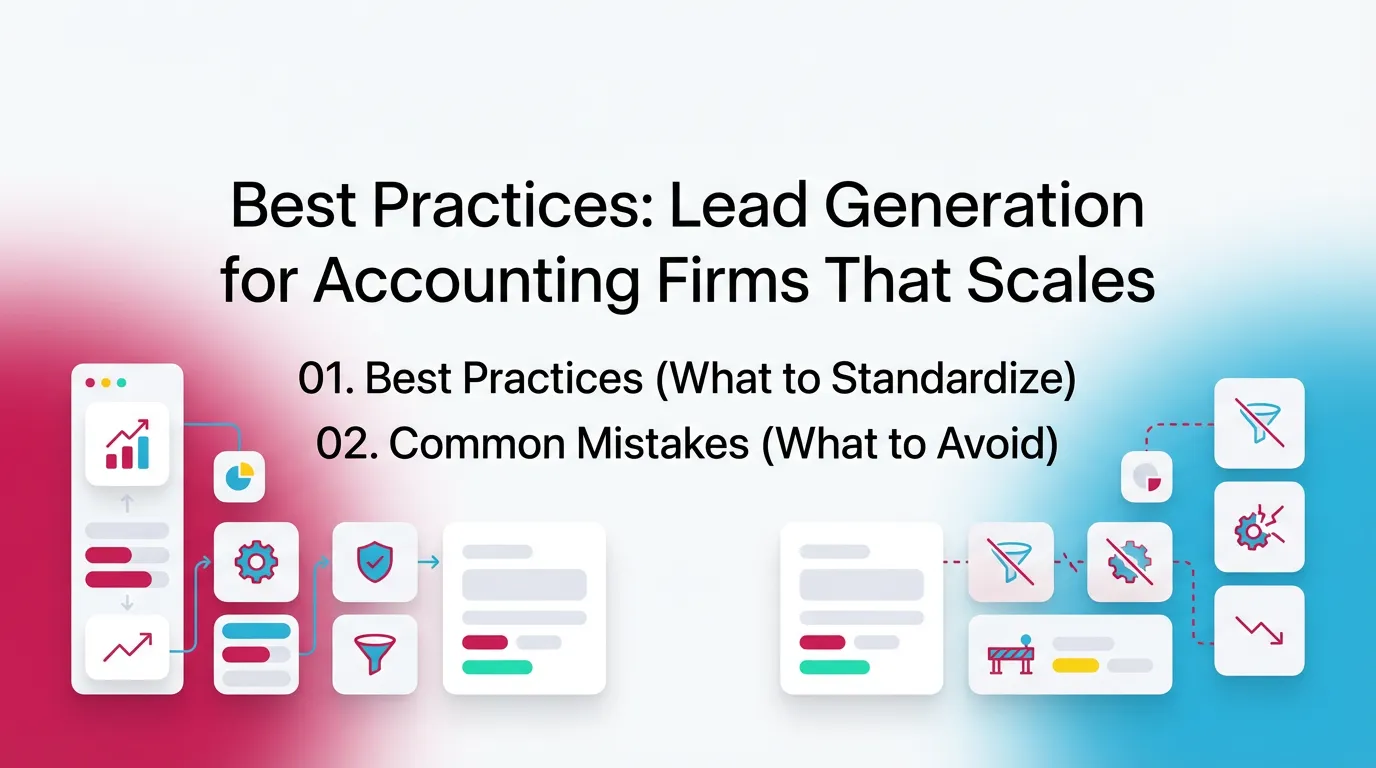
Scaling lead generation for accounting firms requires standard work.
You cannot rely on heroics during the month end.
Best Practices
Standardize what creates repeatable outcomes.
- Standardize the intake and qualification path across all services
- Build niche-aligned content around real triggers
- Use diagnostics to convert
- Track conversion by source and by segment
- Align marketing promises to delivery reality
A real-world insight:
Most firms improve conversion by tightening process.
They do not improve it by adding channels.
If you want more CPA accounting leads, show your operating standards.
Common Mistakes
Avoid mistakes that create churn and write-offs.
- Chasing bookkeeping leads when you want CAS clients
- Offering proposals before confirming book quality
- Treating follow-up as ad hoc
- Measuring success by lead count
- Scaling marketing while month-end delivery stays unstable
If your close runs late, fix operations first. Then scale marketing.
How Xenett Supports Scalable Growth by Standardizing Close Review and Workflow Execution
Operational consistency improves sales outcomes. It also improves retention.
That matters once your accountant lead generation starts working.
Xenett helps teams run month-end close with structure.
It supports workflow and accounting review. It does not support audits.
For more context, see:
Why Operational Consistency Impacts Lead Quality and Conversion
Prospects ask one question, even if they do not say it.
“Will this firm run my books the same way every month?”
Firms win better-fit accounting firm leads when they explain:
- how month-end runs
- how review happens
- how issues get resolved
A chaotic close creates friction. It also creates perceived risk.
Therefore, the sales cycle slows down. Onboarding also drags.
Where Xenett Fits: Operationalizing Best Practices Behind the Scenes
Xenett fits as an operational layer for close and review execution.
It helps standardize work across clients and team members.
- Close task and checklist management: keeps recurring work structured
- This helps follow-up stay consistent during peak periods.
- Review and approval workflows: supports account-level review standards
- Quality does not depend on one senior reviewer.
- Visibility into close status and bottlenecks: shows what is stuck
- For example, reconciliations, flux items, missing entries.
- Accuracy, audit trail, and repeatability: records what got reviewed
- This supports accounting review. It does not provide audit work.
- This supports accounting review. It does not provide audit work.
Practical Link to Lead Handling
Stable delivery changes sales behavior.
When delivery stays stable, firms can:
- accept higher-value clients with confidence
- shorten onboarding timelines
- protect partner time for discovery and closing
This connection matters. Better operations improve lead quality.
They also improve conversion for leads for accounting firms.
FAQ: Accounting Leads and Lead Generation for Accounting Firms
What are accounting leads?
Accounting leads are prospective clients who match your services and model. They also show enough need and readiness to start sales and onboarding.
They should fit your scope, cadence, and review standards.
How do I get accounting leads for my accounting business?
Use inbound and outbound with a clear segment and offer. Then qualify fast with a standard intake and discovery process.
Combine SEO, content, webinars, and referrals with targeted outreach.
What’s the difference between bookkeeping leads and CPA accounting leads?
Bookkeeping leads often compare on price and speed. They also churn more.
CPA accounting leads often require trust and compliance confidence.
CAS leads often involve multiple stakeholders and longer cycles.
Which lead generation channel works best for accounting firms?
SEO-driven inbound and referrals often produce the best-fit accounting leads. Outbound works best when you target narrowly and lead with a diagnostic.
Most firms need a mix, not a single channel.
Why are my accounting firm's leads low quality?
Generic positioning drives low-fit leads. Weak qualification and vague offers also attract price shoppers.
Fix segment, pages, and intake first. Then scale traffic.
How can accounting firms improve lead-to-client conversion rates?
Standardize intake, add lead scoring, and run structured discovery. Require baseline data before scoping. Publish proof of review and close standards.
These steps reduce friction and speed decisions.
What are CAS leads?
CAS leads come from prospects who want ongoing outsourced accounting. They often want controller-level reporting, close management, and advisory support.
They usually value process and rigor.
How do I generate B2B accounting leads without lowering prices?
Tighten segmentation and publish niche problem content. Offer diagnostics instead of discounts. Prove delivery credibility with repeatable close and review standards.
This approach improves fit and protects margins.
Summary: A Practical Operating Model for Accounting Lead Generation
Accounting lead generation works best as an operating model. Not a tactic.
Use this system:
- Segmentation first
- Channel mix second
- Qualification and follow-up third
- Proof assets for trust
- Process discipline tied to capacity
The goal stays simple. Get fewer leads, better fit, and better conversion.
Protect delivery. Protect partner time.