.svg)

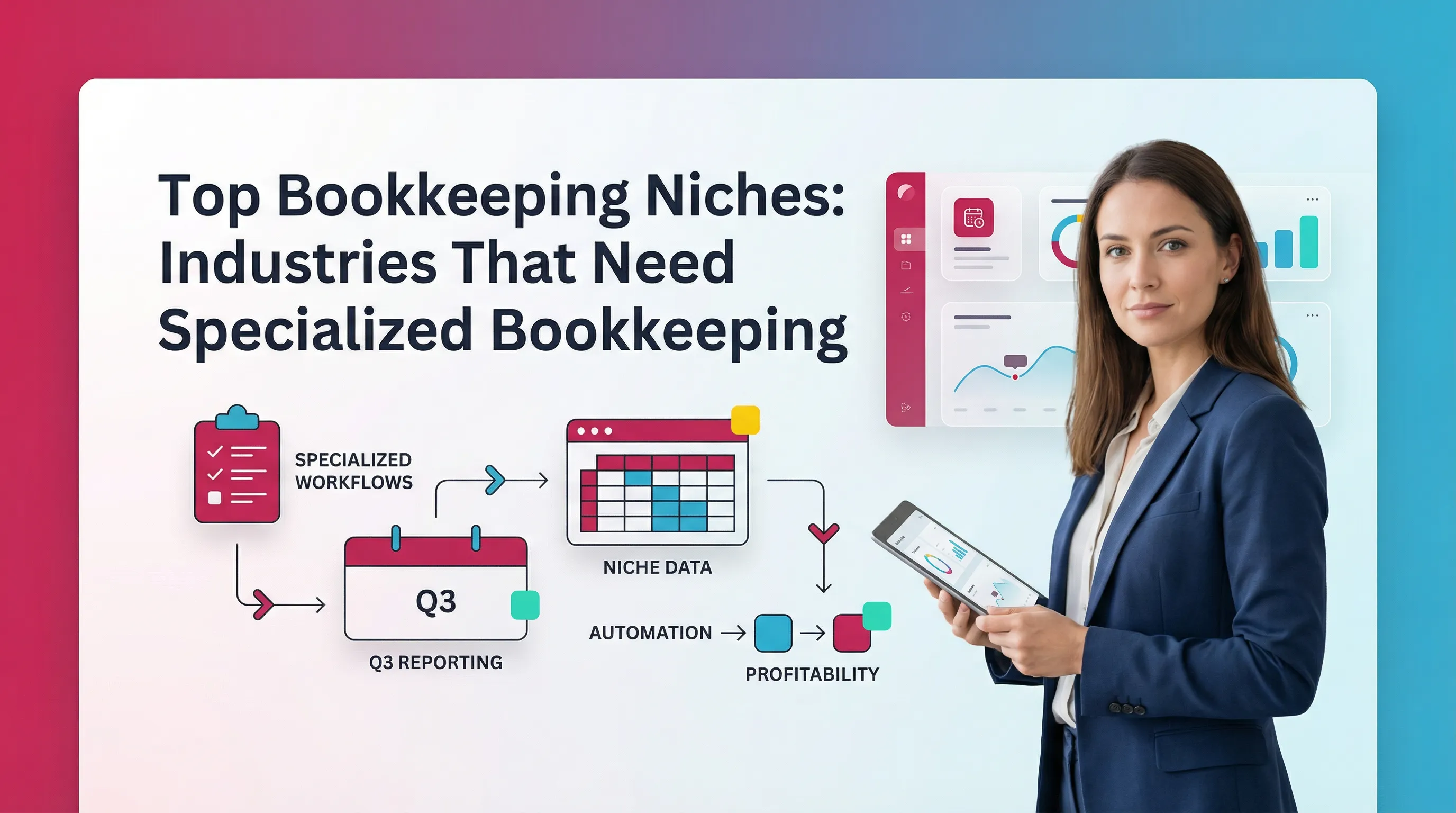
Top Bookkeeping Niches: Industries That Need Specialized Bookkeeping

Ask questions, get summaries, or uncover key takeaways from this article.
Blog Summary / Key Takeaways
- Bookkeeping niches work when the transaction pattern repeats. So does the close.
- “Best bookkeeping niches” usually have higher close risk. They need tighter review.
- Pick niches by transaction shape, not hype. Then validate tooling and SOPs.
- Industry specific bookkeeping succeeds when you define “done” at month-end.
- Xenett helps teams run consistent account-level reviews. It also tracks close work.
Quick Summary: The Best Bookkeeping Niches
A “bookkeeping niche” means you specialize in an industry with repeatable work. That includes transaction types, reconciliations, and a predictable close rhythm. That repeatability makes bookkeeping niches easier to deliver at scale.
This guide fits:
- Bookkeepers building a focused practice
- Virtual bookkeeping firms and CAS teams standardizing delivery
- Small business owners comparing generalist vs specialized help
You will get:
- A scannable bookkeeping niches list
- Niche-specific requirements and close risks
- A step-by-step framework to choose profitable bookkeeping niches
- A way to package specialized bookkeeping services without chaos
What Is a Bookkeeping Niche?
Bookkeeping niches focus on day-to-day transactions and close patterns. Think coding rules, reconciliations, and repeatable month-end checks.
Accounting niches go broader. They can include reporting complexity and advisory. They may include entity structure support.
CPA niches can include tax and attest work. They also include IRS representation. That work sits outside routine bookkeeping.
A practical example:
- A niche bookkeeping services team for restaurants builds POS mapping rules.
- A niche accounting team for restaurants adds margin analysis and cash planning.
- A CPA niche may add sales tax filings and income tax strategy.
Why Industry-Specific Bookkeeping Exists
Industry specific bookkeeping exists because industries behave differently. Revenue triggers differ. Payment rails differ. So does compliance.
What changes by industry:
- When revenue counts, and what “earned” means
- How deposits land, and what fees get netted out
- Whether COGS moves with inventory or labor
- Which accounts drift if no one reviews them
The real differentiator is repeatable review logic. In niche work, you learn where errors hide. You also learn which tie-outs catch them early.
Generalist vs Specialized Bookkeeping Services
General bookkeeping works when the books stay simple. It also works when volume stays low.
General bookkeeping usually fits when:
- Cash-basis reporting works
- One bank account and one card exist
- Few systems feed data into the GL
- No inventory, no job costing, no trust money
Specialized bookkeeping services become required when risk rises.
Specialized work usually fits when:
- Multi-entity or multi-location reporting exists
- Inventory drives margin and cash
- Job costing or WIP matters
- Deposits, retainage, or trust rules apply
- Regulators and lenders want consistent reporting
How to Choose a Bookkeeping Niche
.png)
Step 1: Start With Transaction Shape, Not “Industry Popularity”
Start with how money moves. That tells you the real workload. It also tells you where controls must exist.
Look for:
- Volume and frequency of transactions
- Refunds, returns, and chargebacks
- Splits and allocations across jobs or locations
- Deferred revenue or prepayments
Complexity drivers usually include:
- Inventory
- Payroll burden and tip rules
- Multi-location operations
- Multi-entity structures
- Deferred revenue and accrual needs
If the “shape” repeats, you can standardize. Therefore you can scale without losing quality.
Step 2: Map the “Close Risk Profile”
Define where errors appear late. Late errors cause rework. They also break trust.
Ask:
- Which accounts drift without monthly tie-outs?
- Which reconciliations require source reports?
- Which allocations need documented logic?
Common Balance Sheet drift by niche:
- A/R and unearned revenue timing
- Inventory and COGS mismatches
- Deposits and customer credits
- Clearing accounts for processors and payroll
- WIP, retainage, and unbilled receivables
Practical field note from firm work:
Most “bad books” are not missing transactions. They miss tie-outs.
Clearing accounts and deposits sit unresolved for months.
Step 3: Confirm Demand + Client Fit
Demand matters, but fit matters more. Virtual delivery requires clean inputs.
Virtual bookkeeping works best when:
- Sales flow through card or ACH
- The client uses cloud apps and banks
- Owners approve questions quickly
- Source docs live in one place
Virtual delivery gets harder when:
- Cash sales dominate
- Receipts arrive late and incomplete
- Staff turnover breaks POS or job workflows
- Owners avoid operational discipline
You can still serve those clients. However you need stricter intake controls.
Step 4: Validate Tooling + Workflow Requirements
You need the right stack. You also need repeatable SOPs.
Most niches need:
- QuickBooks Online or Xero
- Payroll platform data that ties to the GL
- Bank feeds with clean rules
Many niches also need:
- POS systems and daily summaries
- Inventory tools and purchase workflows
- Billing platforms with contract data
- Project time tracking tools
Plan for reliable data sources. For example:
- Shopify payouts require processor reports, not bank deposits alone.
- Construction requires job cost detail, not just vendor totals.
Step 5: Package the Service
Package the core close first. Then add niche modules.
A solid baseline package includes:
- Bank and card reconciliations
- A/R and A/P review
- Balance Sheet integrity checks
- Flux review on the P&L
- Close notes and a follow-up list
Then add niche bookkeeping services modules:
- Job costing and WIP reporting
- Inventory rollforwards and shrink review
- Deferred revenue schedules
- Processor payout reconciliations
- KPI packs for owners and lenders
- Cleanup and catch-up projects
This structure also helps you price consistently. It keeps delivery consistent.
Bookkeeping Niches List: 18 High-Opportunity Industries
Use this bookkeeping niches list to scan fast. Then go deep on one or two.
1) Construction
Construction bookkeeping lives on job cost structure. WIP reporting drives trust with owners and lenders.
Key requirements:
- Job costing setup and coding rules
- Progress billing and AIA-style invoicing support
- Retainage tracking in A/R and A/P
- WIP reporting and unbilled receivables logic
Common close issues:
- Job costs misclassified to overhead
- Retainage booked in the wrong bucket
- Unbilled receivables not recorded
2) Real Estate Agents & Brokerages
Real estate books look simple until you track splits. Timing gaps also create confusion.
Key requirements:
- Commission income tracking by agent
- Marketing reimbursements and pass-throughs
- Agent splits and payouts
Common close issues:
- Clearing accounts never zero out
- Closings recorded when cash hits, not when earned
- Reimbursements mixed into income
3) Property Management
Property management requires strong liability tracking. Owner reporting must match the trust reality.
Key requirements:
- Owner statements and owner payables
- Security deposits as liabilities
- Property-level P&L and classes
Common close issues:
- Deposits not reconciled to source logs
- Intercompany allocations get skipped
- Repairs coded inconsistently across properties
4) Restaurants & Food Service
Restaurants need daily sales controls. Tips and payroll also drive risk.
Key requirements:
- POS mapping into the chart of accounts
- Tip reporting tie-outs to payroll
- Daily sales reconciliation process
- COGS margins and inventory routines
Common close issues:
- Sales tax payable drifts
- Comps and voids never reviewed
- Inventory shrink never captured
- Gift card liabilities ignored
5) E-Commerce
E-commerce bookkeeping revolves around clearing accounts. Net deposits rarely equal sales.
Key requirements:
- Shopify or Amazon integration review
- Processor fee mapping and netting logic
- Returns and chargebacks handling
- Clearing account reconciliation each month
Common close issues:
- Undeposited funds build up for months
- Revenue overstated vs net cash
- Fees posted to random expense accounts
- Refunds posted without matching original sales
6) SaaS Companies
SaaS requires disciplined revenue timing. Deferred revenue and metrics must agree.
Key requirements:
- Deferred revenue schedules and rollforwards
- Billing system to GL reconciliation
- MRR and ARR reporting alignment
- Contract changes tracked cleanly
Common close issues:
- Revenue timing errors after upgrades
- Credits and downgrades misposted
- Accrued expenses missed
- Deferred revenue not tied to billing
7) Professional Services Agencies
Agencies need project visibility. Unbilled time and costs often drive margin surprises.
Key requirements:
- Project P&L reporting
- WIP or unbilled time alignment
- Contractor expense controls
Common close issues:
- Unbilled costs missed
- Project codes do not match the chart
- Labor costs coded without project tags
8) Law Firms
Law firm bookkeeping requires trust discipline. You must treat trust money as not yours.
Key requirements:
- Trust account tracking rules
- Matter-level cost categories
- Owner draws and partner allocations
Common close issues:
- Trust reconciliations skipped
- Costs leak across matters
- Retainers treated as earned revenue
9) Medical & Dental Practices
Practices need deposit detail and payer visibility. Payroll also drives most costs.
Key requirements:
- Payer mix awareness and deposit mapping
- Merchant and lockbox reconciliations
- Payroll-heavy close workflow
Common close issues:
- A/R reports do not match GL A/R
- Deposits posted without payer detail
- Patient payments mixed with insurance receipts
10) Home Services
Home services require job tracking without full construction WIP. Materials and labor margins matter.
Key requirements:
- Dispatch or job workflow tie-out
- Materials vs labor margin tracking
- Subcontractor and 1099 readiness
Common close issues:
- Incomplete job costing
- Vehicle and equipment costs ignored
- Deposits and prepayments miscoded
11) Salons, Spas, and Personal Care
This niche looks like retail plus tips. Memberships add liabilities.
Key requirements:
- POS plus membership tracking
- Tips and payroll tie-out
- Booth rent vs service revenue separation
Common close issues:
- Tips coded as income
- Membership liabilities not tracked
- Product sales mixed into service revenue
12) Retail
Retail bookkeeping requires inventory discipline. Location reporting also matters.
Key requirements:
- Inventory valuation method consistency
- Purchasing and COGS controls
- Classes or locations for stores
Common close issues:
- Inventory adjustments posted with no review
- COGS swings with no explanation
- Returns not mapped consistently
13) Nonprofits
Nonprofits need restriction tracking. They also need consistent allocations.
Key requirements:
- Restricted vs unrestricted tracking
- Grant schedules and reporting
- Program vs admin allocation logic
Common close issues:
- Restrictions misapplied
- Allocation logic changes month to month
- Grant revenue timing not supported
14) Logistics & Trucking
Trucking bookkeeping needs fuel control. Per-load profitability can change decisions fast.
Key requirements:
- Fuel and maintenance tracking
- Driver pay structures and settlements
- Per-load or per-route profitability
Common close issues:
- Fuel card reconciliations skipped
- Accrual gaps for repairs and tolls
- Equipment and depreciation misaligned
15) Manufacturing
Manufacturing adds BOM logic and overhead. Inventory valuation becomes a core control.
Key requirements:
- BOM and assembly tracking
- Overhead absorption logic
- Clean COGS structure and mapping
Common close issues:
- Inventory valuation drift
- Clearing accounts never resolved
- Scrap and rework not captured
16) Creators, Freelancers, and Solopreneurs
This niche can standardize fast. It also helps you learn clean routines.
Key requirements:
- Simple chart of accounts
- Consistent categorization rules
- Quarterly estimate readiness
Common close issues:
- Commingled personal spending
- Missed deductions due to weak tracking
- Income streams coded inconsistently
17) Janitorial & Landscaping
Recurring revenue helps, but labor coding matters. Route or job profitability can unlock margin.
Key requirements:
- Recurring invoicing discipline
- Job or route profitability basics
- Payroll coding by crew or job
Common close issues:
- Labor misclassification
- Customer deposits handled inconsistently
- Supplies costs coded with no job context
18) Cannabis
Cannabis bookkeeping requires documentation discipline. Cash controls matter every day.
Key requirements:
- Robust documentation and logs
- Tight inventory and COGS controls
- Cash control routines and approvals
Common close issues:
- Incomplete audit trail from POS to deposits
- Margin volatility never reviewed
- Inventory adjustments lack support
Note: Rules vary by state and change often. Use local legal guidance.
Comparison Table: Which Bookkeeping Niches Pay Well
Bookkeeping niches that pay well often carry higher close risk. Clients value fewer surprises and cleaner reporting. However do not promise income outcomes.
Use this table to pick best bookkeeping niches for your skills. Do not pick only by “profitable bookkeeping niches” lists. Close risk will humble you.
Bookkeeping Niches for Beginners: 6 “Easier to Standardize” Options
What makes a niche beginner-friendly?
A beginner-friendly niche has fewer moving parts. It also has fewer Balance Sheet traps.
Look for:
- Low regulatory burden
- Few complex liability accounts
- No inventory or WIP
- Clean bank feeds and simple invoicing
- Repeatable month-end close pattern
Beginner-friendly niches
These bookkeeping niches for beginners can work well:
- Freelancers and solopreneurs
- Simple professional services
- Coaching and consulting
- Small agencies without inventory
- Content creators with clean banking separation
- Local service businesses with basic invoicing
Set boundaries early:
- Avoid heavy job costing at first
- Avoid trust money until you build controls
- Avoid inventory until you master tie-outs
Best Niches for Virtual Bookkeeping
Traits of a strong virtual bookkeeping niche
The best niches for virtual bookkeeping share one trait. Data arrives digitally and on time.
Strong traits:
- Card or ACH collections
- Stable app stack and integrations
- Consistent source docs and approvals
- Owners who respond within 24 to 48 hours
Niches that typically fit virtual delivery well
These niches often work well remotely:
- SaaS
- E-commerce
- Agencies and marketing services
- Nonprofits with strong documentation
- Professional services with cloud tooling
Niches that are “virtual,” but require stricter intake controls
You can serve these virtually. However you need tighter rules:
- Restaurants (POS discipline)
- Property management (deposit and trust controls)
- Construction (job docs and coding rigor)
In practice, this means:
- A required monthly “source pack” due date
- Standard reports pulled by the client or system
- Clear escalation when data arrives late
Specialized Bookkeeping Services: What to Standardize by Niche
Core monthly deliverables
Standardize these first. They form the base of specialized bookkeeping services.
Core deliverables:
- Bank and credit card reconciliations
- Balance Sheet integrity checks
- Clearing account review and cleanup
- A/R and A/P reasonableness review
- P&L variance review
- Close package with notes and exceptions
A practical example from monthly close:
I have seen “done” closes with unreconciled deposits.
The P&L looked fine. Cash did not.
A simple clearing check would have caught it in minutes.
Niche add-ons
Add these modules based on niche risk:
- Construction: job costing + WIP schedule
- E-commerce: payout reconciliation + fee mapping
- SaaS: deferred revenue rollforward
- Nonprofit: fund tracking + grant reporting
- Restaurants: daily sales reconciliation + sales tax controls
This approach keeps niche bookkeeping services focused. It avoids random extras.
Best Practices for Industry-Specific Bookkeeping
Build the niche around review standards
Define “done” per niche in plain terms. Then enforce it every close.
For each niche, define:
- Required reconciliations and tie-outs
- Accounts that must hit zero, or a threshold
- Reports that must match the GL
- Who approves exceptions
This is how industry specific bookkeeping becomes real. It stops being a label.
Create a niche-specific chart of accounts template + mapping rules
Build a COA template you can reuse. Also define mapping rules.
Standardize:
- Classes, locations, or projects naming
- Vendor naming conventions
- Customer naming conventions
- COGS structure and revenue buckets
For example, e-commerce needs consistent fee accounts.
Restaurants need clear sales tax buckets.
Construction needs job cost types that match field reality.
Make the month-end close repeatable
Run a close calendar. Tie it to how data lands.
Include:
- When POS, payroll, and billing data becomes final
- When owners approve open questions
- When accruals get posted
- When reporting gets released
Also define exception handling:
- Log the issue
- Assign an owner
- Set a due date
- Prevent it next month
Use variance and Balance Sheet behavior checks every month
Flux checks catch trend breaks. Balance Sheet checks catch control breaks.
What to review monthly:
- Sales tax payable movement
- Deposits and customer credits
- Clearing accounts and undeposited funds
- Inventory and COGS relationship
- Deferred revenue rollforward
- A/R aging shifts and write-offs
Use external benchmarks carefully. For example, inflation eased from 2022 peaks.
However costs still vary by sector and region.
Use client history as the primary benchmark.
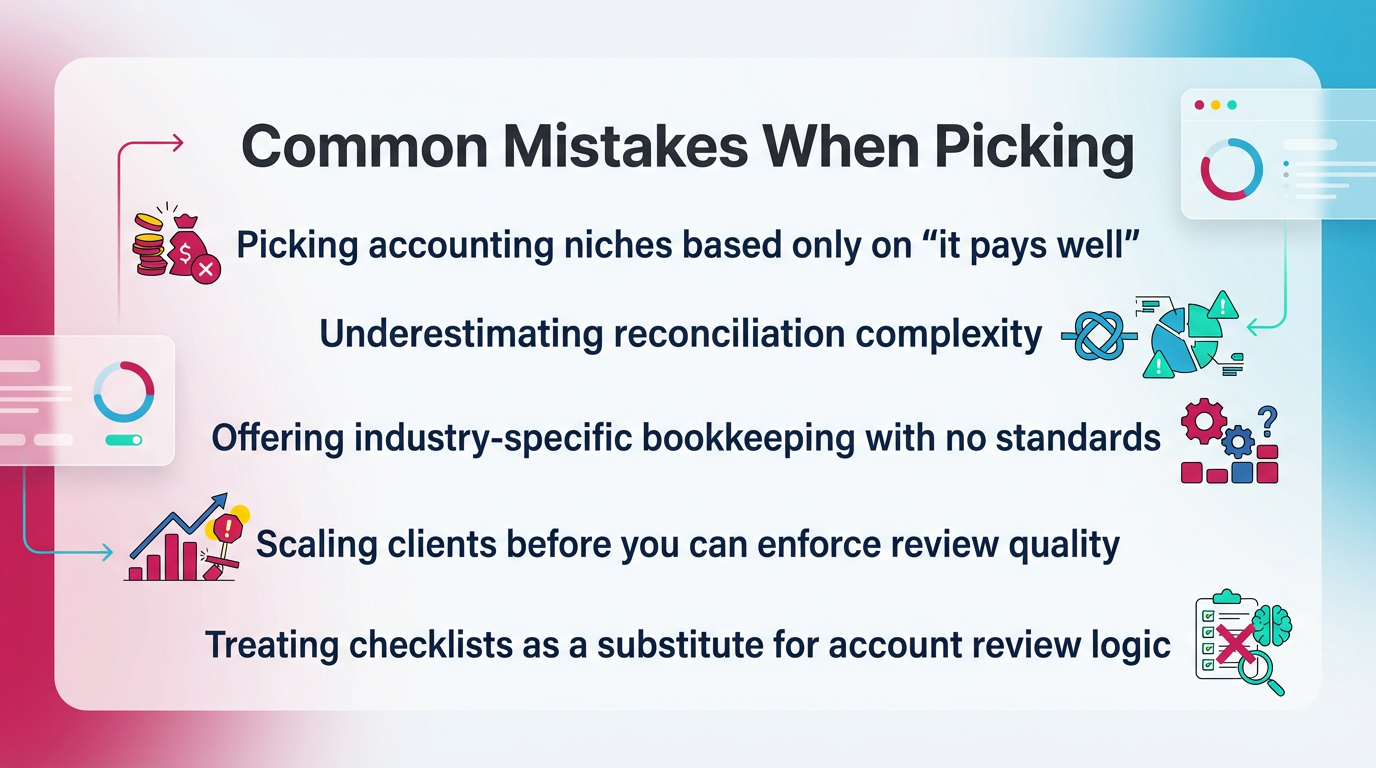
Common Mistakes When Picking Bookkeeping Niches
Avoid these traps. They show up fast in month-end close.
Common mistakes:
- Picking accounting niches based only on “it pays well”
- Underestimating reconciliation complexity
- Offering industry-specific bookkeeping with no standards
- Scaling clients before you can enforce review quality
- Treating checklists as a substitute for account review logic
A checklist helps. It does not think.
Your review must still answer, “Do these balances make sense?”
How Xenett Helps Teams Operationalize Niche Bookkeeping Standards Without Chaos
Why niche work breaks down at month-end
Niche work breaks down when review happens late. It also breaks down when only one person knows what to check.
Common breakdown patterns:
- Senior reviewers rely on memory
- Reviews differ by staff member
- Exceptions get found after “close is done”
- Teams redo work under deadline pressure
That cycle kills the margin. It also hurts quality.
Where Xenett fits
Xenett works as a financial review engine. It runs account-level checks across the P&L and Balance Sheet. This helps teams apply niche standards consistently.
This matters for firms with many clients. It also matters for CAS teams.
You can manage 10 to 500+ books without relying on tribal knowledge.
Learn more about Xenett’s close and review approach here:
Close task and checklist management
Xenett helps link tasks to real exceptions. This reduces “checkbox close.”
In practice:
- The review flags an issue in a clearing account
- You create a task to resolve it
- You track the fix and close notes in one place
Therefore tasks support accuracy. They do not replace it.
Review and approval workflows
Xenett helps standardize how teams review. It supports approvals and handoffs.
This helps when:
- Juniors prep and seniors review
- One person covers during PTO
- You onboard new staff into niche standards faster
You get consistency across reviewers. You also reduce rework.
Visibility into close status and bottlenecks
Xenett gives visibility into what remains unresolved. You can see it by account and by client.
That visibility helps you:
- Manage capacity during close week
- Spot recurring bottlenecks
FAQ: Bookkeeping Niches
What is a good bookkeeping niche?
A good bookkeeping niche has predictable transaction patterns and close risks. You can standardize the workflow. Clients still value specialized expertise, like construction, SaaS, e-commerce, and law firms.
What industries need bookkeepers the most?
High-volume and high-complexity industries need bookkeepers the most. Common examples include construction, restaurants, e-commerce, real estate, and professional services.
What are the best bookkeeping niches for small business?
Bookkeeping niches for small business often include home services, restaurants, e-commerce, professional services, and real estate. These businesses need frequent cash flow visibility and clean reconciliations.
Which bookkeeping niches pay well?
Bookkeeping niches that pay well usually have higher close risk and specialized reporting needs. Examples include construction (job costing and WIP), SaaS (deferred revenue), e-commerce (processor reconciliation), and law firms (trust workflows).
What are the best niches for virtual bookkeeping?
The best niches for virtual bookkeeping are digital-first businesses with clean integrations. SaaS, e-commerce, agencies, and professional services often fit well.
What’s the difference between specialized bookkeeping services and niche accounting?
Specialized bookkeeping services focus on transaction coding, reconciliations, and month-end close requirements. Niche accounting can include advisory, reporting frameworks, and sometimes tax planning, depending on the firm.
Can I serve more than one bookkeeping niche?
Yes. Choose niches that share transaction shapes and close patterns. For example, agencies and consultants can pair well. Too many unrelated niches reduce standardization and increase errors.
How do I pick a bookkeeping niche as a beginner?
Pick a niche with low regulatory burden and fewer Balance Sheet traps. Start with solopreneurs or simple services. Add complexity only after your close and review process stays consistent.
Conclusion
Bookkeeping niches work when you treat them like operations. You standardize the chart, the tie-outs, and the month-end review. You also document what “done” means.
Pick one niche from this bookkeeping niches list. Then map the transaction shape and close risks. Build SOPs you can repeat.
If you manage many clients, tighten review consistency first. Use Xenett to run account-level review checks, track exceptions, and manage month-end close work with clear visibility.
Next step: choose two niches you can realistically support. Then write your first “done at close” standard for each.