
.svg)

Accounting Client Onboarding Checklist (Free Template)

Ask questions, get summaries, or uncover key takeaways from this article.
.webp)
Blog Summary / Key Takeaways
- Chaotic onboarding plants doubt that's hard to undo a formal checklist makes it repeatable and staff-independent
- Six phases: engagement/contracts → information gathering → tool setup → kickoff → first deliverable → ongoing cadence
- Common mistakes: starting work before engagement letter is signed, collecting docs over email, skipping kickoff call, not setting first deliverable date
- Case study: 3-partner firm added 18 clients in January with zero chaos after building a 6-phase Xenett workflow vs. the previous year where clients waited weeks for basic access
- Xenett handles the full process: client portal, document request tracking, workflow automation, recurring tasks
The first 30 days with a new client sets the tone for the entire engagement.
If onboarding is smooth documents collected quickly, access set up cleanly, first deliverable delivered on time clients feel confident they made the right choice.
If onboarding is chaotic email chains, repeated document requests, slow responses, unclear timelines clients start to wonder. That doubt is hard to undo, even if the work is excellent.
Most accounting and bookkeeping firms don't have a formal onboarding process. They have a general sequence of things that usually happen, in a rough order, driven by whoever handles new clients that week.
That's not a process. It's a pattern.
This checklist turns that pattern into a repeatable, professional process that every new client experiences the same way regardless of who runs it.
What Is Client Onboarding in Accounting?
Client onboarding in accounting is the structured process of bringing a new client into your firm from signed engagement letter through first deliverable in a way that sets up a successful, long-term working relationship.
It covers everything that happens after the proposal is accepted: collecting information, getting system access, setting up your tools, establishing communication expectations, and delivering the first piece of work on time.
Done well, onboarding accomplishes three things. It gets you everything you need to do the work. It shows the client that your firm is organized and professional. And it establishes the norms how you communicate, how you collect documents, how you flag issues that govern the whole engagement going forward.
Why Most Firms Don't Have a Formal Onboarding Process
Most accounting firms don't deliberately skip onboarding structure. It just never gets built.
During slow periods, the partners who run onboarding carry it in their heads without needing a formal process. It works because they're doing it themselves and they remember everything.
The problems appear when:
- A new staff member handles onboarding for the first time
- Multiple clients onboard in the same week
- The partner who "does onboarding" is on vacation or in busy season
- A client comes back months later asking where something is
The cost of ad-hoc onboarding is hard to see in real time. But it shows up in delayed first deliverables, clients who weren't told what to expect and feel confused, and staff who spend hours chasing documents that should have been collected in the first week.
A formal checklist removes all of that. It makes onboarding teachable, repeatable, and independent of any one person.
The Complete Accounting Client Onboarding Checklist
This checklist is organized into six phases. Each phase has specific tasks with clear ownership and sequencing. Use this as a template adapt it to your firm's services and workflow.
Phase 1: Engagement and Contracts
The engagement is legally defined and both sides know the terms.
Phase 2: Information Gathering
You have everything needed to access, understand, and work on the client's books.
Phase 3: Tool and Access Setup
Your team has access to everything they need and the client is set up in all relevant systems.
Phase 4: Kickoff and Expectations
The client knows what to expect, how to work with your firm, and what their responsibilities are.
Phase 5: First Deliverable Review
The first piece of work delivered is complete, accurate, and on time.
Phase 6: Ongoing Communication Cadence
The engagement is in a sustainable rhythm that doesn't require constant management.
What to Include in Your Client Onboarding Document Pack
Every new client should receive a consistent set of documents at engagement start. Here's a standard pack.
Standardizing this pack means every client gets the same professional experience and your team doesn't improvise the documents each time.
Common Onboarding Mistakes Accounting Firms Make
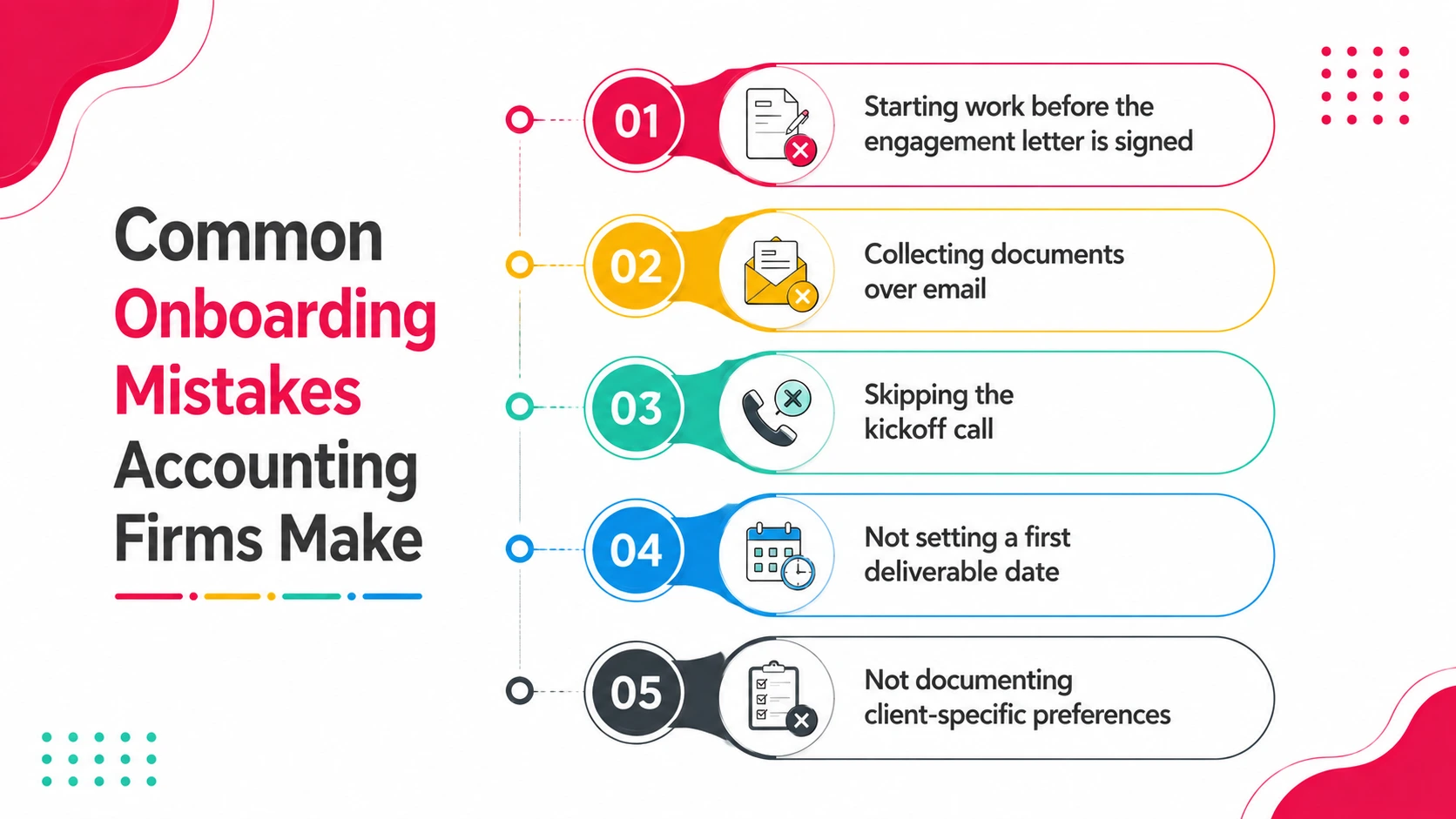
Even firms with good intentions make these mistakes consistently.
Starting work before the engagement letter is signed. This happens more than it should, especially when there's time pressure. Don't do it. No signed engagement letter means no legal protection and no clear scope.
Collecting documents over email. Email is the worst place to collect documents. Things get buried, versions get confused, and there's no clear record of what was received. A client portal with a document request feature solves this immediately.
Skipping the kickoff call. The kickoff call isn't just a formality. It's where you establish expectations, answer questions the client didn't know they had, and build the working relationship. Firms that skip it consistently report more friction in month two and three.
Not setting a first deliverable date. If the client doesn't know when to expect their first financials or return, they'll follow up usually at the worst possible time. Set the date in the kickoff call and confirm it in writing.
Not documenting client-specific preferences. Every client is a bit different. Some want narrative summaries with their financials. Some need invoices sent to a specific email address. Some have a particular contact for document questions. If that's not in the client record, it disappears when the original staff member leaves.
Real Scenario: How a 3-Partner CPA Firm Onboards 12 Clients in a Week
A three-partner CPA firm in Chicago added 12 new bookkeeping clients in January all referred from a tax season promotion.
Previously, each partner onboarded their own clients in their own way. No standard documents, no consistent timeline, no shared system.
The result: some clients didn't receive an engagement letter until week three. Several waited two weeks for portal access. Two clients called in week four asking where their first financials were the work hadn't started because documents hadn't been collected.
The firm built a standardized onboarding workflow in Xenett after that January. Every new client now moves through a six-phase task sequence: engagement, information gathering, tool setup, kickoff, first delivery, and cadence setup. Each phase auto-creates when the prior one is complete.
The next January, they added 18 new clients in the same timeframe. Every client received an engagement letter within 24 hours. Portal access was set up within 48 hours. First deliverables were on time for 17 of 18 clients (the one exception was waiting on client-side bank access).
The difference wasn't more people. It was a process.
How Xenett Can Help
Xenett is built to run this exact onboarding process at scale.
- Client portal: Clients submit documents, complete information requests, and receive deliverables through a secure, branded portal. No email attachments.
- Workflow automation: The six-phase onboarding workflow runs as a task sequence. Each phase triggers automatically when the prior one is complete.
- Document request tracking: Outstanding document requests are visible to your team at all times. Automated reminders go to clients on schedule.
- Client records: Every client's preferences, contacts, history, and notes live in one place. Nothing gets lost when staff changes.
- Recurring tasks: Once onboarding is complete, the ongoing monthly or quarterly workflow starts automatically.
Over 1,000 accounting and bookkeeping firms use Xenett to run onboarding and ongoing client management in one system.
Start your free trial or book a 15-minute demo to see how the onboarding workflow runs inside Xenett.
FAQ
What should be included in an accounting client onboarding checklist?
A complete onboarding checklist covers six areas: engagement and contracts (signed engagement letter, scope confirmation), information gathering (prior financials, access credentials), tool setup (portal access, software integration), kickoff (expectations, communication norms), first deliverable (completed, reviewed, and delivered on time), and ongoing cadence (recurring tasks, document reminders).
How long should client onboarding take for an accounting firm?
Most onboarding processes take 2–3 weeks from signed engagement to first deliverable. The timeline depends on how quickly the client provides documents and access. Firms with a structured onboarding process and a client portal typically complete onboarding faster than those using email.
What is an engagement letter and why does it matter?
\An engagement letter is a written agreement between your firm and the client that defines the scope of services, fees, timelines, and responsibilities. It's your legal protection if the scope changes or a dispute arises. No work should begin without a signed engagement letter.
How do you collect documents from new accounting clients?
The most efficient method is a client portal with a built-in document request feature and automated reminders. Email document collection leads to missed items, version confusion, and no audit trail. Tools like Xenett include document request workflows as part of the client portal.
What is a kickoff call and what should it cover?
A kickoff call is a 30-minute call with the new client within the first week of engagement. It should cover: what the client will receive and when, how to submit documents, how to reach your team, and any questions the client has about the process. It sets expectations early and reduces follow-up questions later.
How do you onboard multiple new clients at the same time?
The key is a standardized, automated process. When onboarding is a workflow in your practice management tool not a sequence of things one person remembers it runs in parallel without adding management overhead. Xenett lets you run multiple client onboardings simultaneously with each in its own workflow queue.
Do bookkeeping firms need a different onboarding process than CPA firms?
The core structure is the same engagement, information gathering, access setup, kickoff, first delivery, ongoing cadence but the specific tasks differ. Bookkeeping onboarding focuses more on bank account setup, reconciliation history, and recurring document collection. Tax-focused firms add more around prior returns, entity structure, and deadline planning.
Conclusion
Client onboarding is the first impression your firm makes as an ongoing service provider not just as a vendor who won a proposal.
A structured, repeatable process tells clients they made the right decision. An improvised one plants doubt that's hard to reverse.
The checklist above works. It's the same structure that firms running 100+ clients use to onboard new business without adding staff or scrambling to track down documents.
Use it. Build it into your practice management tool. And stop onboarding clients the way you did when you had five of them.
Start your free trial of Xenett and build your onboarding workflow today.
A complete onboarding checklist covers six areas: engagement and contracts (signed engagement letter, scope confirmation), information gathering (prior financials, access credentials), tool setup (portal access, software integration), kickoff (expectations, communication norms), first deliverable (completed, reviewed, and delivered on time), and ongoing cadence (recurring tasks, document reminders).
Most onboarding processes take 2–3 weeks from signed engagement to first deliverable. The timeline depends on how quickly the client provides documents and access. Firms with a structured onboarding process and a client portal typically complete onboarding faster than those using email.
An engagement letter is a written agreement between your firm and the client that defines the scope of services, fees, timelines, and responsibilities. It's your legal protection if the scope changes or a dispute arises. No work should begin without a signed engagement letter.
The most efficient method is a client portal with a built-in document request feature and automated reminders. Email document collection leads to missed items, version confusion, and no audit trail. Tools like Xenett include document request workflows as part of the client portal.
A kickoff call is a 30-minute call with the new client within the first week of engagement. It should cover: what the client will receive and when, how to submit documents, how to reach your team, and any questions the client has about the process. It sets expectations early and reduces follow-up questions later.


