
.svg)

What Is Workflow in Accounting? A Firm Owner's Guide

Ask questions, get summaries, or uncover key takeaways from this article.

Blog Summary / Key Takeaways
- Workflow = structured sequence with defined owners and triggers, not just a checklist
- 5 stages: intake → work completion → internal review → delivery → billing/close
- Biggest failure points: intake docs lost in email, review stuck in email chains, billing leakage from late time entry
- Manual workflow hits a ceiling around 20–30 clients automation - scales to 100+ without added overhead
- Results from structured workflow: 70% less review time, 3x faster close, 20–30% capacity gain without hiring
- Case study: 8-person firm avoided a new hire by fixing review visibility - work was done, no one knew it was ready
I once asked a partner at a six-person firm to describe their monthly close workflow.
He pulled up three tabs a spreadsheet, a Slack thread, and an email chain and said, "It's kind of in all of these."
That's not a workflow. That's a system held together by memory and follow-up emails.
Most accounting firms have some version of this. The work gets done. But "how it gets done" lives in people's heads rather than in a documented, repeatable process. And when someone's out sick, on vacation, or just slammed, the whole thing slows down or falls apart.
This post explains what workflow in accounting actually means, where most firms go wrong, and what a well-structured workflow looks like in practice.
What Is Workflow in Accounting?
Workflow in accounting is the structured sequence of steps that takes a piece of client work from intake to delivery with defined owners, stages, and handoff points at each step.
It covers every service your firm delivers: monthly bookkeeping, tax prep, payroll, year-end close, advisory. Each service has a workflow a predictable set of tasks that happen in a specific order, assigned to specific people, with specific dependencies.
A workflow isn't just a checklist. A checklist tells you what to do. A workflow tells you who does what, in what order, and what has to be true before the next step starts.
That distinction matters enormously when you're managing 50 clients with overlapping deadlines.
The 5 Stages of an Accounting Workflow
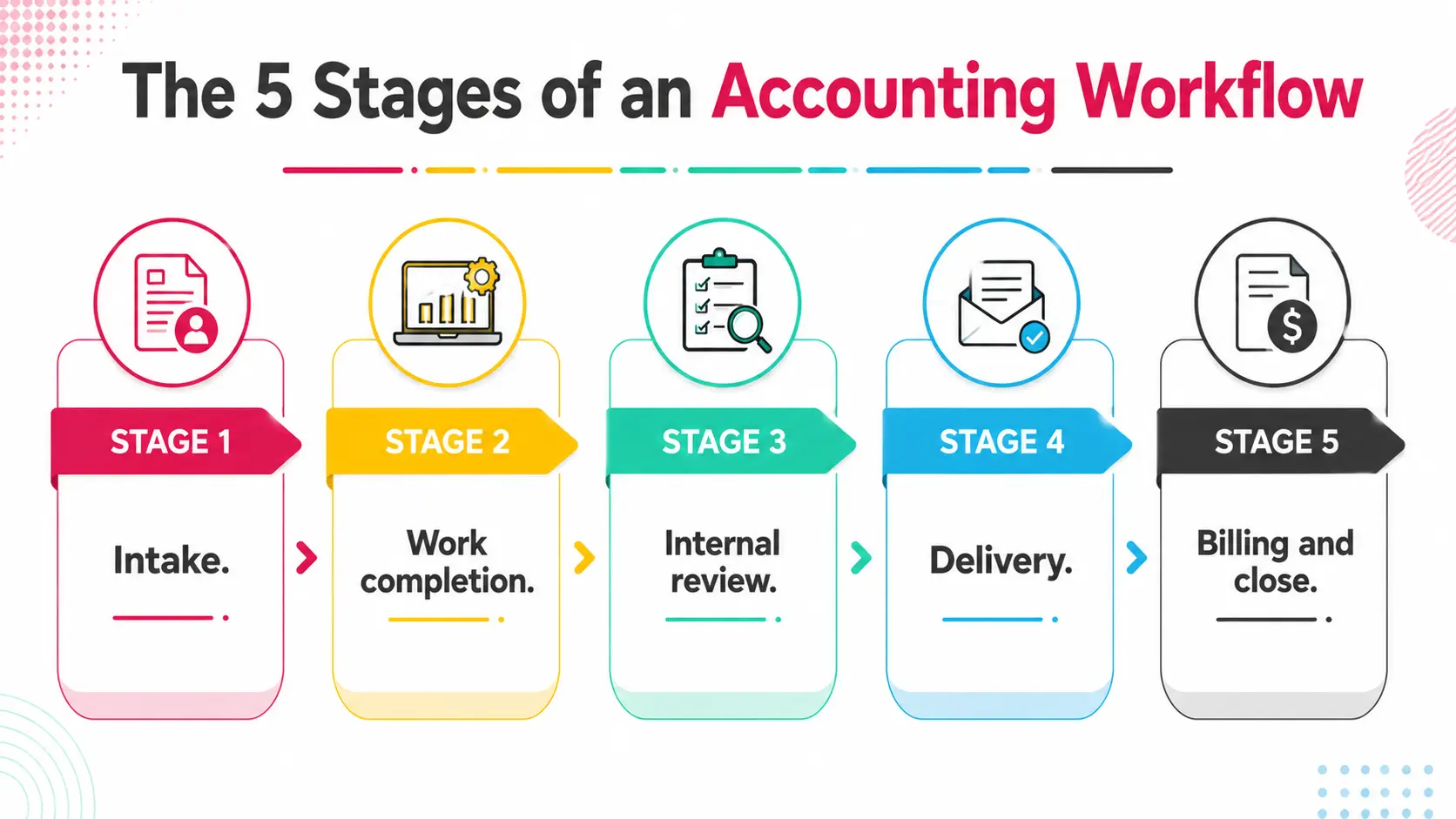
Most accounting workflows regardless of service type move through five stages. The details change by service. The structure doesn't.
Stage 1: Intake. The client request or recurring work trigger arrives. Documents are collected. The job is created and assigned.
Stage 2: Work completion. The preparer completes the work - reconciliations, tax prep, bookkeeping, whatever the service is.
Stage 3: Internal review. A reviewer or manager checks the work for accuracy, completeness, and anything that needs addressing before it goes to the client.
Stage 4: Delivery. The finished work financials, returns, reports goes to the client, typically through a portal or email.
Stage 5: Billing and close. Time is logged, the invoice is generated, and the job is marked complete.
In a well-run firm, each stage has a defined owner and a clear trigger that moves work from one stage to the next. In most firms, at least two of these stages have gaps.
Where Most Firms Break Down
The five stages above look simple. But each stage has a common failure point that shows up across firms of all sizes.
Intake gaps are the most common. "Can you send me your bank statements" disappears in an inbox. No one follows up until the job is already behind.
Review gaps are the most expensive. When review lives in email chains, comments are missed, versions get confused, and the back-and-forth takes days instead of hours.
Billing gaps are the quietest. Work gets done. Time never gets logged. The invoice misses hours that were worked. At scale, this is significant revenue that never gets captured.
Manual vs. Automated Workflow (What's the Real Difference?)
Both approaches can get work done. The difference is what happens at scale and during busy season.
Manual workflow isn't wrong. It's just a ceiling. At a certain point usually around 20–30 recurring clients the coordination overhead outpaces your capacity to manage it without a system.
What a Good Accounting Workflow Actually Looks Like
Here's a specific example: a monthly bookkeeping client.
Week 1: Intake A recurring task auto-generates on the 1st of the month. It's assigned to the bookkeeper with a due date. The client portal automatically sends a request for bank statements and any receipts from the prior month.
Week 1–2: Work completion The bookkeeper receives documents, reconciles accounts, categorizes transactions, and prepares a draft P&L and balance sheet. When complete, they mark the work ready for review. The next step triggers automatically.
Week 2: Internal review The manager receives a notification that the work is in review. They open it, leave specific comments on any items that need correction, and either approve or send back. The bookkeeper addresses comments and resubmits. Review cycle: 24–48 hours.
Week 2–3: Delivery Once approved, the financials are packaged and delivered to the client through the portal. A notification goes out automatically.
Week 3: Billing Time was tracked throughout. An invoice is generated from the logged time and sent to the client.
Every step had a defined owner. Every transition happened automatically. No email chains. No one wondering what stage the work is in.
That's what a structured accounting workflow looks like when it's functioning well.
How Workflow Automation Changes the Math
The numbers firms report after implementing structured workflow automation are consistent.
Review time. When review moves from email chains to a structured tool, the average review cycle drops from 3–4 days to under 24 hours. Firms using Xenett report a 70% reduction in review time.
Close speed. Month-end close accelerates when handoffs are automatic and document collection is handled by the system. 3x faster close is a result consistently reported by firms with structured workflows.
Billable hours captured. When time tracking is integrated into the workflow tool, time gets logged as work happens not at the end of the week from memory. Revenue leakage drops.
Capacity. When coordination overhead drops, the same team can handle more clients without adding headcount. Firms that implement structured workflow typically grow capacity by 20–30% without hiring.
These aren't theoretical gains. They're what happens when structure replaces improvisation.
Real Scenario: A Tax Firm That Fixed Bottlenecks Without Hiring
A tax and bookkeeping firm with eight staff was preparing to hire a ninth person. The stated reason: they were at capacity.
Before hiring, they did a workflow audit. What they found: their bottleneck wasn't capacity — it was review. Partners were reviewing work that had been sitting for two to three days because there was no alert, no queue, and no visibility into what needed attention.
Work was done. No one knew it was ready.
After implementing structured review workflows through Xenett, work moved to the partner queue automatically when the preparer marked it complete. The partner's daily view showed exactly what needed review that day. Average review lag dropped from three days to same-day.
They didn't hire the ninth person. The capacity they needed was already there — it was just stuck in transit.
How Xenett Can Help
Xenett is built around the exact workflow structure described in this post. Every stage — intake, work, review, delivery, billing — has a corresponding feature.
- Recurring tasks auto-generate on schedule for every client. No manual setup each month.
- Client portal handles document collection with automated reminders. No email chains.
- Workflow stages move work from preparer to reviewer to partner automatically.
- Review tools tie comments directly to work items. No version confusion, no email chains.
- Bookkeeping Dashboard gives partners and managers a real-time status view across all clients.
- Close Dashboard tracks month-end close progress across every client simultaneously.
1,000+ accounting firms use Xenett to run this structure at scale.
If your firm's workflow currently lives across email, spreadsheets, and memory, book a 15-minute demo and we'll show you what a structured version looks like in practice.
FAQ
What is accounting workflow management?
Accounting workflow management is the process of defining, tracking, and automating how work moves through your firm from client intake to delivery and billing. It ensures every job has an owner, a status, and a clear next step, regardless of who's in the office that day.
Why do most firms not have a formal workflow?
Most accounting firms grew organically. Processes developed around individual preferences and "how we've always done it" rather than a designed system. A formal workflow requires upfront documentation and a tool to run it two things that get deprioritized during busy periods.
What's the difference between a workflow and a checklist?
A checklist tells you what tasks need to be done. A workflow defines who does each task, in what order, what triggers each step, and what conditions must be met before work can move forward. A checklist is a component of a workflow not a substitute for one.
How does workflow automation work in accounting?
Workflow automation uses software to trigger actions automatically creating recurring tasks on schedule, notifying reviewers when work is ready, sending client reminders when documents are overdue, and moving work through defined stages without manual intervention.
How many clients do you need before workflow software makes sense?
Most firms feel the pain around 15–25 recurring clients. Below that, manual tracking is manageable. Above it, the coordination overhead of tracking status across clients, managing review cycles, and following up on documents becomes a meaningful time sink.
Does workflow structure slow down small teams?
The opposite. Small teams are disproportionately affected by workflow gaps because there's no one to absorb the coordination overhead. A 3-person firm where one person is sick has no buffer. Structured workflows mean work doesn't stop because someone isn't available to remember the status of every job.
What's the first step to improving workflow in my firm?
Map one service workflow from start to finish. Pick your most common service monthly bookkeeping or quarterly tax prep. Write down every step, who owns it, and what triggers the next step. That map becomes the foundation for your first automated workflow.
Conclusion
Workflow isn't a nice-to-have. It's the difference between a firm that scales and one that keeps hiring to stay in place.
Most firms aren't operating at their actual capacity. They're operating at the ceiling of what their current workflow structure supports. That ceiling is almost always lower than it needs to be.
Fixing the structure defining stages, automating handoffs, building review into the process is how firms grow without proportionally growing their headcount.
Book a 15-minute demo with Xenett and see what a structured accounting workflow looks like when it's running at full capacity.
Accounting workflow management is the process of defining, tracking, and automating how work moves through your firm from client intake to delivery and billing. It ensures every job has an owner, a status, and a clear next step, regardless of who's in the office that day.
Most accounting firms grew organically. Processes developed around individual preferences and "how we've always done it" rather than a designed system. A formal workflow requires upfront documentation and a tool to run it two things that get deprioritized during busy periods.
A checklist tells you what tasks need to be done. A workflow defines who does each task, in what order, what triggers each step, and what conditions must be met before work can move forward. A checklist is a component of a workflow not a substitute for one.
Workflow automation uses software to trigger actions automatically creating recurring tasks on schedule, notifying reviewers when work is ready, sending client reminders when documents are overdue, and moving work through defined stages without manual intervention.
Most firms feel the pain around 15–25 recurring clients. Below that, manual tracking is manageable. Above it, the coordination overhead of tracking status across clients, managing review cycles, and following up on documents becomes a meaningful time sink.



%20(1).webp)